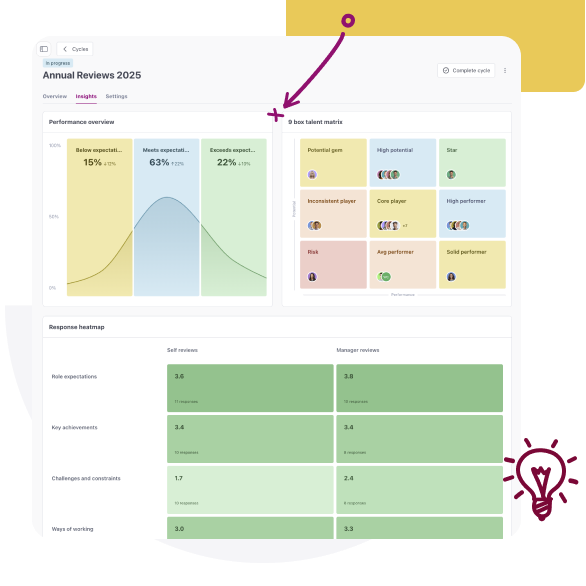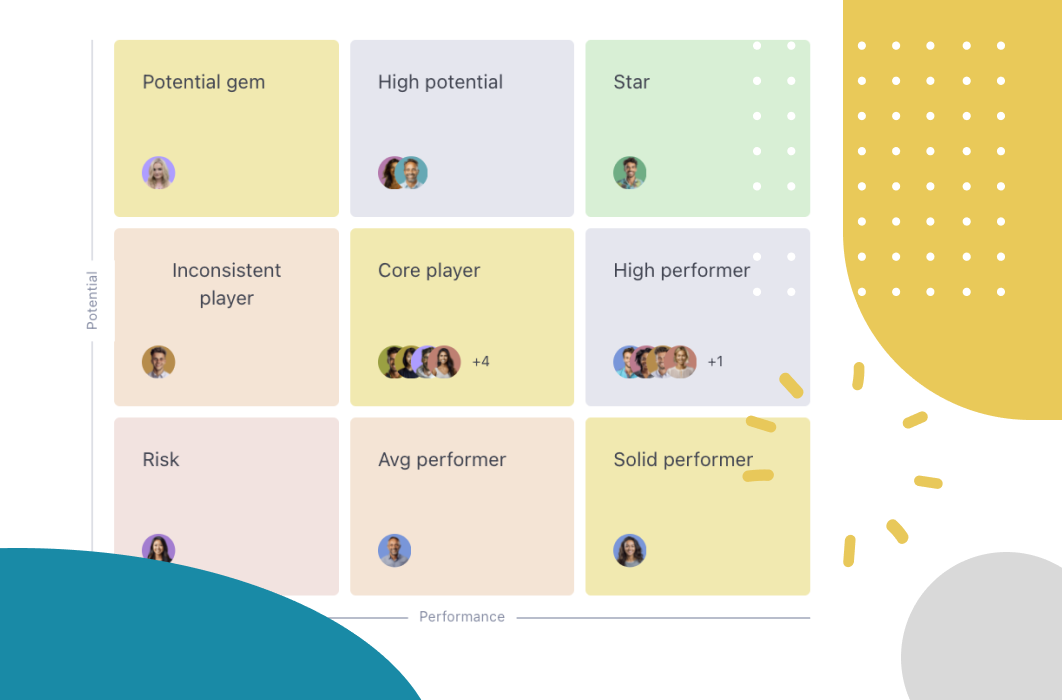
The 9 box talent matrix is a 3×3 grid that plots employees on past performance and future potential to inform development and succession planning. Done well, it surfaces bias and forces leaders to calibrate their views; done badly, it labels people, entrenches bias, and gets misused for pay or termination decisions it was never designed to make.
Key takeaways
- The 9 box is a calibration tool, not a decision tool — its job is to make leaders defend their ratings to each other, not to assign rewards or exits.
- “Potential” is the ratings axis most vulnerable to bias; Harvard Business Review and academic research consistently find it skews against women, employees on parental leave, and underrepresented groups when criteria aren’t anchored.
- Fewer than one in five HR leaders rate their organisation’s succession planning as highly effective (Gartner), and a 9 box without a follow-through development plan is the most common reason.
- In Australia, using 9 box outputs to drive termination or significant adverse decisions carries Fair Work Act and Privacy Act exposure if the process isn’t documented, calibrated, and connected to genuine performance criteria.
- The right software for a 9 box review is the one that connects placement back into individual development plans — not the one with the prettiest grid view.
What is the 9 box talent matrix?
The 9 box talent matrix is a 3×3 grid that plots each employee on two axes — performance (low / moderate / high, based on past results) and potential (low / moderate / high, based on capacity to take on bigger or different roles). The output is nine “boxes” leaders use to identify successors, plan development, and surface inconsistent ratings across teams.
The framework was developed by McKinsey for General Electric in the 1970s and has been adapted across most large organisations since. The exact box labels vary — common ones include Star / Future Leader (top-right), Core Player / High Performer (middle-right), Solid Professional (bottom-right), Emerging Talent (top-middle), Solid Contributor (centre), and Underperformer / Risk (bottom-left) — but the structure is consistent: performance horizontally, potential vertically.
Two definitions are worth being explicit about, because vague criteria are where most 9 box reviews fall apart:
- Performance is what someone has achieved against agreed expectations in their current role. It’s backward-looking and should be anchored to objective outputs — goals met, ratings from the formal review cycle, customer or commercial outcomes — not “general impression”.
- Potential is the capacity to perform effectively in a bigger or substantially different role. It usually combines learning agility, ambition, and demonstrated leadership behaviours. It is not “how senior I think they could be one day” — that question is where bias enters fastest.
A 9 box review isn’t the same as a performance review. It’s a manager-and-leader exercise that happens after individual reviews are complete, using those ratings as one of several inputs.
Why does the 9 box talent matrix matter?
Used well, the 9 box matters because it forces leaders to make their implicit assumptions about people explicit and defend them in front of peers. That calibration is the actual product — the grid itself is just the artefact. It exists to produce a defensible succession bench, targeted development investment, and earlier surfacing of performance risk.
According to McKinsey research on talent management, organisations with disciplined talent review processes are meaningfully more likely to outperform peers on revenue growth and employee retention. Gartner’s HR research similarly finds that organisations with calibrated succession planning identify viable successors for critical roles at roughly twice the rate of those without — though Gartner also reports that fewer than one in five HR leaders are confident in the strength of their succession bench.
The strategic value of the 9 box isn’t the grid. It’s three downstream outcomes:
- A defensible succession bench. When the CEO asks “who could step into the GM Operations role if we lost her tomorrow?”, the 9 box review tells you whether you have one ready name, two developing names, or nobody.
- Targeted development investment. Coaching, stretch projects, and L&D budget are finite. The 9 box gives you a defensible reason to invest in the top-middle and middle-right boxes rather than spreading budget evenly.
- Earlier surfacing of risk. Underperformers in the bottom-left box rarely become a surprise at exit interview. The 9 box, done annually, creates a forcing function to address those situations before they become legal exposure.
The Worknice POV: the 9 box earns its place if it’s the trigger for development action, not the destination. A 9 box review that produces a grid and no plan is wasted time.
How do you run a 9 box talent review?
Run a 9 box review as a four-step process that starts with criteria, ends with development plans, and never skips calibration. The grid is the middle of the process, not the start of it. Most failures happen because organisations skip step 1 (vague criteria) or step 4 (no follow-through), then blame the framework.
Step 1: Anchor performance and potential criteria before the review
Write down what “high performance” and “high potential” look like in your organisation — in plain language, with examples — and circulate to every manager before they place their reports. For performance, anchor to the rating distribution from your formal review cycle (e.g., “high = exceeded expectations on 80%+ of goals”). For potential, define 3–5 observable behaviours such as “actively seeks feedback and adjusts”, “leads cross-functional initiatives without formal authority”, or “has expressed aspiration to a larger role and is taking action toward it”. Without this, the review collapses into vibes.
Step 2: Run manager pre-work, then collect placements
Each manager places their direct reports on a draft grid before the calibration session, with two or three sentences of evidence per person. Do this asynchronously so managers aren’t anchored by what they hear in the room. Collect placements centrally — in your HRIS, talent platform, or even a structured shared sheet — so the calibration facilitator can see the full population on one canvas.
Step 3: Calibrate in cross-functional sessions
Calibration is the irreducible core of a 9 box. Bring leaders together in groups of 6–10, with an HR facilitator, and review placements function-by-function. The question isn’t “is this person a star?” — it’s “is this person a star relative to the rest of the population in this box?” Expect rating distributions to flatten as managers see how their team compares to others; that flattening is the bias correction the process exists to produce.
Two facilitation rules earn their keep here: (a) the facilitator should challenge any placement where evidence wasn’t presented, and (b) demographic patterns should be reviewed before the session closes — if every “high potential” is the same age, gender, or background, that’s a calibration finding, not a coincidence.
Step 4: Turn each placement into a development action
A 9 box review without a development action for each placement is a labelling exercise. For every employee on the grid, the output should be one of: a development plan (stretch assignment, coaching, formal training), a succession plan (named for a specific role within a defined horizon), a performance conversation (with criteria and timeline), or a deliberate “stay the course” note for solid contributors. Capture each in the HRIS so it’s tracked and reviewed at next year’s cycle.
What are the common pitfalls of the 9 box talent matrix?
The 9 box fails in predictable ways: vague criteria, no calibration, using outputs for the wrong decisions, treating placements as permanent, and never closing the loop with development. Each of these is preventable with process design — the framework itself isn’t the problem.
According to Harvard Business Review and a body of academic research on performance ratings, the most consistent failure mode is bias in the “potential” axis. Ratings of potential have repeatedly been shown to skew against women, employees who took parental leave, part-time workers, employees over 50, and underrepresented groups — because “potential” is read as “looks like our current leadership team” when criteria aren’t anchored.
The other recurring failures:
- Using the 9 box to drive pay decisions. It wasn’t designed for compensation and using it that way creates legal exposure under Fair Work Act adverse action provisions if the criteria aren’t tied to legitimate performance grounds.
- Treating placements as labels rather than snapshots. Once someone is whispered about as “a 9 box top-right”, they’re hard to move. Refresh placements annually and treat the grid as a point-in-time view, not a fixed designation.
- Skipping calibration. A 9 box with no cross-functional calibration is just nine managers’ personal opinions, plotted on a grid. The calibration session is where the actual work happens — if it’s cancelled “to save time”, cancel the whole process.
- No follow-through. Roughly half of organisations that run 9 box reviews don’t tie the outputs to development plans, according to talent practitioner surveys. That’s the single biggest predictor of whether the process produces ROI.
- Sharing the grid with employees. Most organisations don’t, and shouldn’t. Tell employees the outputs — “you’re identified as a successor for X role” or “we’re investing in your development with Y stretch assignment” — not the box.
What are the Australian legal and privacy considerations for a 9 box review?
In Australia, a 9 box review is lawful and common, but using its outputs to drive significant employment decisions creates exposure under the Fair Work Act 2009 (Cth), anti-discrimination law, and the Privacy Act 1988 (Cth). The risk is highest when placements influence termination, demotion, or non-promotion, and when the underlying criteria aren’t documented or evenly applied.
Three specific considerations matter most:
- Adverse action. Under section 340 of the Fair Work Act, taking adverse action against an employee because of a protected attribute (age, sex, race, disability, family/carer’s responsibilities, pregnancy, parental leave, and others) is unlawful. If a 9 box placement contributed to an adverse decision and the placement reflected one of those attributes rather than legitimate performance criteria, the organisation carries the burden of proof. Calibrated criteria, documented evidence, and a demographic review at calibration are the practical defence.
- Anti-discrimination law. Federal and state anti-discrimination acts (Sex Discrimination Act, Age Discrimination Act, Disability Discrimination Act, plus state equivalents) apply to internal decisions, not just hiring. Bias in “potential” ratings is the most common source of complaints.
- Privacy Act and assessment data. 9 box placements and the evidence behind them are personal information; some of it (e.g., health-related context, family responsibility notes) is sensitive information under the Privacy Act and the OAIC’s Australian Privacy Principles. Store it in systems with appropriate access controls — typically your HRIS or talent platform with role-based permissions — and apply your standard retention and deletion rules.
None of this is a reason not to run a 9 box. It’s a reason to run it with documented criteria, calibration evidence, and a clear access-control model — the same standards you’d apply to any other people decision.
How do you measure if your 9 box process is working?
Measure the 9 box on its actual job: better calibration, faster development action, and a stronger succession bench. Don’t measure it on whether the grid was completed on time. Three metrics earn their keep year over year, and one optional “diagnostic” metric is worth tracking once you’ve run two cycles.
The core three:
- Rating distribution by manager, before and after calibration. If calibration is working, distributions narrow toward the centre and become more consistent across teams between pre-work and post-session placements. A flat pre-to-post means calibration isn’t doing anything.
- Successor coverage for critical roles. What share of your critical roles (typically top two or three layers) have a named, ready-now successor, and what share have a developing successor with a defined horizon? Gartner’s benchmarks suggest target ranges of 70%+ “ready now or developing” coverage for top critical roles; under 50% is a red flag.
- Development action follow-through rate. Of the development plans created at the calibration session, what share are still active and tracked 12 months later? Below 60% means the loop isn’t closing and the review will lose credibility fast.
The optional diagnostic: demographic distribution across boxes versus the demographic distribution of your overall workforce. If the top-right boxes are consistently less diverse than the bottom-left, that’s a calibration problem worth investigating before the next cycle.
The best talent management and succession planning software for Australian mid-to-large teams in 2026
The right talent management platform is the one that makes calibration easier and connects 9 box outputs back to development plans inside your HRIS — not the one with the polished grid screenshot. The criteria below are weighted toward Australian organisations of 200–5,000 employees that already run an HRIS and payroll and need a dedicated talent module.
How we chose:
- Depth of 9 box / calibration functionality (not just a static grid view)
- Fit for Australian mid-to-large organisations based on each vendor’s published customer data
- Two-way integration with the buyer’s existing HRIS, performance review module, and payroll
- Transparent pricing and reasonable implementation footprint
1. Worknice
Best for: Australian mid-to-large teams that want the 9 box matrix, critical-role tagging, and the development and offboarding actions that follow built directly into their core HRIS — not bolted on as a separate platform.
Typical customer size: 100–2,000 employees, primarily Australian.
Key strengths for 9 box:
- Native 9 box talent matrix embedded in the employee record, so placements sit alongside performance ratings, lifecycle history, and policy data rather than in a separate tool
- Critical-role tagging at the position level, so the talent review surfaces successor coverage for the roles that actually matter — not just the senior org chart
- Development plans that turn 9 box placements into concrete training requirements, deployed via LMS integration or Worknice’s native training tracking
- Offboarding workflows that ensure knowledge transfer steps run when an outgoing employee in a critical role is identified through the 9 box
Integration with your core HR stack: Worknice is the core HR stack. Native two-way integrations with payroll (Xero, MYOB, KeyPay, Employment Hero Payroll, ADP), LMS, ATS, identity (Okta/Azure AD), and ticketing — so 9 box outputs flow into onboarding, performance, and offboarding workflows automatically.
Watch-outs: Built for organisations that want the 9 box embedded in their HRIS, not for those running a dedicated enterprise talent suite alongside. If you need decades-deep succession scenario planning across thousands of roles, a specialised enterprise platform will go further.
Pricing: From AUD $8/employee/month, transparent on website.
2. Culture Amp
Best for: Australian mid-to-large teams that want talent reviews tightly integrated with engagement data and performance check-ins, run alongside an existing HRIS.
Typical customer size: 50–5,000 employees, with strong representation in the 200–2,000 band. Australian-founded; published case studies span tech, professional services, retail, and not-for-profit.
Key strengths for 9 box:
- Native 9 box and talent review module with manager pre-work workflows and calibration session support
- Engagement and performance data flow into the same record, so calibration discussions can reference real signals rather than impressions
- Strong analytics on rating distribution and demographic patterns out of the box
Integration with your core HR stack: Native two-way integrations with most major HRIS platforms (BambooHR, HiBob, Worknice, Workday, SAP SuccessFactors, etc.) and SSO providers.
Watch-outs: Heavier on engagement DNA than deep succession planning — strong for talent reviews, lighter on long-horizon succession scenarios that enterprise platforms support.
Pricing: Custom — published pricing is per-employee with module-based packaging. Expect AUD $10–$20 per employee per month for the talent module depending on bundle.
3. PageUp
Best for: Australian and APAC mid-to-large enterprises (and the public sector) wanting an integrated talent management suite with recruitment, performance, and succession in one platform.
Typical customer size: 500–20,000+ employees. Australian-founded with strong public-sector, higher-education, retail, and large-enterprise customer base across APAC.
Key strengths for 9 box:
- Talent review and succession module with configurable matrices (9 box is one of several view options)
- Strong scenario planning for critical-role coverage and “what if we lost X” modelling
- Compliance-grade audit trails on placement changes and calibration decisions
Integration with your core HR stack: Two-way integrations with major payroll systems used in Australia (Aurion, Chris21/Frontier, ADP) and HRIS platforms. SSO and SCIM provisioning included.
Watch-outs: Best fit for organisations already running PageUp Recruit or Performance — buying the talent module standalone can feel oversized for teams below ~500 employees.
Pricing: Custom enterprise pricing; contact PageUp for a quote. Typically annual contracts with implementation services included.
4. SAP SuccessFactors (Talent Management module)
Best for: Large enterprises (typically 2,000+ employees) already on SAP for HR or finance who need the deepest configurability and global compliance coverage.
Typical customer size: 1,000–100,000+ employees. Long list of large Australian customers across financial services, telco, utilities, and government.
Key strengths for 9 box:
- Mature 9 box / talent review functionality with configurable axes, custom box labels, and multi-cycle history
- Deep succession planning with talent pools, readiness ratings, and bench strength dashboards
- Strong compliance, audit, and access-control tooling for jurisdictions with strict people-data rules
Integration with your core HR stack: Native within the SuccessFactors suite (Performance, Compensation, Learning). Extensive APIs and pre-built connectors for third-party HRIS and payroll.
Watch-outs: Heaviest implementation in this list — typically 6–12 months with a partner. Configuration depth is genuine but requires HR-tech expertise to maintain. Overkill for organisations below ~1,500 employees.
Pricing: Custom enterprise pricing. Implementation services typically run six figures.
5. Workday Talent Optimization
Best for: Large enterprises already on Workday HCM who want talent reviews in the same data model as their core HR.
Typical customer size: 1,000–100,000+ employees. Strong Australian presence in financial services, telco, and retail enterprise.
Key strengths for 9 box:
- Talent review and succession built natively on the Workday HCM data model — no separate sync needed
- Configurable talent matrices (9 box, 4 box, custom), with calibration session workflows
- Powerful reporting and analytics, particularly for distribution-by-demographic views
Integration with your core HR stack: Native within Workday; integrates with adjacent best-of-breed tools via Workday’s integration framework.
Watch-outs: Only viable if you’re already on Workday HCM — buying it standalone isn’t realistic. Cost and complexity are at the high end of this list.
Pricing: Custom enterprise pricing, typically bundled with Workday HCM. Expect six-figure annual licence and similar implementation costs.
6. Lattice
Best for: Mid-market teams (typically 100–2,000 employees) that want a modern performance-management platform with talent reviews built in, without enterprise complexity.
Typical customer size: 50–2,000 employees, primarily North America with growing APAC presence. Australian customer base smaller than Culture Amp or PageUp.
Key strengths for 9 box:
- Native 9 box talent review with manager pre-work, calibration session view, and rating-distribution analytics
- Tight integration between performance reviews, 1:1s, and 9 box placements — calibration discussions reference the same data
- Good user experience for managers, which materially affects pre-work completion rates
Integration with your core HR stack: Two-way integrations with most major HRIS platforms, SSO providers, and Slack/Teams.
Watch-outs: Lighter on long-horizon succession features than enterprise platforms — strong for annual talent reviews, less so for “build a 5-year successor pipeline for 30 critical roles”.
Pricing: Published per-employee pricing; talent review functionality typically requires the Performance + Talent bundle. Expect USD $8–$15 per employee per month depending on bundle.
7. Cornerstone OnDemand
Best for: Mid-to-large global enterprises that want a unified talent management suite spanning learning, performance, recruitment, and succession.
Typical customer size: 500–50,000+ employees, global. Notable for L&D-led talent management approaches.
Key strengths for 9 box:
- Talent review and succession module with 9 box matrix and successor readiness tracking
- Strong link between talent placements and learning content — development plans can include direct LMS assignments
- Multi-region compliance and language support for global Australian-headquartered groups
Integration with your core HR stack: Two-way integrations with major HRIS and payroll providers; well-developed API.
Watch-outs: Implementation and admin UX are dated relative to newer platforms. Best when L&D is a primary use case and talent review is the second; less compelling if you only need the talent review piece.
Pricing: Custom enterprise pricing; module-based packaging.
How to choose the right talent management software for a 9 box review
Choose the talent platform that makes calibration easier and ties 9 box outputs to development plans inside your HRIS — not the one with the most features on the comparison sheet. For most Australian mid-to-large organisations, the right answer is a focused talent module integrated with your existing HRIS, not an enterprise suite bought to replace systems that already work.
Four decision criteria, in priority order:
- Does the platform support real calibration, not just a grid view? Look for manager pre-work workflows, evidence capture, calibration session screens, and rating-distribution analytics. A static 9 box visualisation isn’t enough.
- Does it live alongside your HRIS and payroll? 9 box placements and development plans need to sit alongside the rest of the employee record. You get this two ways: run the 9 box inside your HRIS (Worknice and a small number of others now support this natively), or insist on two-way integration between a standalone talent platform and your HRIS so onboarding, performance, and offboarding workflows reflect 9 box outcomes automatically.
- Is it sized for your organisation, not three sizes up? SAP SuccessFactors and Workday are excellent if you’re already on them. They’re overkill if you’re 400 employees on a modern HRIS. Match the platform to your scale.
- What does the development-plan loop look like? This is the bit most platforms underspecify. Ask demos to walk you from a 9 box placement → development plan → 12-month review of that plan. If the answer is hand-waved, the platform isn’t actually solving the follow-through problem.
A pragmatic pattern for Australian mid-to-large teams: either run the 9 box embedded in your HRIS (Worknice now supports this natively, including critical-role tagging and development actions that fire into onboarding, performance, and offboarding workflows) or run a focused talent suite alongside the HRIS and integrate the two cleanly. Both patterns work — the choice usually comes down to whether you want one system handling HR data and talent workflows, or specialised tooling for the talent process specifically.
Frequently asked questions
What is the difference between performance and potential in the 9 box matrix?
Performance is past results in someone’s current role — what they actually delivered against expectations over the review period. Potential is forward-looking capacity to take on a substantially bigger or different role, usually measured through learning agility, leadership behaviours, and demonstrated ambition. Performance is more objective; potential is more vulnerable to bias and needs anchored criteria.
Should employees be told their 9 box placement?
Most Australian organisations don’t share the placement itself, and that’s the right call. Share the outputs — “you’re identified as a successor for this role”, “we’re investing in your development with this stretch assignment”, “here’s the performance conversation we need to have” — not the box label. Sharing labels creates anchoring effects and tends to demotivate the middle of the grid.
Can the 9 box be used to make termination decisions?
It shouldn’t be the basis for termination. The 9 box surfaces patterns that may trigger a performance management process, but actual termination decisions must follow your standard procedure — documented evidence, clear expectations, procedural fairness. Using a 9 box placement directly as grounds for dismissal creates exposure under Fair Work Act adverse action provisions and unfair dismissal claims.
How often should you run a 9 box talent review?
Annually is standard for most Australian mid-to-large organisations, usually 4–6 weeks after the formal performance review cycle closes so the latest ratings are available. Run a lighter mid-year refresh if your business is changing fast — re-org, acquisition, rapid growth — but resist running it more than twice a year. The value is in the calibration, not the frequency.
Do I need dedicated talent management software to run a 9 box review?
Not strictly — small organisations run 9 box reviews in spreadsheets every year. But once you’re past about 200 employees, the calibration workflow, evidence capture, demographic analytics, and link to development plans are hard to do well manually. A dedicated talent platform integrated with your HRIS usually pays for itself within one cycle.
Sources
- Fair Work Ombudsman. General Protections — Adverse Action. Australian Government. https://www.fairwork.gov.au/employment-conditions/protections-at-work/protection-from-discrimination-at-work
- Office of the Australian Information Commissioner (OAIC). Australian Privacy Principles. https://www.oaic.gov.au/privacy/australian-privacy-principles
- Gartner. HR Research on Succession Management. https://www.gartner.com/en/human-resources
- McKinsey & Company. Talent Management Research. https://www.mckinsey.com/capabilities/people-and-organizational-performance/our-insights
- Harvard Business Review. Performance Ratings and Bias. https://hbr.org/topic/subject/performance-management
- Australian Human Rights Commission. Federal Discrimination Law. https://humanrights.gov.au/our-work/legal/federal-discrimination-law
- Australian HR Institute (AHRI). Talent and Succession Practices. https://www.ahri.com.au/