Performance management is the ongoing process of setting goals, giving feedback, and managing capability in someone’s current role. Talent management is the broader strategic system that also includes hiring, development, succession, and retention. Performance management is a component of talent management, and most mid-market organisations should get it working before investing in a full talent management strategy.
Last updated 24 September 2026.
Key takeaways
- Performance management is operational, current-role, and run by managers; talent management is strategic, lifecycle-wide, and run by HR and senior leadership.
- Performance management is a subset of talent management: you can do PM without TM, but TM collapses without working PM underneath it.
- Most Australian mid-market organisations underinvest in performance management process and overinvest in talent management tooling, which is the wrong order.
- The Deloitte- and Gartner-documented shift from annual ratings toward continuous performance management has changed how the two integrate, but not the dependency between them.
- Software choice should follow organisational maturity, not the other way around.
What is performance management?
Performance management is the ongoing process of setting expectations, providing feedback, and reviewing results for employees in their current roles. It typically combines goal-setting (often OKRs or quarterly objectives), regular one-to-ones between manager and report, formal reviews on an annual or biannual cycle, and a documented process for managing underperformance.
The discipline has shifted significantly over the past decade. According to Deloitte’s Global Human Capital Trends research, the majority of large organisations have moved away from once-a-year ratings toward more frequent, lower-friction performance conversations, driven by mounting evidence in Harvard Business Review and elsewhere that annual ratings demotivate without measurably improving performance. The annual review hasn’t disappeared, but it now sits inside a broader rhythm of weekly or fortnightly check-ins, quarterly goal reviews, and continuous feedback.
In Australia, performance management also carries specific legal weight. Performance improvement plans, underperformance conversations, and any process that leads to termination need to follow procedural fairness principles under the Fair Work Act 2009 (Cth). That’s why “performance management” is sometimes used as a euphemism for a managed exit, a usage that’s technically incorrect (PM is the broader discipline) but reflects how seriously the formal process is treated in Australian workplaces.
What is talent management?
Talent management is the strategic, organisation-wide system for attracting, developing, retaining, and deploying people across their entire employment lifecycle. It includes performance management, but also covers recruitment, onboarding, learning and development, succession planning, career pathing, and retention, connected through workforce planning and the HRIS as the system of record.
The boundary between talent management and “everything HR does” is fuzzy on purpose. Practitioners distinguish talent management from HR operations by asking whether the activity is strategic (multi-year, capability-focused) or operational (transactional, current-cycle). Hiring is talent management; processing the new starter’s tax declaration is HR operations. Building a successor pipeline is talent management; running this year’s review cycle is performance management (a subset of talent management).
According to McKinsey research on people and organisational performance, organisations with disciplined talent management (clear capability frameworks, structured succession reviews, deliberate development investment) consistently outperform peers on revenue growth, retention, and time-to-fill for critical roles. The qualifier is disciplined. Talent management strategy without the discipline to execute it produces nothing.
What is the difference between performance management and talent management?
Performance management is about current-role results, runs on a quarterly or annual cadence, and is owned by line managers. Talent management is about strategic capability across the lifecycle, runs on a multi-year horizon, and is owned by HR and senior leadership. PM asks if someone is meeting expectations today; TM asks if you have the bench in three years.
The cleanest way to see the difference is side by side:
| Performance management | Talent management | |
|---|---|---|
| Scope | Current role, current cycle | Whole lifecycle, multi-year |
| Primary question | Is this person delivering against expectations? | Do we have the people to win over the next three years? |
| Owner | Line manager (with HR support) | HR and senior leadership |
| Cadence | Weekly check-ins → quarterly reviews → annual cycle | Annual talent review → multi-year workforce planning |
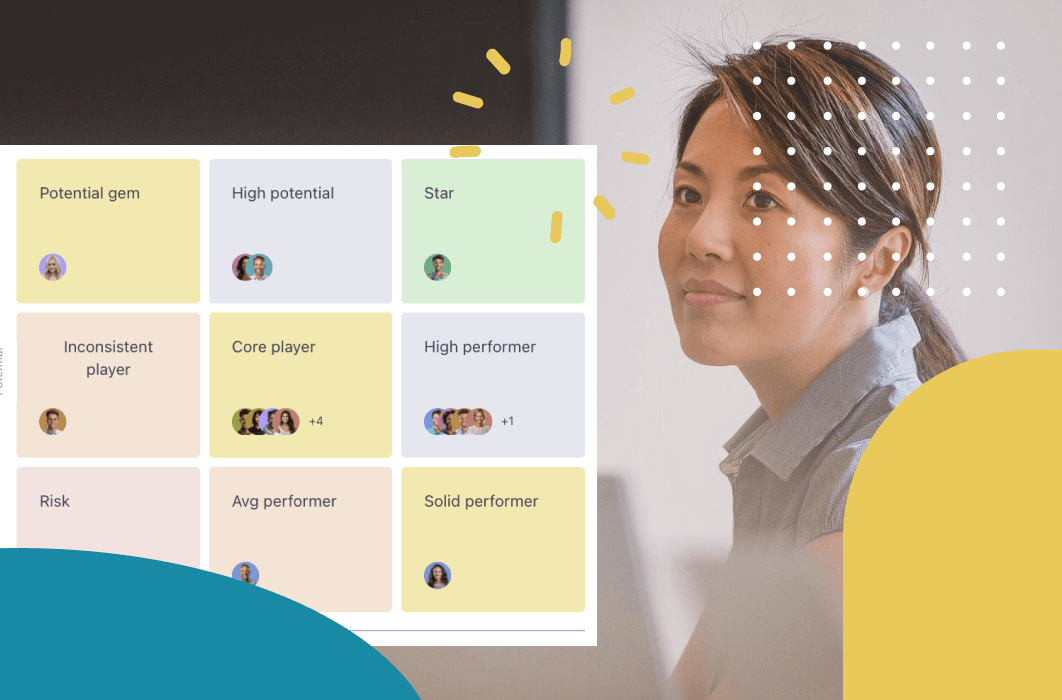
| Core artefacts | Goals, 1:1 notes, reviews, PIPs | 9 box matrix, succession plans, development plans, capability frameworks |
| Inputs needed | Role expectations, goal-setting framework, calibration | Performance ratings, potential ratings, business strategy, workforce data |
| Failure looks like | Late reviews, ungranted bonuses, no underperformance management | No named successors, vacant critical roles, surprise resignations |
| Software category | Performance management tools or HRIS-embedded PM | Talent management suites or HRIS-embedded talent modules |
The two disciplines share a vocabulary, which causes most of the confusion in the market. “High performer” comes from PM. “High potential” comes from TM. Both ratings live on the same employee record. Both feed each other. They’re not the same thing.
Where do performance management and talent management overlap?
They overlap on three things: development planning (PM identifies development needs that TM systems then deliver), succession decisions (PM ratings feed TM successor selection), and the data backbone (both rely on the HRIS as the system of record for who works where and what their ratings are). If those overlaps are broken, both disciplines lose value.
The development overlap is where most organisations leak ROI. A manager identifies in a quarterly check-in that their report needs a stretch project to develop strategic thinking, and the development action either goes into a personal note, a shared document nobody revisits, or worst, the formal review form that’s reviewed once a year. The TM side of the loop (career framework, L&D catalogue, succession bench) never sees it. Connecting that signal is what makes PM and TM mutually reinforcing rather than parallel.
The succession overlap is less common in practice than in theory. Most Australian organisations have a 9 box review or talent review process that, on paper, draws on annual performance ratings. In practice, the talent review often happens months after the ratings were given, in a different system, with different definitions of “high performance”, and the link breaks. Calibration is the fix; shared data infrastructure is the prevention.
Do you need performance management or talent management first?
Performance management first. Always. A talent management strategy without working performance management is unmoored: there’s no rating data to drive succession decisions, no development inputs to feed L&D, and no underperformance handling to clear space for promotions. Get performance management working at the manager level before investing in talent management tooling or strategy.
The pattern is so common it’s almost a rule. According to multiple Gartner studies of HR effectiveness, organisations that prioritise talent management initiatives over fixing performance management process end up with neither working well: they have polished succession decks based on rating data nobody trusts, and they have engagement surveys identifying problems the formal review process should have surfaced six months earlier.
The practical sequence for an Australian mid-to-large organisation:
- Get performance management working at the manager level. Goals are set, check-ins happen, reviews run on time, underperformance is named and addressed within the formal process. This is the prerequisite, not the destination.
- Calibrate. Run cross-functional calibration sessions on performance ratings before they feed any other decision. Uncalibrated ratings poison everything downstream.
- Layer in talent management. Once PM is producing trustworthy data, introduce 9 box reviews, succession planning for critical roles, structured development plans, and career frameworks. The data infrastructure is already there.
- Connect the loop. Make sure PM signals (development needs, performance concerns, aspirations identified in 1:1s) flow into the TM system, and TM decisions (successor nominations, development plans) flow back into manager workflows.
The Worknice perspective on this: most mid-market organisations buy talent management tooling before getting performance management working, and end up with two underused systems. The cheaper path is to get the discipline right first, then choose tooling that fits.
How do performance management and talent management fit together in an Australian mid-to-large organisation?
In practice they sit in a layered relationship: PM is the operating system, TM is the strategy that runs on top, and the HRIS is the data backbone connecting both. For a typical Australian organisation of 200 to 5,000 employees, that means weekly check-ins, quarterly goal reviews, an annual review cycle, and an annual 9 box talent review using the year’s ratings.
Two Australian context notes worth being explicit about:
Compliance considerations. Performance management documentation feeds into Fair Work Act adverse action and unfair dismissal exposure. Talent management decisions (particularly around succession and promotions) can attract anti-discrimination scrutiny if ratings reflect protected attributes rather than legitimate criteria. Both disciplines benefit from documented criteria, calibration evidence, and role-based access controls in whatever system holds the data. The Office of the Australian Information Commissioner (OAIC) classifies much of the underlying data as personal information under the Privacy Act 1988 (Cth).
Award and EBA implications. For organisations with award-covered or EBA-covered roles, performance management processes may be subject to specific procedural requirements set out in the agreement. Talent management decisions (promotions, redeployments, redundancies) often interact with the same agreements. PM and TM aren’t legally separable in those contexts: the same procedural standards apply to both.
What software supports performance management vs talent management?
Performance management software handles goals, check-ins, reviews, and feedback. Talent management suites layer succession planning, career pathing, learning, and workforce analytics on top. Some HRIS platforms now embed both: useful for mid-market teams that want one source of truth rather than two integrated systems. The right choice depends on organisational maturity, not feature lists.
Performance management software focuses on the operational PM cycle: goal-setting, manager 1:1s, review templates, feedback workflows. The strongest examples for Australian mid-market teams are Lattice, 15Five, and Culture Amp Perform: modern, lightweight, designed to integrate with whatever HRIS the buyer already runs. These are the right purchase when performance management process is broken or non-existent and the priority is fixing the cycle before anything else.
Talent management suites add succession planning, career frameworks, learning, and workforce analytics on top of PM. The strongest examples for AU mid-to-large are PageUp (Australian-founded, strong public-sector and enterprise customer base), Culture Amp’s full suite, SAP SuccessFactors, Workday Talent Optimization, and Cornerstone OnDemand. These are the right purchase when PM is working, the organisation has a multi-year talent strategy, and there’s budget and HR capability to use the depth.
HRIS with both embedded is the third option, and increasingly the default for AU mid-market teams. The HRIS becomes the system of record for employee data, position data, performance reviews, talent reviews (including 9 box), critical-role tagging, development plans, and offboarding workflows, without running two separate platforms and an integration between them. Worknice is built around this pattern for Australian organisations of 100 to 2,000 employees.
How to choose between PM-only, TM-only, and HRIS-embedded platforms
Choose by where the actual pain is, not by feature count. If reviews are late and underperformance isn’t managed, you need PM tooling and process, not a talent suite. If PM works but you can’t name a successor for a critical role, you need TM. For AU mid-market teams wanting both, an HRIS that embeds both is the practical answer.
Three decision criteria, in priority order:
- What’s broken today? If you can’t run a review cycle on time, fix that before buying anything strategic. PM tools or an HRIS with embedded PM is the right starting point. If reviews work and ratings are trusted but you have no successor visibility for critical roles, add TM: either as a focused suite or by enabling the talent module in your HRIS.
- How mature is your HR function? PM tools and HRIS-embedded PM both work without a large HR team. Enterprise TM suites (SAP SuccessFactors, Workday Talent) require dedicated HR-tech resourcing to configure and maintain. Match the platform to the team that will run it.
- One source of truth or best-of-breed? Running PM in a focused tool and TM in another platform means an integration layer to maintain and ratings that live in two places. Running both inside an HRIS removes that overhead at the cost of feature depth at the upper end. For most AU teams in the 200 to 2,000 employee band, the integration overhead matters more than feature depth.
Sequence matters as much as choice. Buying a talent suite before fixing performance management is the most common, and most expensive, mistake in this category.
Frequently asked questions
Is performance management part of talent management?
Yes. Performance management is one of the operational disciplines that sits inside the broader talent management system, alongside recruitment, onboarding, learning, succession, and retention. TM is the strategic frame; PM is the cycle that produces most of the ratings data the strategic frame depends on. You can run PM without TM, but TM without PM has nothing to act on.
Can one piece of software cover both performance management and talent management?
Yes, and the market has moved that way. Enterprise platforms (SAP SuccessFactors, Workday) have covered both for years. Australian mid-market HRIS platforms like Worknice now embed performance reviews, check-ins, 9 box talent matrix, critical-role tagging, and development planning in the same system, removing the need for two separate platforms when the organisation is in the 200 to 2,000 employee band.
Do small companies need talent management or just performance management?
Smaller organisations (under ~150 employees) usually only need performance management: clear goals, regular feedback, reviews on time, and a documented underperformance process. Talent management activities like succession planning and structured career pathing only earn their keep when there are enough roles and people to make analysis non-trivial. Above 200 employees the case for layering TM onto PM becomes clearer.
What’s the difference between performance reviews and talent reviews?
A performance review evaluates one person’s results against expectations for their current role, conducted by their manager, usually annually or biannually. A talent review is a cross-functional session where leaders calibrate ratings, identify successors for critical roles, and decide where to invest development budget, typically using a 9 box matrix. Different purpose, different participants, different cadence.
How do performance and talent management connect under the Fair Work Act?
Both disciplines carry Fair Work Act exposure. Performance management documentation underpins adverse action and unfair dismissal defensibility. Talent management decisions (promotions, redeployments, succession-based redundancies) can attract discrimination claims if the underlying ratings reflect protected attributes rather than legitimate criteria. Documented criteria, calibrated ratings, and role-based access to records protect both disciplines from the same legal risks.
Related reading
- Should employees see their 9-box rating: how to handle transparency once performance and potential ratings feed a talent review.
- How a performance review platform works: the review cycle that produces the ratings talent management depends on.
- 360 feedback software explained: a way to add evidence from peers and reports before ratings are calibrated.
Sources
- Deloitte. Global Human Capital Trends: Performance Management Research. https://www.deloitte.com/us/en/insights/topics/talent/human-capital-trends.html
- Gartner. HR Research on Performance Management and Talent. https://www.gartner.com/en/human-resources
- McKinsey & Company. Talent Management Research. https://www.mckinsey.com/capabilities/people-and-organizational-performance/our-insights
- Harvard Business Review. Performance Management and Continuous Feedback. https://hbr.org/topic/subject/employee-performance-management
- Fair Work Ombudsman. Managing underperformance best practice guide. Australian Government. https://www.fairwork.gov.au/tools-and-resources/best-practice-guides/managing-underperformance
- Office of the Australian Information Commissioner (OAIC). Australian Privacy Principles. https://www.oaic.gov.au/privacy/australian-privacy-principles
- Australian HR Institute (AHRI). Performance and Talent Practices. https://www.ahri.com.au/