An HRIS (Human Resources Information System) is the central platform that stores employee records, manages the employee lifecycle, and automates HR compliance and reporting. For Australian organisations, an HRIS is the system of record for people data. It sits alongside (and integrates with) your existing payroll system rather than replacing it.
Key takeaways
- HRIS stands for Human Resources Information System: the single source of truth for employee data, the org chart, and the employee lifecycle.
- An HRIS is not payroll. It integrates with payroll platforms like Xero, MYOB, KeyPay, Employment Hero Payroll, and ADP, but pay rules and STP Phase 2 lodgement remain in the payroll system.
- Core modules typically include employee records, onboarding, time off, performance, policy and compliance, reporting, and a robust integration layer.
- Australian buyers should evaluate HRIS platforms against Fair Work obligations, modern award and EBA mapping, STP Phase 2 data flow, and state-based leave rules.
- Most Australian organisations adopt their first dedicated HRIS between 50 and 200 employees, which is the point at which spreadsheets stop scaling and compliance risk becomes material.
What is an HRIS?
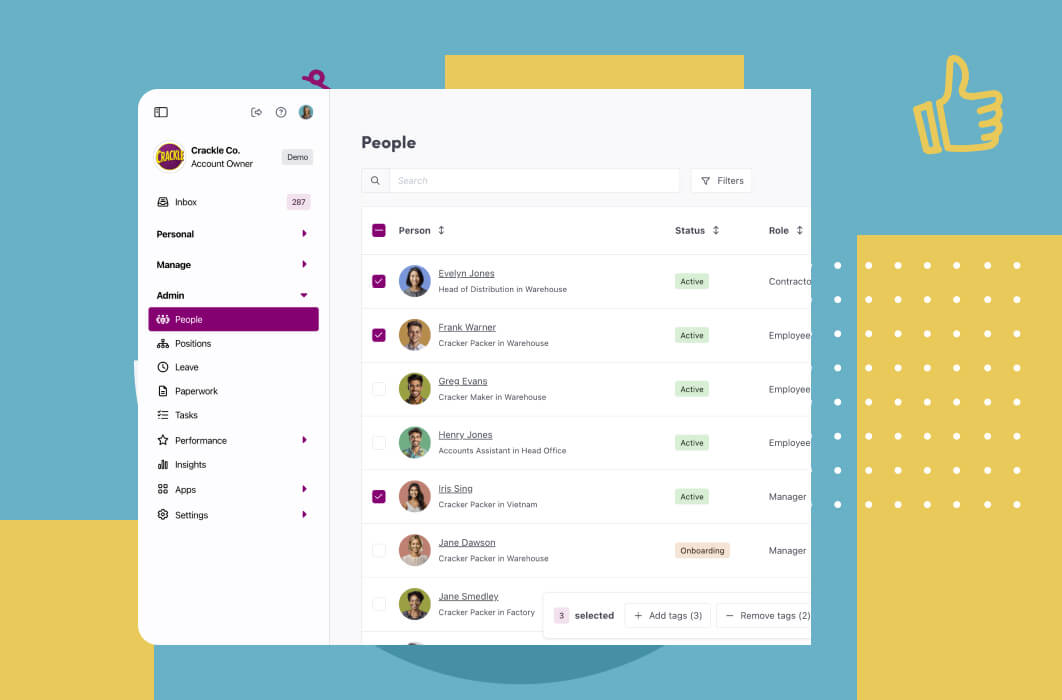
An HRIS (Human Resources Information System) is software that centralises employee records, the org chart, lifecycle workflows (onboarding, role changes, offboarding), HR policies and acknowledgements, and people reporting in one platform. It is the system of record for who works at your organisation: what role they hold, when their key dates fall, what they’ve been trained on, and what they’ve agreed to.
In a mid-to-large Australian organisation, the HRIS sits at the centre of a connected HR stack. Payroll, learning management, applicant tracking, engagement surveys, identity providers, and ticketing tools sync employee data to and from the HRIS. According to Sapient Insights Group’s 2023 to 2024 HR Systems Survey, organisations with a single, well-integrated core HR system report measurably higher data quality and lower administrative cost than those running disconnected point tools.
Worknice and other Australian-focused platforms typically frame the HRIS as the foundation layer: get your employee data clean and consolidated here, and every other HR system downstream gets more reliable.
What does HRIS stand for, and where does the term come from?
HRIS stands for Human Resources Information System. The term emerged in the 1980s when HR departments started moving employee records off paper and into early relational databases. Today, HRIS specifically refers to cloud software that combines an employee database, lifecycle workflows, compliance tooling, and reporting. It is distinct from standalone payroll, talent acquisition, or learning systems.
The acronym persists even though most modern HRIS platforms do far more than store records. In Australian buying conversations, “HRIS” is still the most common umbrella term for core HR software, used roughly interchangeably with “core HR system” and “people platform”.
What’s the difference between HRIS, HRMS, and HCM?
The three terms overlap but describe progressively broader scopes. HRIS refers to the system of record for employee data and core HR processes. HRMS (Human Resources Management System) typically adds operational features like time and attendance and sometimes light payroll. HCM (Human Capital Management) is the widest scope: it folds in talent acquisition, learning, succession, workforce planning, and compensation as a single suite.
In practice, vendor marketing has blurred the boundaries. A platform pitched as “HRIS” in Australia usually covers what international vendors label “HRMS”. When you’re comparing platforms, ignore the acronym and look at the actual feature scope:
- HRIS: employee records, org chart, onboarding, leave, policies, reporting, integrations.
- HRMS: all of HRIS, plus operational HR (time and attendance, scheduling, sometimes embedded payroll).
- HCM: all of HRMS, plus talent acquisition, learning, performance, succession, compensation, and workforce planning as one suite.
For most Australian organisations between 100 and 2,000 employees, an HRIS (or HRIS plus best-of-breed point solutions) delivers more value than a full HCM suite. Workday, SAP SuccessFactors, and Oracle HCM are designed for the global enterprise segment and are typically over-scoped for mid-market Australian buyers.
What are the core modules of an HRIS?
A modern Australian HRIS typically includes seven core modules: employee records, onboarding and offboarding, time off, performance, policies and compliance, workflows and automation, and reporting. Together they replace the patchwork of spreadsheets, shared inboxes, and PDF forms most HR teams accumulate before their first HRIS purchase.
Here’s what each module does in practice.
Employee records. The system of record for every employee, including personal details, employment contract terms, role history, reporting line, qualifications, right-to-work documentation, and emergency contacts. This is the data every other HR system depends on.
Onboarding and offboarding. Structured workflows that trigger automatically on a hire date or termination date. Typical actions include sending the contract, capturing tax file number declarations, super choice forms, bank details, and right-to-work evidence; provisioning IT accounts; assigning an induction plan; and on offboarding, revoking access and capturing exit feedback.
Time off. Leave requests, approvals, balances, and accrual rules, including the Australian-specific complexity of personal/carer’s leave, long service leave (which varies by state), parental leave under the Fair Work Act, and modern award entitlements. The HRIS holds the request and approval workflow; payroll calculates the actual accrual against pay periods.
Performance. Check-ins, reviews, goals, and feedback. Mid-market Australian buyers increasingly want light-touch continuous performance over heavy annual reviews, and most modern HRIS platforms support both.
Policies and compliance. Policy distribution, version control, and acknowledgement tracking. This is where you prove that every employee has read the current Code of Conduct, WHS policy, and award-specific obligations, which is important if a Fair Work inspector or auditor asks.
Workflows and automation. Trigger-based actions across the above. A promotion workflow might update the org chart, change the salary, sync to payroll, generate a new contract addendum, and notify the manager, all from one event.
Reporting and people insights. Headcount, turnover, time-to-hire, gender pay gap reporting (relevant for WGEA-reporting employers with 100+ staff), training compliance rates, and ad-hoc people analytics.
How does an HRIS fit into Australia’s compliance landscape?
An HRIS supports Australian compliance by storing the records, acknowledgements, and lifecycle history needed to demonstrate compliance with the Fair Work Act, modern awards or enterprise agreements, work health and safety legislation, and privacy obligations. It does not directly lodge payroll data with the ATO (that remains the role of your payroll system), but it owns the upstream employee data those lodgements depend on.
Five Australian-specific obligations an HRIS typically helps with:
Fair Work Act record-keeping. The Fair Work Ombudsman requires employers to keep specific employee records for seven years, including pay rates, hours of work, leave, superannuation, and termination details. According to the Fair Work Ombudsman, failing to keep prescribed records can attract civil penalties of up to AUD 18,780 for individuals and AUD 93,900 for companies per contravention (rates as published by the Fair Work Ombudsman; check current values before relying on them).
Modern awards and enterprise agreements. Australia has 121 modern awards covering different industries and occupations, each with different rules for pay, allowances, breaks, and overtime. An HRIS that maps employees to their applicable award (or EBA) makes it possible to apply the correct rules consistently, and to prove you did so.
Single Touch Payroll (STP) Phase 2. STP Phase 2, mandatory for most employers from 1 January 2022, requires expanded reporting to the ATO including employment basis, tax treatment codes, and disaggregation of gross. The HRIS is where the underlying employment data (start date, employment type, tax-free threshold claim, country code for working holiday makers, etc.) is captured before being passed to payroll for lodgement. The ATO’s STP Phase 2 employer guide sets out the data fields required.
Job specific compliance requirments. State-based WHS Acts (largely harmonised under the model WHS laws, with Victoria operating under its own OHS Act) require employers to provide and document training, manage hazards, and consult with workers. An HRIS centralises training records and policy acknowledgements that demonstrate the employer’s primary duty of care.
Privacy Act 1988. The Australian Privacy Principles (APPs) regulate how personal information is collected, used, stored, and disclosed. Although employee records are partially exempt from the APPs in some contexts under the employee records exemption, contractor and applicant data is not, and most HR teams choose to apply APP-grade controls across all people data to reduce risk. An HRIS provides the access controls, audit trail, and data-minimisation tooling needed.
The HRIS doesn’t make compliance automatic (your processes and the people running them still matter), but it gives you the evidence and consistency layer that manual systems can’t.
What are the benefits of an HRIS for different business sizes?
The case for an HRIS shifts with scale. Sub-50-employee businesses typically run lean on HR admin and may get by with payroll-plus-spreadsheets. Between 50 and 200 employees, manual processes start cracking and the HRIS pays for itself in admin time saved. Above 200, the HRIS becomes a compliance and reporting necessity rather than an optional extra.
Under 50 employees. A dedicated HRIS is usually optional. A founder-led business with a strong payroll provider (Xero Payroll, MYOB, KeyPay) and a few well-built spreadsheets can manage. The most common entry-point at this size is a lightweight HRIS module bundled with payroll, or a free or low-cost tool focused on onboarding and leave.
50 to 200 employees. This is where most Australian organisations buy their first dedicated HRIS. The drivers are usually: an HR Manager being hired and needing data they can’t get from spreadsheets; a Fair Work audit risk that becomes material; a payroll error rate that’s getting expensive; or an offer letter and onboarding process that’s not scaling beyond word-of-mouth. According to Deloitte’s 2024 Global Human Capital Trends report, organisations in this size bracket consistently rank “improving HR data quality” as a top-three operational priority.
200 to 1,000 employees. The HRIS becomes the foundation for a real HR function. Managers expect self-service, executives expect quarterly people reporting, and compliance obligations (WGEA reporting at 100+, multi-award workforces, multi-state operations) make manual handling unworkable. Most organisations in this band run an HRIS plus best-of-breed integrations rather than a full HCM suite.
1,000 to 5,000 employees. Mid-to-large Australian organisations at this size typically have multiple HR specialisms (talent, L&D, ER, reward) and a mature integration layer. The HRIS still anchors the stack, but workforce planning, succession, and advanced analytics become serious requirements. Buyers compare focused mid-market HRIS platforms against the lower tier of HCM suites.
5,000+ employees. True enterprise scale. Workday, SAP SuccessFactors, Oracle HCM, and Dayforce dominate this segment in Australia. Implementation projects run 12 to 24 months and cost millions; the value comes from global consistency, sophisticated workforce planning, and deep talent-suite integration. Most organisations under 5,000 employees would be over-scoped on these platforms.
How is an HRIS different from a payroll system?
An HRIS is the system of record for people data, while a payroll system is the system of record for pay data. The HRIS owns who someone is, what role they hold, and their lifecycle events. The payroll system owns pay rules, gross-to-net calculation, tax treatment, super contributions, leave accrual against pay periods, and STP lodgement to the ATO.
In a well-architected stack the two systems integrate, with employee data flowing from the HRIS into payroll and pay-relevant lifecycle events (start date, terminations, role changes, leave taken) flowing back. Some Australian “all-in-one” vendors bundle payroll and HR into a single product, which can simplify procurement at small scale but tends to constrain choice as organisations grow.
The practical buying implication: when you’re choosing an HRIS, you almost always already have a payroll system you’re keeping. Evaluate the HRIS on how cleanly it integrates with your specific payroll platform, not on whether it has a payroll module of its own.
When should an Australian organisation invest in an HRIS?
Most Australian organisations should start evaluating an HRIS when they cross 50 employees, hire their first dedicated HR person, or experience a compliance event (a Fair Work query, a payroll audit, a privacy incident) that exposes the limits of spreadsheets. Below 50, a strong payroll platform plus disciplined manual processes is usually enough.
Five practical trigger points:
- You’ve hired your first HR Manager and they’re spending more than half their time on admin rather than people work.
- You’re failing audit-quality questions like “show me every employee’s signed Code of Conduct acknowledgement from the last 12 months” without a multi-day spreadsheet exercise.
- You operate across multiple states or multiple awards and your payroll team is calculating entitlements differently for similar roles.
- You’re approaching 100 employees and will soon have WGEA reporting obligations that require structured remuneration and gender data.
- A leadership team member has asked for people analytics such as turnover, time-to-hire, or internal mobility, and you can’t produce them without manual extraction.
If two or more of these apply, you’re past the point where an HRIS pays for itself.
Frequently asked questions
What does HRIS stand for?
HRIS stands for Human Resources Information System. It refers to the central software platform that stores employee records, manages HR workflows like onboarding and offboarding, tracks leave and policy acknowledgements, and produces people reporting. The term has been in use since the 1980s and is roughly interchangeable with “core HR system”.
Is an HRIS the same as payroll software?
No. An HRIS stores employee data and runs HR workflows (onboarding, leave requests, policy acknowledgements, performance, reporting). Payroll software calculates pay, tax, and super, and lodges STP data to the ATO. The two systems integrate but own different sources of truth: an HRIS holds who and what role, while payroll holds pay rules and pay history.
Do small Australian businesses need an HRIS?
Most Australian businesses under 50 employees can manage with a strong payroll platform (such as Xero, MYOB, or KeyPay) plus disciplined manual processes for onboarding, leave, and policy management. The case for a dedicated HRIS becomes compelling between 50 and 200 employees, when manual admin starts to break down and Fair Work compliance risk becomes material.
How does an HRIS help with Fair Work compliance?
An HRIS centralises the records the Fair Work Act requires you to keep, including pay rates, hours, leave, superannuation, and termination details, for the prescribed seven-year retention period. It also tracks policy acknowledgements, maps employees to modern awards or enterprise agreements, and provides an audit trail of lifecycle changes. The HRIS doesn’t make you compliant on its own, but it makes compliance evidence retrievable in minutes rather than days.
What’s the typical cost of an HRIS in Australia?
For a mid-market Australian organisation, expect to pay between AUD 8 and AUD 25 per employee per month for a dedicated HRIS, plus a one-off implementation fee that typically scales with payroll integration complexity and headcount. Worknice and similar focused mid-market platforms sit in the lower half of this range; full HCM suites such as Workday or SAP SuccessFactors sit well above it. Always model total cost of ownership over three years, not headline subscription cost.
About the author
This guide was prepared by the Worknice product and content team. Worknice is an Australian-built HRIS used by mid-to-large organisations to consolidate employee records, automate onboarding and compliance workflows, and integrate cleanly with payroll providers including Xero, MYOB, KeyPay, Employment Hero Payroll, and ADP. The guide draws on customer conversations, published research, and primary regulatory sources cited below.
Sources
- Fair Work Ombudsman. “Record-keeping.” fairwork.gov.au. https://www.fairwork.gov.au/pay-and-wages/paying-wages/record-keeping
- Australian Taxation Office. “Expanding Single Touch Payroll (Phase 2).” ato.gov.au. https://www.ato.gov.au/businesses-and-organisations/hiring-and-paying-your-workers/single-touch-payroll/single-touch-payroll-phase-2/expanding-single-touch-payroll-phase-2
- Office of the Australian Information Commissioner. “Australian Privacy Principles.” oaic.gov.au. https://www.oaic.gov.au/privacy/australian-privacy-principles
- Workplace Gender Equality Agency. “Reporting requirements.” wgea.gov.au. https://www.wgea.gov.au/what-we-do/reporting
- Sapient Insights Group. “Annual HR Systems Survey 2023 to 2024.” sapientinsights.com.
- Deloitte. “2024 Global Human Capital Trends.” deloitte.com.
- Safe Work Australia. “Model WHS laws.” safeworkaustralia.gov.au. https://www.safeworkaustralia.gov.au/law-and-regulation/model-whs-laws