TL;DR: The Worknice WGEA Reporting App prepares the employee data for your Workplace Profile, the largest file in a WGEA report. It pulls records from Worknice, annualises base salary, and includes people who left during the period. You then review a CSV and copy it into WGEA’s template. You still lodge through the Employer Portal.
Last updated 9 October 2026.
Key takeaways
- According to WGEA, employers with 100 or more employees in Australia must report every year, covering the period from 1 April to 31 March.
- According to WGEA, the 2026 lodgement period ran from 1 April to 31 May, and the whole program, extensions included, closes on 31 July.
- The Workplace Profile is the data-heavy part: one row per employee, with pay converted to an annualised, full-time equivalent amount.
- The Worknice WGEA Reporting App builds that file from records you already keep, so the work shifts from collating data to checking it.
- Total remuneration, occupational category checks, and the Questionnaire stay with you, because they need judgement or payroll data the app does not hold.
What does WGEA reporting ask an employer to produce?
WGEA reporting asks employers with 100 or more employees to lodge a Gender Equality Report each year. It has three parts. A Questionnaire covers policies and strategies, Workforce Management Statistics cover employee movements, and a Workplace Profile lists every employee with their role, employment type, and pay. A CEO or equivalent signs off before lodgement.
According to WGEA, the reporting period runs from 1 April to 31 March. The lodgement period then runs from 1 April to 31 May. If you need longer, you apply for an extension within the lodgement period, and an approved extension ends by 31 July. For the 2026 program WGEA made that date final: reports cannot be lodged after 31 July.
The three parts are measured differently, which is where effort goes. The Questionnaire and the Workforce Management Statistics cover the full 12 months. By contrast, the Workplace Profile is a snapshot of everyone employed on one chosen date, including people who have since left.
Each part also has its own format. According to WGEA, a separate Workforce Management Statistics worksheet must be lodged for each employing ABN. For the 2026 program, year of birth became a mandatory Workplace Profile field, entered as a four-digit year. WGEA has also announced a move from ANZSCO to OSCA occupation codes for the 2027 program. So occupation mapping will need attention again next year. For the wider picture, see what WGEA reporting involves.
Why is the Workplace Profile the hard part?
The Workplace Profile is hard because every employee needs consistent, annualised pay data and a correct classification. According to WGEA, base salary and total remuneration must both be entered as annualised, full-time equivalent amounts. So a part-time, part-year, or casual employee’s actual earnings must be converted before they go in.
Suppose a part-time coordinator started in October and works three days a week. Their actual earnings to a 31 March snapshot cover six months at 0.6 FTE. WGEA wants the figure they would have earned working full-time hours for the whole year. Multiply that conversion across 300 people, add allowances, bonuses, and superannuation to total remuneration, and the spreadsheet starts to sprawl.
Classification adds a second layer. Each employee needs a manager or non-manager occupational category. WGEA’s 2026 template then checks that a manager occupation matches the manager category. It also flags total remuneration below base salary, a category code that is not four digits, and a missing year of birth.
So doing it well needs four things:
- One clean employee record: Gender, year of birth, employment type, dates, and position, held in one place rather than across payroll exports.
- Consistent conversion: Annualised, full-time equivalent salary worked out the same way for everyone.
- History that survives exits: People employed on the snapshot date stay in the file, even if they resigned in March.
- A review step: Somebody checks the output before it reaches WGEA’s validation, because the CEO signs off on it.
How does the Worknice WGEA Reporting App work?
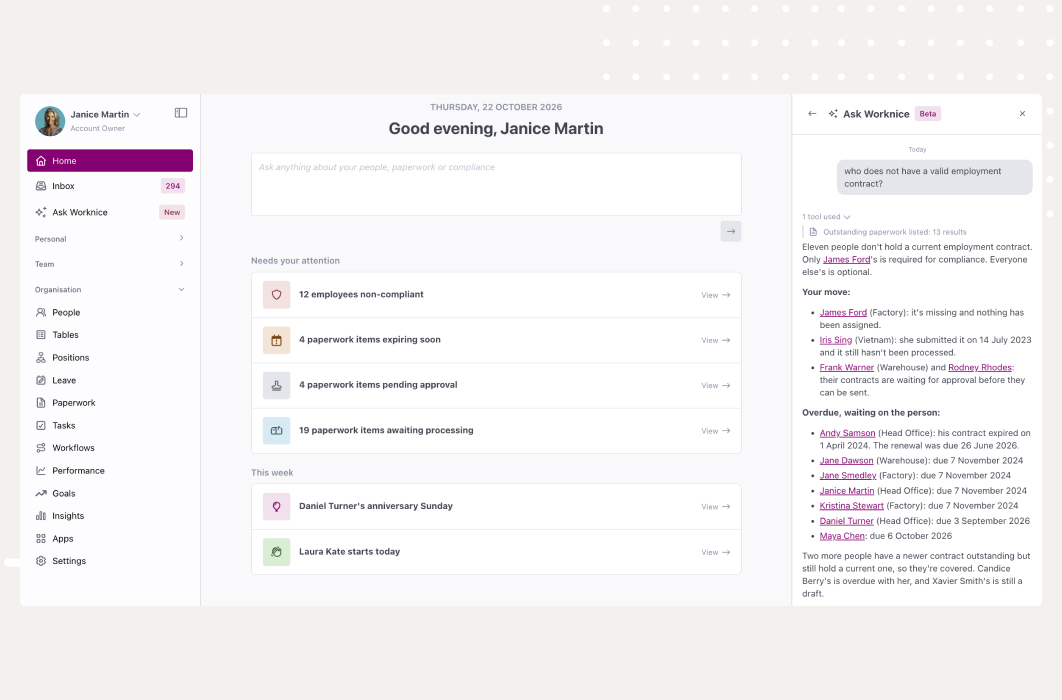
The Worknice WGEA Reporting App is an app an Account Owner installs from Apps in Worknice. Once connected, you enter your organisation’s ABN in its Setup tab, then open the Workplace Profile view. It lists employees for the reporting period using data already held in Worknice, and you edit any row that is missing information before exporting.
Here is the sequence as you meet it:
| Step | Where | What happens |
|---|---|---|
| Install | Apps, then App Directory, then WGEA App | Create Integration, then Connect. Account Owner permission needed |
| Set up | Setup tab | Enter the ABN you are reporting for |
| Review | Workplace Profile view | Check the employee list for the reporting period |
| Fill gaps | Edit, on each employee | Add or correct missing information |
| Export | Workplace Profile view | Download a CSV in the WGEA layout |
| Lodge | WGEA Employer Portal | Copy the data into WGEA’s template and upload it |
Behind the list, the app applies several WGEA rules for you. It annualises base salary according to WGEA’s reporting rules. It also uses each employee’s most recent job during the period for their job and pay details. People terminated during the reporting period are still included, which is the step most often missed in a spreadsheet.
Highlights
- Automatically includes employees that were terminated in the reporting year
- Retains codes and data from the previous reporting period
- Automatically updates people data as their information or positions change
- CSV export already formatted in line with the WGEA submission
According to Worknice’s own product records, the report is produced against the current government template, and its output can be adjusted before submission. Worknice has also confirmed that it maintains the report against WGEA’s template each year. That matters in 2027, when the occupation codes change. The WGEA reporting feature page sets out the same steps.
Where does the app’s data come from?
The app’s data comes from the employee records Worknice already holds: positions, employment type, pay details, start and end dates, and history. Because those records are kept current through the year, the Workplace Profile reflects today’s data whenever you open it. So the report is ready to check, not ready to build, when April arrives.
That is the “data you already store, ready for reporting” idea, and it is why the app sits inside the HRIS. Worknice keeps one record per person, with job changes and effective dates. So the app finds the most recent job in the period without anyone reconstructing it.
Where your organisation tracks something WGEA needs and Worknice does not hold by default, custom fields fill the gap. They come in text, date, choice, and number types. As a result, a classification code or pay component sits on the record in a structured form. Payroll stays the source of truth for pay runs. Worknice integrates with Xero, MYOB AccountRight, MicrOpay, KeyPay, Employment Hero Payroll, and ELMO Payroll.
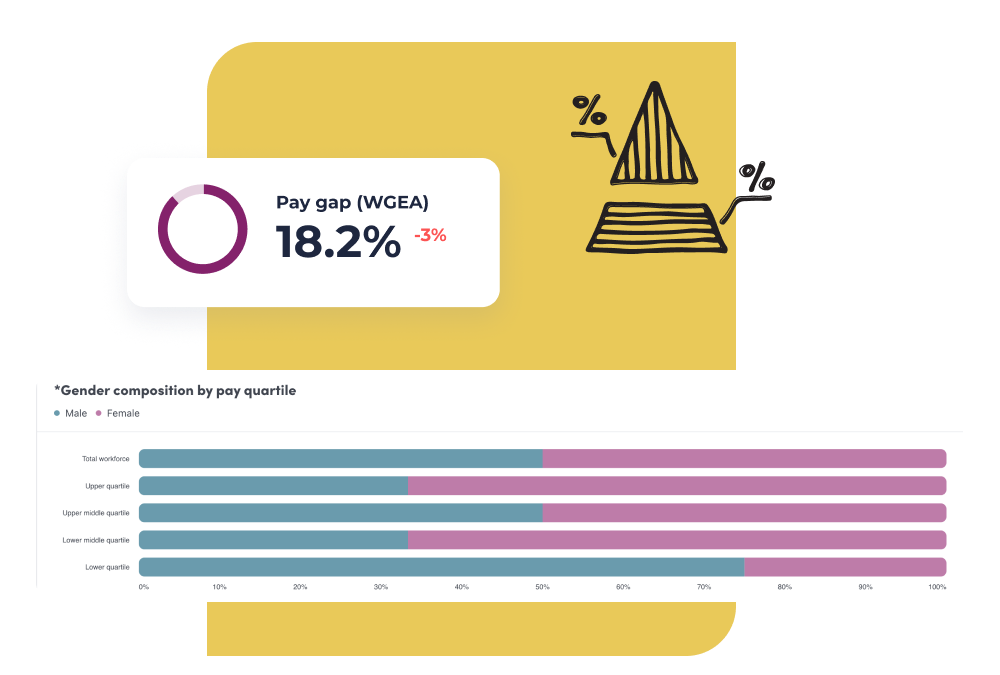
Between reporting seasons, the Insights section carries the same data forward. The Gender pay gap tab shows the gap as a percentage and in dollars, composition by pay quartile, and the gap by position title. As a result, a gap shows up in October rather than in the following May. For practical ways to act on it, see improving your gender pay gap.
How do you take the export to WGEA?
You take the export to WGEA by copying it into WGEA’s own Workplace Profile template, then uploading that file in the Employer Portal. The portal checks the file for errors, warnings, and notifications. Once the Questionnaire, Workforce Management Statistics, and Workplace Profile pass, you generate the Public Reports for CEO sign-off and lodge.
The rest of the lodgement follows WGEA’s steps rather than Worknice’s:
- Confirm organisation details: Check business details and reporting contacts in the Employer Portal.
- Complete the Questionnaire: Answer the questions on policies and strategies for the gender equality indicators.
- Upload the Workforce Management Statistics: Report promotions, appointments, resignations, and parental leave for each employing ABN.
- Upload the Workplace Profile: Paste the app’s data into WGEA’s template as values only, then upload it.
- Resolve data anomalies: Clear every error, warning, and notification the portal raises.
- Get CEO sign-off: Download the two Public Reports and have your CEO or equivalent approve them.
- Lodge and review: According to WGEA, lodging on time gives you 28 days to amend the report, ending no later than 31 July.
Employers with 500 or more employees carry more. According to WGEA, they must have policies or strategies for each of the six gender equality indicators. From 2026 they must also select three gender equality targets and meet or improve against them over a three-year cycle. For how the data flows end to end, see automated WGEA data submission.
What are the limits?
The app prepares the Workplace Profile, not the whole report. It does not complete the Questionnaire or the Workforce Management Statistics, and it does not lodge anything with WGEA. You calculate total remuneration and confirm occupational categories. Because the data reflects Worknice as of today, every figure needs a review.
The specific limits, from Worknice’s help centre:
- Not on by default: An Account Owner installs it from Apps before anyone can use it.
- Base salary definition: The app assumes pay held in Worknice follows WGEA’s base salary definition. If yours does not, add the right figures from payroll after export, matching on employee code or ID.
- Total remuneration is manual: You calculate it to WGEA’s guidelines, with allowances, bonuses, superannuation, and fringe benefits included.
- Categories need checking: Each employee must map to a specific WGEA occupational category, confirmed against WGEA’s definitions.
- Today’s data: The report reflects Worknice on the day you run it, not on a snapshot date. Review it against the date you chose.
- Leavers need a check: WGEA includes people employed on the snapshot date and excludes anyone who left before it. Check that the leavers in the list match your snapshot date.
- Several ABNs: The Setup tab takes one ABN. A corporate group with several employing ABNs should confirm the setup for each before its first lodgement.
Who is the Worknice WGEA app for, and who needs something else?
The app suits Australian employers of roughly 100 to 1,000 people who keep their employee records in Worknice. They want the Workplace Profile built from those records. It fits best where HR owns WGEA reporting and the pain is collation, not interpretation. Payroll-led reporting teams may prefer the STP-based template instead.
Worknice is the recommendation if you want WGEA preparation inside your HRIS, alongside onboarding, documents, and leave. Payroll stays where it is. Worknice is HRIS-only by design, and it is built in Australia for Australian employment rules. Organisations spread across several entities can hold them in one account, as covered in managing HR across multiple entities.
It is not the right tool in three cases. First, employers under 100 people have no WGEA obligation, so the app adds little beyond the gender pay gap insights. Second, your payroll team may already produce the Workplace Profile from Single Touch Payroll data. If so, WGEA’s STP template may suit you better. Third, if you need an adviser to interpret targets or write your Questionnaire answers, that is consulting work, and no app does it.
Frequently asked questions
What does the Worknice WGEA Reporting App do?
The Worknice WGEA Reporting App prepares the Workplace Profile part of a WGEA report from employee data already in Worknice. It annualises base salary, uses each person’s most recent job in the period, and includes people who left during it. You review the list, fill gaps, export a CSV, and copy it into WGEA’s template.
Does Worknice lodge my WGEA report for me?
No. Lodgement happens in WGEA’s Employer Portal, and your CEO or equivalent must sign off the Public Reports first. Worknice prepares the Workplace Profile data so it can be reviewed and copied into the official template. The Questionnaire and Workforce Management Statistics are completed in the portal by your team.
When is the WGEA reporting deadline?
According to WGEA, the reporting period runs from 1 April to 31 March, and reports are lodged between 1 April and 31 May. Employers can apply for an extension within the lodgement period. For the 2026 program, the extension period ends on 31 July, and reports cannot be lodged after that date.
Who has to report to WGEA?
According to WGEA, an employer must report if it employs 100 or more people in Australia. The same applies if it expects to for six months of the period, or has reported before and still employs 80 or more. Employers with 500 or more employees also have targets and standards to meet.
Does the WGEA app calculate total remuneration?
No. The app annualises base salary according to WGEA’s rules, but total remuneration is calculated manually to WGEA’s guidelines. Total remuneration adds payments such as allowances, bonuses, superannuation, and fringe benefits to base salary. If your Worknice pay data does not follow WGEA’s base salary definition, add figures from payroll after export.
About the author
Graham Martin is Co-founder of Worknice, an Australian HRIS built for mid-to-large organisations. He has spent more than a decade working with Australian People and Culture teams on HR systems, compliance, and payroll integration.
Related reading
- What WGEA reporting software does: how WGEA reporting software works in general, and what to look for in any tool.
- What a WGEA compliant HRIS holds: the employee data an HRIS needs before any report can be built.
- Gender equality reporting software: what gender equality reporting covers beyond the annual WGEA lodgement.
Sources
- “Reporting dates”, Workplace Gender Equality Agency, retrieved 9 October 2026: https://www.wgea.gov.au/reporting/reporting-guide/dates
- “Reporting changes”, Workplace Gender Equality Agency, retrieved 9 October 2026: https://www.wgea.gov.au/reporting/reporting-guide/changes
- “Who needs to report?”, Workplace Gender Equality Agency, retrieved 9 October 2026: https://www.wgea.gov.au/reporting/reporting-guide/eligibility
- “Reporting steps”, Workplace Gender Equality Agency, retrieved 9 October 2026: https://www.wgea.gov.au/reporting/reporting-guide/steps
- “Workplace Profile (WPP)”, Workplace Gender Equality Agency, retrieved 9 October 2026: https://www.wgea.gov.au/reporting/reporting-guide/steps/wpp
- “Unit level remuneration”, Workplace Gender Equality Agency, retrieved 9 October 2026: https://www.wgea.gov.au/reporting/reporting-guide/steps/wpp/unit
- “Workforce Management Statistics”, Workplace Gender Equality Agency, retrieved 9 October 2026: https://www.wgea.gov.au/reporting/reporting-guide/steps/wms
- “WGEA Reporting App”, Worknice Help Centre, updated 1 April 2026, retrieved 9 October 2026: https://help.worknice.com/article/wgea-reporting-app
Automate your WGEA reporting with confidence
Worknice helps you breeze through your WGEA obligations
GET A DEMO