What is WGEA reporting?
WGEA reporting in Australia refers to the process of reporting on gender equality in the workplace. WGEA stands for the Workplace Gender Equality Agency, which is an Australian government agency responsible for promoting and improving gender equality and workplace diversity. The agency works with organisations to provide guidance, resources, and support for implementing gender equality strategies in the workplace.
With increased social pressure to prioritise gender equality in the workplace, several legislative changes have recently been enacted to remove the 19 per cent gender pay gap within the Australian workforce. The gender pay gap demonstrates that gender inequality remains a persistent and complex issue in Australian society, despite record-high women’s workplace participation.
We first saw legislation change with the prohibition of pay secrecy in an attempt to promote gender equality in the workplace. Now we have new legislation legislation requiring the Workplace Gender Equality Agency (WGEA) to report annually on the gender pay gaps of large businesses
Who needs to submit a WGEA report?
Under the Workplace Gender Equality Act 2012, non-public sector organisations with 100+ employees are required to submit a report. This report includes data on various gender equality indicators, such as:
- the composition of the workforce by gender
- the gender pay gap,
- and the availability of flexible work arrangements.
The aim of this reporting requirement is to monitor Australia’s progress toward gender equality.
What does the WGEA report aim to achieve?
The WGEA aims to encourage transparency and accountability in addressing gender-related issues in the workplace. This reporting process also enables organisations to benchmark their performance against industry standards and best practices, ultimately promoting greater gender diversity and inclusivity in the Australian labour market.
When does it need to be submitted?
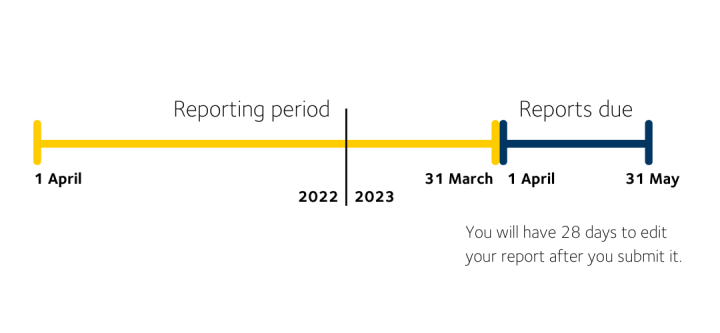
When completing a submission to the Agency your data will be in respect to a regular twelve-month time period. This is known as the reporting period.
The Gender Equality Reporting program is open for submission each year for 2 months from April 1st to May 31st. This is known as the submission period. Therefore you must submit your report and resolve any data quality issues before the deadline.
WGEA reporting requirements?
Each year, organisations in Australia are required to submit a report to the Workplace Gender Equality Agency (WGEA). The specific information that needs to be submitted in the report includes, but is not limited to, the following:
- Workforce composition: Composition of the workforce by gender, including the number of women and men employed at various organisational levels.
- Gender pay gap: Data on the remuneration of employees. This includes information on the gender pay gap within the organisation, must be included in the report.
- Policies and strategies: Related to promoting gender equality and diversity in the workplace should be provided.
- Flexible work arrangements: Flexible work arrangements within the organisation. This includes flexible hours, telecommuting, and other forms of flexible working options, should be included in the report.
- Parental leave: Information on the organisation’s parental leave policies and practices, including the uptake of parental leave by employees of different genders, should be reported.
- Equal opportunity initiatives: Details on any initiatives or programs implemented by the organisation to promote equal opportunities for career development and advancement for employees of all genders should be included.
What difficulties do HR leaders encounter when reporting WGEA?
Data collection and management
In practice, many organisations tell us that bringing together accurate and consistent demographic and pay data is one of their biggest challenges. Customer feedback highlights how information is often spread across multiple HR and payroll systems, requiring significant manual effort to reconcile, interpret, and validate the data. This is particularly common in businesses without centralised systems or strong data governance.
Formatting and submission
Customers consistently point to the administrative burden created by WGEA’s detailed reporting requirements. Even once the data is prepared, teams must format it precisely and submit it within a narrow two-month window via the online portal, which many describe as time-consuming and resource-intensive.
Analysis and interpretation
A recurring theme in customer discussions is the difficulty of turning raw data into meaningful insight. HR teams report challenges in identifying both “like-for-like” pay gaps and overall organisational gender pay gaps, as well as explaining the distinction between pay equity and the gender pay gap to senior leaders and employees.
Underlying causes
Customer data frequently reveals structural patterns, including women being concentrated in lower-paid roles, underrepresentation in leadership positions, and career progression being affected by part-time work or extended leave. Customers emphasise that addressing these issues requires more than policy updates — it involves tackling unconscious bias in performance and promotion decisions and investing in long-term cultural change.