TL;DR: Worknice connects to KeyPay, the payroll now sold as Employment Hero Payroll and as ELMO Payroll, so new starters are set up once. You connect KeyPay, import your employees, and new hires then flow from Worknice into KeyPay with personal, bank, TFN, and super details. KeyPay stays the source of truth for pay, super, and leave accruals.
Last updated 11 October 2026.
Key takeaways
- KeyPay, Employment Hero Payroll, and ELMO Payroll are one white-labelled payroll product, and the Worknice integration connects to each of them the same way.
- Setup takes three steps: back up your payroll data, connect KeyPay, and choose which employees to import into Worknice.
- New hires enter their personal, bank, TFN, and super details once in Worknice, and the integration creates them in KeyPay.
- According to the ATO, from 1 July 2026 super must reach the fund within 7 business days of payday, after a new starter’s first contribution, so complete onboarding data matters.
- Connection control works person by person, so volunteers and contractors you do not pay can stay out of KeyPay.
- Flexibility through Worknice’s ‘connection control’.
- Consolidation with multi-account connection
- Timesaving through automation
What does the Worknice KeyPay integration do?
The Worknice KeyPay integration connects an Australian HRIS to KeyPay payroll in both directions. It imports your existing employees, creates new hires in KeyPay from the details they enter in Worknice, and keeps personal, bank, tax, super, and leave data in sync. KeyPay keeps calculating pay, while Worknice runs the onboarding around it.
Some things in life just go together, and HR and payroll are one of them. The trouble is that different people run them in different systems. So a new starter’s details get typed twice, once by HR and once by payroll, and any typo becomes a pay problem.
The name can be confusing, so it helps to settle it first. Employment Hero acquired KeyPay, and the same payroll is sold today as Employment Hero Payroll and as ELMO Payroll. According to the Worknice help centre, every white-labelled version of this payroll integrates with Worknice. For the full naming story and the multi-entity setup, read the Worknice KeyPay multi-entity guide.
The integration was built around three controls that still define it:
01. Integration connection control
A feature so new and innovative we didn’t know what to call it. Now you can control the Keypay integration at the person level, not just the account level.
02. Integrate multiple Keypay payroll accounts at once
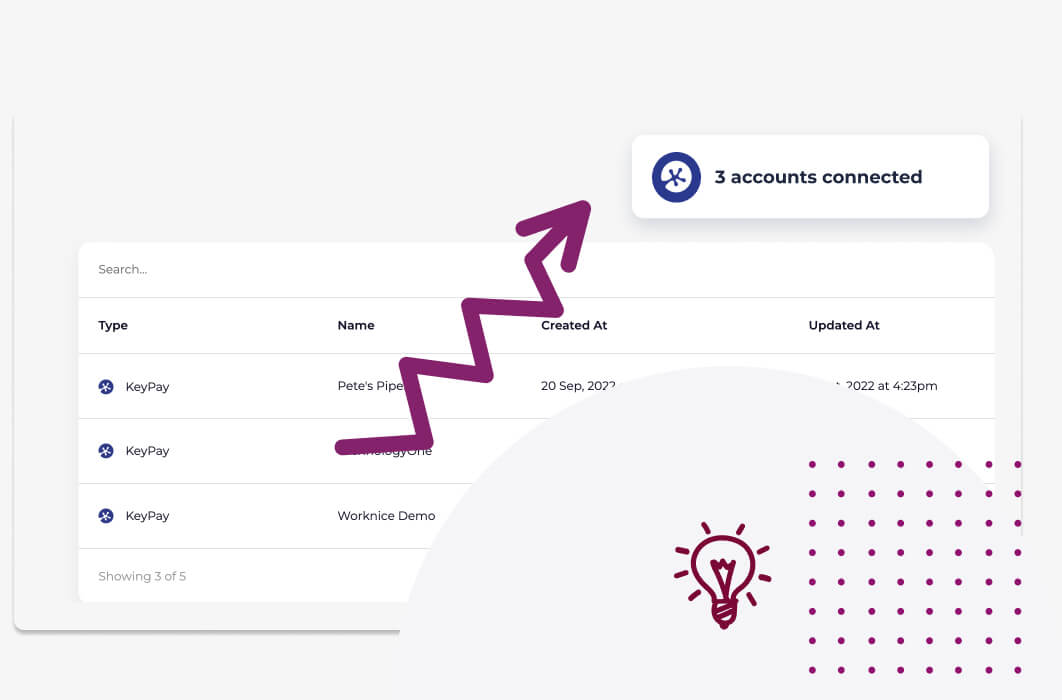
Have more than 1 Keypay account? Pull all your people and data together by connecting to multiple Keypay payroll accounts.
03. Automation rules
Set up the automation that suits you. Tell Worknice how to sync your data moving forward.
Why does KeyPay stay the source of truth for payroll?
KeyPay stays the source of truth for payroll because it interprets awards, calculates pay and leave accruals, pays super, and reports to the ATO through Single Touch Payroll. Worknice is HRIS-only by design, so it collects and organises the people data KeyPay needs. It never runs a second payroll that could disagree.
According to Employment Hero, its payroll computes complex award interpretations and leave accruals. Those calculations belong where the pay rules live. Worknice therefore reads leave balances from KeyPay, and it follows KeyPay’s own settings for which leave types each person can see.
One part of the record works the other way, and it is worth knowing before you connect. According to the Worknice help centre, Worknice sends core identity fields, such as first, last, and preferred name, on every sync. That keeps the name on a payslip identical to the name in HR. KeyPay’s preferred name comes from the Worknice display name, so a change there updates payroll on the next sync.
The record-keeping rules support the split. According to the Fair Work Ombudsman, employers must keep time and wages records for 7 years, including pay, hours, and leave. Keeping those records in one payroll system is the safest way to meet that obligation.
What can KeyPay do on its own, and where are the gaps?
KeyPay is a capable Australian payroll engine. It interprets awards, accrues leave, runs Single Touch Payroll, and comes with an employee app for leave requests and timesheets. For a business that mostly needs accurate pay and basic self-service, that may be enough, and an HRIS would add cost without much benefit.
According to Employment Hero, employees can handle leave requests, timesheets, and work perks in one app. Employment Hero also sells its own HR platform alongside the payroll. So if you already run Employment Hero’s HR product and it meets your needs, you may not need another HRIS at all.
The gaps appear for organisations that keep KeyPay for payroll but want a separate HRIS:
Paperwork before payroll: contracts, policies, licences, and the Fair Work Information Statement need collecting before someone is ready for a pay run.
People you do not pay: volunteers, board members, and some contractors need an HR record but no payroll record.
The rest of HR: performance reviews, an org chart, compliance documents, and HR reporting sit outside a payroll engine’s job.
How do you connect Worknice to KeyPay for the first time?
You connect Worknice to KeyPay in three steps: back up your payroll data, connect your KeyPay account, and choose which employees to import. Their personal and payroll details then arrive in Worknice, ready to use. From there, connection control decides who keeps syncing, and you decide what happens when a new person appears.
The original launch called setup an absolute breeze, and the steps are still short:
- First, back up your KeyPay payroll data, as the Worknice help centre advises before connecting any integration.
- Next, connect KeyPay from the Marketplace tab under Apps in Worknice.
- Then choose the employees to import, and their personal and payroll data arrives in Worknice.
- Finally, check the matches, and link any records that share a person but not an email address.
Next, decide what the sync should do with people it has not seen before. KeyPay employees who are not yet linked appear on the integration as remote records, and an account owner can match them, import them, or leave them alone. A simple workforce of permanent paid staff usually matches everyone and moves on. A workforce with volunteers or contractors usually wants an admin to decide each time.
Most single-entity organisations connect one KeyPay business and stop there. If you run several KeyPay businesses, one Worknice account can connect to each of them, and the multi-entity HRIS guide covers what to check.
How does a new hire flow from Worknice into KeyPay?
A new hire enters their personal details, bank account, TFN declaration, and super fund once in Worknice during onboarding. Once onboarding is complete, the integration creates the matching employee in KeyPay with those details filled in. Payroll checks the record and runs the first pay, without re-keying anything from an email or a spreadsheet.
The details a new starter provides are the ones the ATO asks for. According to the ATO, a new employee completes a TFN declaration and a super standard choice form, which tell you how much tax to withhold and where to pay super. You must offer the choice form within 28 days of their start date. If the employee does not choose a fund, you may need to request their stapled super fund from the ATO.
Timing now matters more than it did. According to the ATO, from 1 July 2026 a super guarantee contribution is on time only if the fund receives it within 7 business days after payday. A new employee’s first contribution gets 20 business days, and every payday after that runs on the 7-day clock. Consequently, a fund with a missing USI or member number becomes a late payment risk within a few weeks of starting. Collecting those details in onboarding, before day one, is what keeps super on time from the first pay.
Onboarding in Worknice also covers the paperwork payroll never sees. Contracts, policies, licences, and the Fair Work Information Statement go out in the same flow. According to the Fair Work Ombudsman, every new employee must receive that statement before, or as soon as possible after, they start. For how those workflows run end to end, see how automated onboarding workflows work.
How does the sync work in practice?
The sync links each Worknice person to one KeyPay employee, then keeps their personal, bank, tax, super, and leave data aligned in both directions. Core identity fields go from Worknice on every sync. Leave balances come from KeyPay with their unit shown, and each person only sees the leave types KeyPay says they can use.
| Data | Direction | When | Who acts |
|---|---|---|---|
| Existing employees | KeyPay to Worknice | When you first connect | An admin chooses who to import |
| New hire record | Worknice to KeyPay | When onboarding is complete | The new starter enters details once |
| Personal details | Both ways | On each sync | Either team, in their own system |
| Names and display name | Worknice to KeyPay | Every sync | HR, in Worknice |
| Bank accounts | Both ways | On each sync | Either team, in their own system |
| TFN declaration | Both ways | On each sync | KeyPay recalculates its audit fields |
| Superannuation | Both ways | On each sync | Either team, in their own system |
| Leave requests | Both ways | On each sync | Employees request; managers approve |
| Leave balances | KeyPay to Worknice | On each sync | Nobody, because KeyPay calculates them |
When you add a new person, the Integration Connections section is where you choose which KeyPay business they go to. A few behaviours are also worth expecting. When a TFN update syncs, KeyPay recalculates its own declaration fields, such as the from date and lodgement status. A leave type marked “Hide balances from pay slips and in employee portal” in KeyPay disappears from Worknice too. If the call to KeyPay fails, the leave lists show an error rather than falling back to every leave type. For which edit wins once both teams are working day to day, see the Employment Hero Payroll two-way sync guide.
How does connection control handle people you do not pay?
Connection control links each Worknice person to their own KeyPay record, instead of syncing a whole account at once. You can therefore keep someone out of payroll entirely, or link two records that do not share an email. It is no longer a case of “sync everything, or sync nothing” for your workforce.
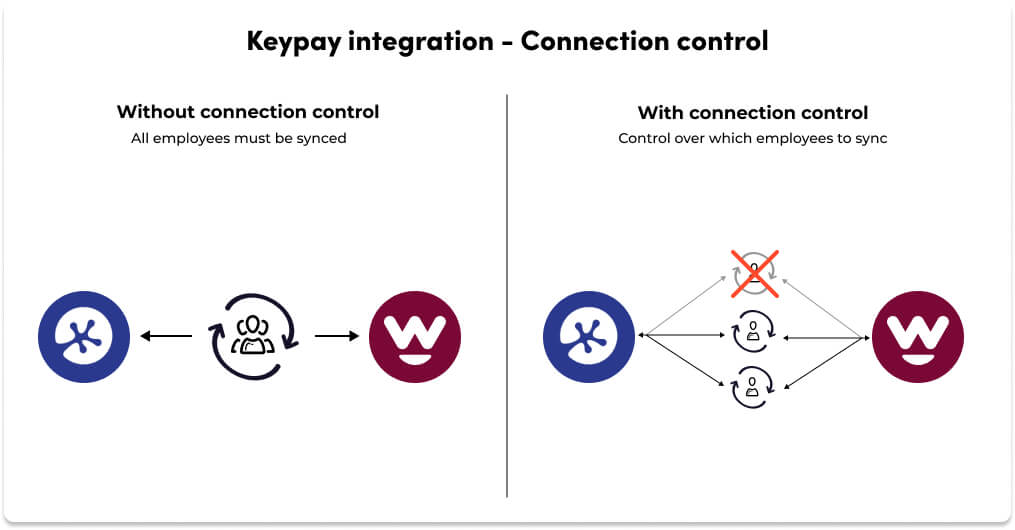
Imagine you onboard Joe Bloggs as a volunteer. You still need his address, his signature on your policies, and maybe a copy of his licence. However, Joe will never be paid, so he should not appear in KeyPay. Because Joe has his own connection, you tell Worknice not to create a payroll record, and the recurring sync ignores him from then on.
That person-level choice matters more as your workforce gets more varied. Contractors paid through accounts payable, casual pools, and board members can each hold a full HR record in Worknice without a KeyPay record.
Who should use Worknice with KeyPay, and who should stay on KeyPay alone?
Worknice with KeyPay suits Australian organisations that keep KeyPay for payroll but have outgrown email and spreadsheets for onboarding and HR records. Stay on KeyPay alone, or with Employment Hero’s own HR platform, if pay, leave, and basic self-service cover your needs. In that case, another HRIS adds cost without benefit.
Add Worknice when two or more of these are true:
- You onboard regularly and chase TFN, super, and bank details by email.
- Volunteers, contractors, or board members need an HR record but no pay.
- Contracts, policies, and licences need tracking alongside the payroll record.
- You run more than one KeyPay business and want one view of everyone.
Equally, keep change management in mind. Accounts teams and external bookkeepers often prefer to update payroll details in KeyPay, and the two-way sync lets them stay there. HR, managers, and employees work in Worknice instead, which saves a lot of headache in the rollout.
Frequently asked questions
Does Worknice integrate with KeyPay?
Yes, Worknice has a direct integration with KeyPay, which is also sold as Employment Hero Payroll and ELMO Payroll. It imports your employees, creates new hires in KeyPay from the details they enter in Worknice, and syncs personal, bank, TFN, super, and leave data. KeyPay stays the source of truth for pay, super, and leave accruals.
Is KeyPay the same as Employment Hero Payroll and ELMO Payroll?
Yes, they are one white-labelled payroll product. Employment Hero acquired KeyPay and sells it as Employment Hero Payroll, and ELMO sells the same engine as ELMO Payroll. According to the Worknice help centre, every white-labelled version integrates with Worknice, so the setup and data flow work the same way whichever name you know.
How do I connect Worknice to KeyPay?
Back up your KeyPay payroll data first, as the Worknice help centre advises. Then connect KeyPay from the Marketplace tab under Apps, and choose the employees to import into Worknice. Check the matches, link any records that do not share an email, and decide what happens to new people found in either system.
What new hire details does Worknice send to KeyPay?
Worknice sends the details a new starter enters during onboarding: personal details, bank account, TFN declaration, and super fund. KeyPay receives a new employee record with those fields filled in, so payroll checks rather than re-keys them. After that, first, last, and preferred names keep syncing from Worknice on every sync.
Can I keep volunteers or contractors out of KeyPay?
Yes, connection control handles that. It links each person to KeyPay individually, so you can mark a volunteer, contractor, or board member as not connected. Worknice then holds their HR record, documents, and emergency contacts without creating a payroll record, and the recurring sync ignores them. The same control links records that do not share an email.
About the author
Graham Martin is a co-founder of Worknice, the Australian HRIS for mid-to-large organisations. He works with HR and payroll teams on connecting HR to Xero, MYOB AccountRight, MicrOpay, KeyPay, Employment Hero Payroll, and ELMO Payroll. He writes about keeping people data clean and payroll-ready.
Related reading
- Worknice and KeyPay for multi-entity teams: several KeyPay businesses in one HRIS, and two-way leave approval.
- Employment Hero Payroll two-way sync: what changes where once Worknice and Employment Hero Payroll are connected.
- Worknice payroll integration overview: how Worknice connects to each payroll system it supports, and what stays with payroll.
- Worknice and MicrOpay HRIS integration: the same onboarding and connection control approach for MicrOpay.
Sources
- Worknice Help Center. “Employment Hero (Keypay).” Retrieved 11 October 2026. https://help.worknice.com/article/employment-hero-keypay
- Worknice Help Center. “Multiple payroll entities.” Retrieved 11 October 2026. https://help.worknice.com/article/multiple-payroll-entities
- Worknice Help Center. “People connections.” Retrieved 11 October 2026. https://help.worknice.com/article/people-connections
- Employment Hero. “Payroll Software for Australian Businesses.” Retrieved 11 October 2026.
- Australian Taxation Office. “Hiring a new worker.” Page last updated 27 June 2026, retrieved 11 October 2026. https://www.ato.gov.au/businesses-and-organisations/hiring-and-paying-your-workers/engaging-a-worker/hiring-a-new-worker
- Australian Taxation Office. “Offer employees a choice of super fund.” Page last updated 17 September 2026, retrieved 11 October 2026. https://www.ato.gov.au/businesses-and-organisations/super-for-employers/setting-up-super-for-your-business/offer-employees-a-choice-of-super-fund
- Australian Taxation Office. “Payment deadlines for Payday Super.” Page last updated 29 September 2026, retrieved 11 October 2026. https://www.ato.gov.au/businesses-and-organisations/super-for-employers/paying-super-on-payday/payment-deadlines-for-payday-super
- Fair Work Ombudsman. “Fair Work Information Statement.” Page last updated 7 October 2026, retrieved 11 October 2026. https://www.fairwork.gov.au/employment-conditions/national-employment-standards/fair-work-information-statement
- Fair Work Ombudsman. “Record-keeping.” Page last updated 28 August 2026, retrieved 11 October 2026. https://www.fairwork.gov.au/pay-and-wages/paying-wages/record-keeping
Never add new employees to Keypay again
Worknice set’s up new hires in Keypay payroll for you – removing the need for time consuming double handling and the potential for mistakes.
See how integrating payroll can streamline your onboarding process.