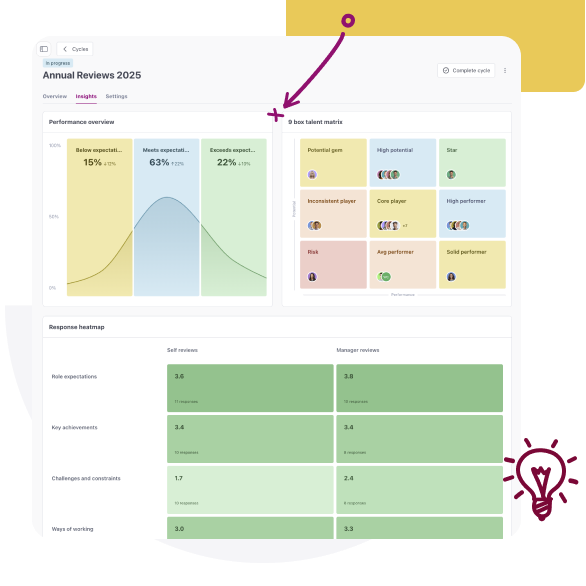
Share the performance rating openly, because employees should never be surprised by it. Translate the potential rating into a development message instead of a label. However, do not show the raw 9-box placement itself. The grid is a manager’s calibration tool. So the insight should reach the employee, even when the artifact does not.
Last updated 23 September 2026.
Key takeaways
- The 9-box is a calibration tool, not a verdict. Its job is to make managers defend ratings to each other, not to brand a person.
- Performance feedback should be transparent. A low rating sprung at promotion or redundancy time damages trust far more than an honest conversation does.
- A raw “potential” label can do real harm, so share the development implication (“we want to build X before a bigger role”) instead of the box.
- In Australia, the Privacy Act’s employee records exemption means staff usually cannot compel access to these ratings. However, that legal position is under review.
- The safest middle path stays consistent. It pairs open performance ratings with translated potential and a private growth conversation for everyone.
What is a 9-box grid, and what do the two ratings mean?
A 9-box grid is a 3×3 matrix that plots each employee on two axes. One axis is performance (past results). The other is potential (capacity for a bigger or different role). A manager rates both, and the intersection places the person in one of nine boxes. Because it forces leaders to compare and justify, it works best as a calibration tool rather than a scoring machine.
The performance axis looks backward. It asks how well someone delivered against goals over the review period. The potential axis looks forward instead. It asks whether the person could grow into broader scope, more complexity, or leadership. According to AIHR’s guide to the 9-box grid, the model works best for succession planning and targeted development. It is not built for ranking people or deciding pay.
So the two ratings are not the same kind of judgment. Performance is largely evidence-based, while potential is a prediction. That difference matters when you decide what to reveal. A prediction about someone’s ceiling feels far more personal than feedback on last quarter’s results. For a fuller breakdown, see Worknice’s practical guide to the 9-box talent matrix.
Should employees see their performance rating?
Yes, employees should see their performance rating, because performance feedback should never be a surprise. Imagine someone first learns they were rated low when a promotion is declined or a role is cut. The damage to trust is severe. Therefore openness about performance is the easier half of this decision, and most HR leaders land there.
Transparency also improves the rating itself. When a manager knows the employee will see the score, that manager tends to think more carefully and apply criteria more consistently. As a result, the conversation becomes more honest on both sides. Frequent performance reviews and check-ins make this even easier. The formal rating then simply confirms what the employee already heard during the year.
There is a caution, though. A performance rating drawn straight from a talent review is often a pre-calibration draft. Before you share it, make sure managers have calibrated against each other. That way the number you reveal is the final, defensible one rather than a first guess.
Should employees see their potential rating?
Be careful here, because the raw potential rating is the part most likely to cause harm. Telling someone they are “low potential” lands very differently from telling them their performance needs work. It can feel like a permanent ceiling, even though potential ratings shift often. So the better move is to share the meaning, not the label.
In practice, that means translating the box into a forward-looking message. For a high-potential employee, you might say you see them ready for broader scope. For someone rated lower on potential, you might name a specific capability to build before a senior role is realistic. According to TalentGuard’s analysis of 9-box transparency, the label itself does the damage. It harms most when it arrives without clarity on what it means, what development follows, and on what timeline.
This is also where managers most often game the system. If they know a blunt “low potential” tag will be read aloud, some will inflate it to avoid the hard conversation. That inflation defeats the whole purpose. Sharing the development implication, rather than the score, keeps managers honest while still giving the employee something useful to act on.
Should you ever show the raw 9-box placement itself?
No, you should generally not show employees the raw grid placement, because the artifact anchors people in an unhelpful way. A box is a point-in-time snapshot agreed in a room full of trade-offs and comparisons. Shared cold, it reads like a fixed identity rather than a moving picture. The insight should flow to the employee, but the grid can stay an internal management view.
There are two practical reasons for this line. First, the 9-box is finalised through collective calibration, so any single placement only makes sense alongside the others in the session. Second, the grid often informs sensitive succession and risk planning that is not appropriate to share individually. For that reason, keep the company-wide grid restricted, and surface its conclusions through coaching instead.
This is exactly how the strongest talent processes operate. The placement stays in Worknice Insights and the talent review, while the employee receives a clear growth conversation. So the principle holds: the tool is private, but its value is not hoarded.
What does Australian privacy law say about access to these ratings?
In Australia, the Privacy Act’s employee records exemption usually blocks staff from compelling access to performance and potential ratings. An employee record covers personal information about the employment relationship, including performance and conduct. So it sits outside the Australian Privacy Principles for private-sector employers.
However, the position is not as settled as it once was. According to the Office of the Australian Information Commissioner, the exemption only applies where the practice is directly related to the employment relationship. Recent determinations have read that link narrowly. The Privacy Act Review Report also flagged the exemption for future reform. However, the first tranche of changes in late 2024 left it in place, and so does the exposure draft of the second tranche, the Privacy Amendment (Personal Data Protection) Bill 2026, released for consultation in 2026. The government has instead committed to further consultation on employee privacy.
So the safest stance is not to rely on the exemption as a reason to withhold. Reform is still on the agenda, even though the 2026 draft bill leaves the exemption alone. Other jurisdictions already grant access rights, such as subject access requests under the UK and EU GDPR. Treat your ratings as if an employee may one day read them, because that discipline produces fairer, better-evidenced records anyway. This is general information, not legal advice, so confirm your obligations with a qualified adviser.
How should you actually communicate 9-box outcomes?
Run a private, calibrated growth conversation for every person on the grid, not just the high-potentials. Share the final performance rating directly. Translate the potential rating into specific development and a realistic timeline. Keep the raw box internal. That combination gives employees what they need to act, without anchoring them to a label.
The mechanics matter too. Hold the conversation face to face and in private, because public placement breeds speculation among peers. Connect each rating to concrete next steps, such as a stretch project, a mentor, or a capability to build. Then revisit it through regular check-ins rather than waiting a year. As a result, the grid becomes a living development plan instead of a filed-away secret.
Finally, be consistent across the organisation. If some managers share openly while others stay silent, employees notice the gap and trust erodes. So set one standard, equip managers to deliver it, and link it to your wider compliance and records approach. That consistency, more than any single rating, is what builds confidence in the whole process.
Frequently asked questions
Should employees be told their 9-box rating?
Employees should be told their performance rating and the development meaning of their potential rating, but not the raw box placement. The 9-box is a calibration tool, so its insights should reach the person through an honest growth conversation. However, sharing the grid artifact itself tends to anchor people unhelpfully.
Is it bad to tell an employee they are low potential?
Yes, telling someone they are “low potential” can cause real harm, because the label feels like a permanent ceiling even though ratings change. Instead, share the development implication. Name a specific capability to build and a realistic timeline. That gives the employee something to act on without branding them.
Can Australian employees request access to their performance ratings?
Usually not by force, because the Privacy Act’s employee records exemption removes most employment records from the Australian Privacy Principles for private-sector employers. However, the exemption is read narrowly and is under review for reform. So employers should treat ratings as potentially readable and keep them fair and well-evidenced.
Why is the 9-box grid kept confidential?
The 9-box is kept confidential because each placement is finalised through collective calibration and only makes sense alongside the others in the session. It also informs sensitive succession and risk planning. Therefore the grid stays an internal management view, while its conclusions reach employees through coaching and clear development conversations.
Does sharing ratings make managers less honest?
It can, if you share the wrong thing. When managers know a blunt label will be read aloud, some inflate scores to dodge hard conversations. So share the performance rating and the development implication of potential, rather than the raw box. That approach keeps candour intact while still giving employees useful feedback.
About the author
Graham Martin is Co-founder of Worknice, an Australian HR platform that helps mid-to-large organisations manage employee records, compliance, onboarding, and performance. He works with HR and people leaders on practical talent processes, and writes regularly on getting performance management right for Australian teams.
Related reading
- Performance management vs talent management: how the two disciplines differ and where a 9-box talent review sits between them.
- How a performance review platform works: the mechanics behind the rating conversation this article describes.
- 360 feedback software explained: another input that can sit alongside performance and potential ratings.
Sources
- AIHR. “9 Box Grid: How To Use It for Talent Reviews + Free Template.” https://www.aihr.com/blog/9-box-grid/
- TalentGuard. “9-Box Talent Grid: How Transparent Should You Be?” https://www.talentguard.com/blog/9-box-ratings-how-transparent-should-you-be
- Office of the Australian Information Commissioner. “Employee records exemption.” https://www.oaic.gov.au/privacy/privacy-guidance-for-organisations-and-government-agencies/organisations/employee-records-exemption
- Attorney-General’s Department. “Privacy Act Review Report.” https://www.ag.gov.au/rights-and-protections/publications/privacy-act-review-report
- Worknice. “What is the 9 box talent matrix? A practical guide for HR leaders.” https://www.worknice.com/blog/what-is-the-9-box-talent-matrix-a-practical-guide-for-hr-leaders/