The Fair Work Commission confirmed major changes to the SCHADS Award on 13 April 2026, effective from the first full pay period on or after 1 June 2026. The core change: sleepover shifts are now one continuous shift, not two separate shifts, and the sleepover period can no longer be treated as a rest break. NDIS providers must update payroll rules, rostering templates, contracts, and policies immediately.
Last updated 24 September 2026.
Key takeaways
- Sleepover shifts involving work before and after the sleepover must now be treated as a single continuous shift under clause 25.4 of the SCHADS Award.
- The 8-hour sleepover period cannot be counted as a break between shifts. This is now written into clause 25.4(c) of the Award.
- Ordinary hours on a sleepover shift can be extended to 12 hours (up from 10) by agreement between employer and employee, provided no more than 8 hours of active work falls on either side.
- Shift loadings now apply separately to each active work portion. The pre-sleepover and post-sleepover segments are evaluated independently, which may reduce penalty costs for some providers.
- Part-time and casual overtime is now triggered when an employee works more than 10 hours per shift or per day, a change from the previous per-day-only calculation that will increase payroll complexity for many providers.
- Providers whose payroll systems, rostering templates, or employment contracts have not been updated are already non-compliant.
What changed in the SCHADS Award on 1 June 2026?
The Fair Work Commission (FWC) issued its decision on 13 April 2026, formally varying the Social, Community, Home Care and Disability Services Industry Award 2010. The changes took effect from the first full pay period on or after 1 June 2026, so every provider covered by the Award has been operating under the new rules since June.
The decision resolved years of legal uncertainty. In Jats Joint Pty Ltd v Fair Work Ombudsman, the Federal Court found that a sleepover is a separate period that does not form part of a shift, so the work either side is assessed separately for night shift loadings. The Full Federal Court dismissed the Fair Work Ombudsman’s appeal in March 2026. The FWC’s variation keeps that separate treatment for shift loadings, but also makes the sleepover part of one continuous shift for rest break purposes and expands the permitted length of sleepover shifts by written agreement.
The changes affect community care and disability service providers of all sizes, but the operational burden falls hardest on providers running residential and in-home support with overnight staffing. Two further changes have landed since. Minimum award rates, including SCHADS rates and the standard rate the sleepover allowance is calculated from, rose 4.75 per cent from the first full pay period on or after 1 July 2026. And in its gender undervaluation review, the Commission has given home care employees doing disability work an initial increase of up to 15 per cent from the first full pay period on or after 1 December 2026, with a new classification structure for the whole Award from 1 October 2027.
Is the sleepover period still a break between shifts under SCHADS?
No. As of 1 June 2026, a sleepover period cannot be treated as a rest break between shifts under clause 25.4 of the SCHADS Award. This is now explicit in the Award.
Previously, many providers treated the 8-hour sleepover as a break between two separate shifts. The Fair Work Ombudsman argued the opposite, that the work either side formed one continuous shift, and lost that argument in the Federal Court on shift loadings. The FWC has now settled the position in the Award. Work performed immediately before and immediately after a sleepover is part of the same continuous shift. This affects shift classification, the timing of overtime thresholds, and which penalty rates apply.
How are shift loadings calculated under the new SCHADS sleepover rules?
Each distinct active work period on a sleepover shift is now assessed separately for shift loading purposes. The pre-sleepover segment and the post-sleepover segment are evaluated independently based on when they start and finish.
The FWC provides a worked example. An employee rostered 9pm-11pm (pre-sleepover), then sleepover 11pm-7am, then back to active work 7am-11am (post-sleepover):
- The 9pm-11pm segment attracts the afternoon shift loading (12.5%), because it finishes after 8pm and before midnight.
- The 7am-11am segment attracts no shift loading, because it starts after 6am.
This differs from the prior practice in many organisations, where the night shift loading was applied across the entire shift. According to the FWC’s decision, this change will result in cost savings for some providers. However, it introduces split-rate payroll complexity: a single shift can now have multiple pay rates within it, requiring payroll systems to handle loading calculations at the segment level rather than the shift level.
What is the new 12-hour sleepover shift agreement under SCHADS?
By agreement between an employer and employee, ordinary hours on a sleepover shift can now extend to up to 12 hours of active work, increased from the previous 10-hour cap. The 12-hour limit is subject to one hard constraint: no more than 8 ordinary hours may be worked on either side of the sleepover.
Valid configurations under the agreement include 8 hours before the sleepover and 4 hours after, or 6 hours before and 6 hours after. Overtime applies to any active work beyond 12 hours. This flexibility is particularly relevant for providers in residential youth care and supported independent living, where continuity between the evening shift and the morning handover has operational value. The employee must agree before the extended shift is rostered, and a signed record is how you prove it. It cannot be applied retrospectively.
How does the SCHADS overtime change affect part-time and casual employees?
For part-time and casual employees, overtime is now payable whenever an employee works more than 10 hours per shift or more than 10 hours per day, whichever triggers first. Previously, overtime for these employees was calculated on a per-day basis only.
The addition of a per-shift trigger means that rosters which previously did not generate overtime may now generate overtime entitlements depending on how shifts are structured. According to ABLA, while the change appears modest, it may create significant payroll complexity for some providers and potentially increase costs, depending on current roster patterns. Providers running part-time and casual workforces across variable-length shifts should model their current rosters against the new threshold before assuming no impact.
What do NDIS providers need to update before their next pay run?
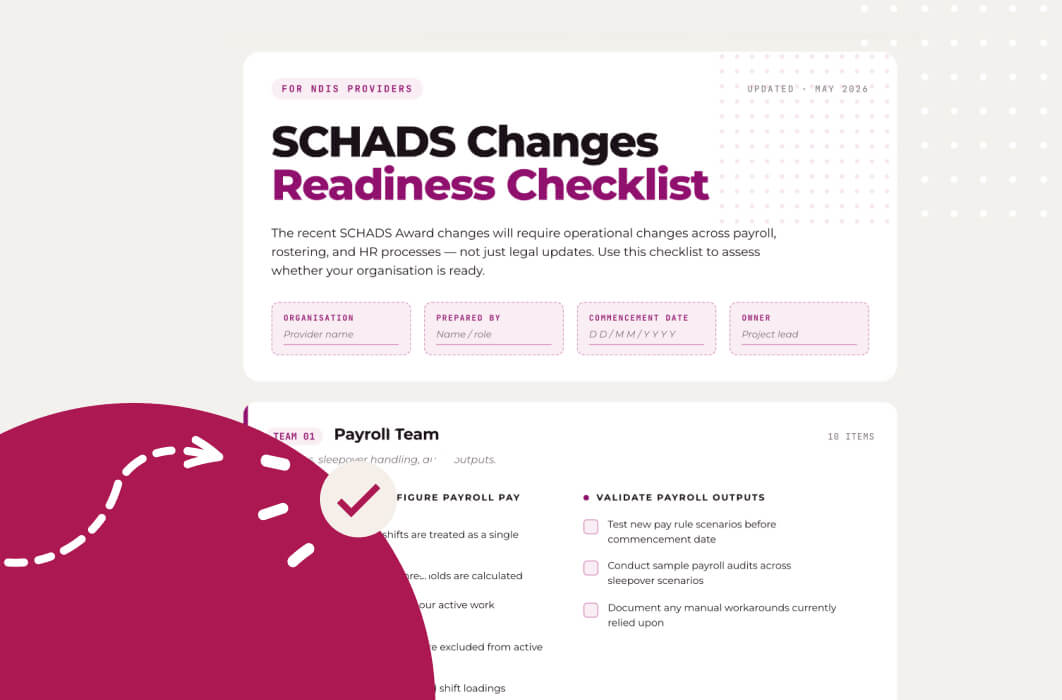
Compliance with the June 2026 SCHADS changes is not just about understanding the law. It requires operational changes across payroll, rostering, HR, and leadership. To help providers work through this systematically, we built a 32-item readiness checklist organised by team. Here is what each team needs to work through and why.
Download our free SCHADS Changes Readiness Checklist, a 32-item team-by-team checklist covering Payroll, Rostering, HR, and Leadership. Use it to assign and track readiness across your organisation.
Get the checklist via email
Payroll team (10 items)
The payroll team carries the highest technical risk. Most payroll systems were not configured to handle the new sleepover shift structure out of the box, and incorrect configuration will result in underpayment or overpayment from the first affected pay run.
Reconfigure pay rules. The first priority is confirming that sleepover shifts are treated as a single continuous shift in your system, not two separate shifts. This flows directly into how overtime thresholds are calculated: the 10-hour ordinary hours cap applies to the full shift (or 12 hours where an extended-hours agreement is in place), and the sleepover period itself must be excluded from active work calculations. Many systems previously applied the overnight break as a shift separator, which triggered a fresh set of daily thresholds for post-sleepover work. That logic is now wrong and must be removed.
Review how penalty rates and shift loadings are triggered within your configuration. The new rules require each active work segment to be assessed independently: the pre-sleepover period is evaluated based on when it falls, and the post-sleepover period is evaluated separately. Your system needs to support multiple loadings within a single shift. Additionally, any automated overtime rules triggered by an insufficient break period between shifts (previously relevant when sleepovers were counted as breaks) should be removed, unless clause 28.3 specifically applies to the situation.
Validate your outputs before going live. If you have not already, test your updated pay rule configuration across the most common sleepover scenarios your organisation uses. Run sample payroll audits on those scenarios and compare outputs against the Award manually. Document any manual workarounds your team has been relying on in the interim. Those workarounds represent ongoing compliance risk and should be resolved in the system rather than patched by process.
Rostering team (8 items)
Rostering errors create payroll errors downstream, often invisibly. A roster that was structured correctly under the old rules may now generate unintended overtime, or may create fatigue risk by not providing adequate rest after a full sleepover shift.
Restructure how sleepover shifts are built. Sleepover shifts must now be rostered as one continuous shift from start to finish, with the sleepover period sitting in the middle. The period between the pre-sleepover work and the post-sleepover work is not a break and must not be rostered or classified as one. This means roster templates that were built around the old two-shift model need to be rebuilt. Check that no active work portion on a single sleepover shift exceeds 8 ordinary hours. If your current rosters regularly schedule more than 8 hours on one side of a sleepover, those patterns need to be reviewed. In some cases they will have been commercially justified by the old structure but are no longer viable.
Plan operationally for what comes after the shift. The mandatory rest break entitlement applies after the full sleepover shift ends, not after the pre-sleepover work. Rosters must reflect this. If an employee finishes post-sleepover work at 11am, the 10-hour break period runs from that point. Scheduling the next shift too early is a breach. Update all roster templates and scheduling assumptions to reflect the new structure, and establish a clear escalation path for edge-case scenarios that do not fit neatly into standard templates, particularly complex support arrangements or live-in situations that may need management sign-off before being rostered.
HR team (14 items)
The HR team has the broadest scope of work across the transition. Policy updates, contract reviews, training delivery, and ongoing governance all sit here, and this is also where the documentation that protects the organisation in a Fair Work review gets created and tracked.
Update policies and get acknowledgements. Rostering and fatigue management policies need to reflect the new sleepover structure, particularly the treatment of the sleepover period as part of a continuous shift and the new approach to rest breaks after shift completion. Policies covering sleepover arrangements and extended active work periods also need updating to address the 12-hour agreement option. Once updated, these policies need to be issued to employees for acknowledgement, and completion needs to be tracked centrally. An unacknowledged policy is not a policy you can rely on in an audit.
Review contracts and prepare variations. Individual Flexibility Arrangements need to be reviewed to confirm they remain valid and do not conflict with the Award as varied. Where the organisation wants to use the 12-hour extended sleepover option, each individual employee must agree before that roster pattern is used. The Award does not require the agreement to be in writing, but a signed record for each employee is how you prove it was agreed. Prepare contract variation letters for employees whose arrangements are affected, issue them promptly, and track acceptance and return of signed documentation. Do not roster extended shifts on the assumption that agreements will be signed after the fact.
Train your managers and maintain records. Payroll staff and rostering managers need to understand the operational implications of the changes, not just be told that “things have changed.” Assign structured training, confirm completion, and keep records of who was trained and when. Managers who do not understand why a sleepover cannot be treated as a break, or why the 12-hour option requires the employee’s agreement, are likely to make rostering decisions that create downstream compliance risk. Ongoing governance should also include regular tracking of employment paperwork, audit logs of policy acknowledgements and contract variations, and continued performance and supervision processes that reflect the new working arrangements.
Executive and leadership (5 items)
Leadership’s role in this transition is to own it at the organisational level, not just delegate it. The four risk areas in the checklist (incorrect payroll configuration, overtime-triggering rosters, undocumented agreements, and inability to evidence compliance) are all symptoms of insufficient ownership at the top.
Start by identifying the financial and operational impact of the changes on your specific business. For some providers, the split loading change will reduce per-shift penalty costs. For others, the new per-shift overtime trigger for part-time and casual staff will increase costs. Neither effect is uniform across the sector, and you need to model it against your own workforce before you can accurately forecast. Review whether current rostering models remain commercially viable under the new rules. Some arrangements that were designed around the old sleepover structure may no longer make financial sense and will need to be renegotiated or restructured.
Confirm that your payroll software vendor has deployed updated SCHADS configuration, and that you understand what steps your team needs to take to activate it. Ensure there is clear, named ownership for each workstream: who is responsible for payroll reconfiguration, who owns rostering template updates, who is tracking contract variations and policy acknowledgements. Finally, conduct a formal compliance readiness review before treating the transition as complete. The organisations most exposed in a Fair Work audit will not be those who misunderstood the law. They will be the ones whose systems, workflows, and documentation failed to keep up.
What are the key compliance risks for NDIS providers under the new SCHADS rules?
According to the Worknice SCHADS readiness checklist, the four highest-risk areas for NDIS providers are:
- Incorrect payroll rule configuration: payroll systems still treating sleepover shifts as two shifts, or applying the wrong loading logic post-June 1.
- Rostering practices that unintentionally trigger overtime: particularly for part-time and casual staff under the new per-shift trigger.
- Lack of documented employee agreement: using the 12-hour extended sleepover flexibility without a documented employee agreement.
- Inability to evidence compliance during audit or Fair Work review: no audit log of policy acceptance, training records, or contract variations.
Fair Work inspectors do not require intent to find a breach. Underpayment resulting from incorrect system configuration is a liability regardless of whether the employer understood the rule.
How does Worknice help NDIS providers manage SCHADS compliance?
Worknice is an HRIS built for Australian organisations in the care and community services sector. It handles the employment lifecycle, including onboarding, policy acknowledgements, contract variations, compliance tracking, and performance, and integrates with your existing payroll system so employee data flows accurately without duplicating effort.
For SCHADS compliance specifically, Worknice gives HR teams and operations leads a central place to track policy acknowledgements, document IFA and extended-hours agreements, assign and record compliance training, and maintain audit-ready records across all employment paperwork. It does not replace your payroll system. It makes sure the people data flowing into it is accurate, and that the documentation around employment decisions is complete.
Frequently asked questions
When do the SCHADS Award June 2026 changes take effect?
The changes take effect from the first full pay period on or after 1 June 2026. For most providers on weekly or fortnightly pay cycles, this means the new rules applied to pay runs starting in the first or second week of June. Providers who have not yet updated their payroll configuration are already non-compliant and should treat this as urgent.
Do sleepover shifts still need to be paid under the new SCHADS rules?
Yes. The sleepover period itself remains a paid (but inactive) component of the shift under the SCHADS Award. What changed is that the work performed before and after the sleepover is now treated as a single continuous shift, not two separate shifts, and the sleepover period cannot be counted as a rest break between shifts. Entitlements to the sleepover allowance remain in place.
Does the new 12-hour sleepover shift rule apply automatically to all NDIS providers?
No. The extension to 12 ordinary hours on a sleepover shift requires the agreement of the individual employee. The Award does not require it in writing, but a signed record is how you prove it was agreed. The default cap remains 10 ordinary hours of active work per sleepover shift. Providers who want to use the 12-hour flexibility should document an agreement per employee before rostering the extended shift. It cannot be applied retrospectively.
Will the SCHADS shift loading changes reduce our payroll costs?
For some providers, yes. Previously, many organisations applied the night shift loading across the full pre- and post-sleepover active work periods. Under the new rules, shift loadings are assessed separately for each work segment based on when it falls. Where post-sleepover work starts after 6am, it will attract no loading, which may reduce per-shift penalty costs. However, this needs to be weighed against potential new overtime exposure from the revised part-time and casual overtime trigger.
What documentation should NDIS providers keep for SCHADS compliance?
Providers should maintain: written agreements for any 12-hour extended sleepover shifts; signed acknowledgements of updated rostering and fatigue management policies; records of training completion for payroll and rostering managers; IFAs and contract variations issued since June 2026; and payroll audit logs showing correct application of the new shift classification and loading rules. These records are what a Fair Work inspector or auditor will ask for first.
Related reading
Sources
- Fair Work Commission. “2026FWCFB79: SCHADS Award Variation Decision.” 13 April 2026. fwc.gov.au
- Fair Work Ombudsman. “Changes to sleepovers in the SCHADS Award.” 2026. fairwork.gov.au
- Citation Group. “SCHADS sleepovers simplified: Federal Court dismisses FWO appeal, Fair Work Commission reacts swiftly.” 2026. citationgroup.com.au
- Fair Work Ombudsman. “Minimum wages increase from 1 July 2026.” 2026. fairwork.gov.au
- Fair Work Ombudsman. “Changes to the Social, Community, Home Care and Disability Services Award.” 2026. fairwork.gov.au
- Scott, Kyle. “Important changes to the SCHADS Award commencing from 1 June 2026.” Australian Business Lawyers & Advisors, 17 April 2026. ablawyers.com.au
- Belic, Garth. “SCHADS Sleepover Changes Now Confirmed: What Changes on June 1, 2026.” Pay Cat, 2026. paycat.com.au
- Workplace Plus. “SCHADS Sleepover Changes Confirmed for June 2026.” 2026. workplaceplus.com.au