A performance review platform runs your formal review cycles: it sends review forms, collects manager and self assessments, supports calibration, and stores the outcomes. It replaces spreadsheets and email with a consistent, trackable process. Because only 14% of employees say reviews inspire them, the platform’s job is not just to run reviews, but to make them fair, timely, and useful.
Last updated 24 September 2026.
Key takeaways
- A performance review platform runs review cycles with templates, self and manager assessments, and calibration.
- According to Gallup, only 14% of employees strongly agree their reviews inspire them to improve.
- Reviews work best when paired with regular check-ins, not run once a year in isolation.
- Calibration keeps ratings fair across managers, which is where a platform adds real value.
- Review data is most useful when it connects to your wider people data in the HRIS.
What is a performance review platform?
A performance review platform is software that runs your review cycles from start to finish. It builds review forms, sends them to managers and employees, collects assessments, supports rating and calibration, and stores the results. As a result, reviews follow a consistent process that everyone can see, rather than a scramble of documents and email each cycle.
The platform is one part of broader performance management software. Where performance management covers goals, check-ins, and feedback all year, a review platform focuses on the formal cycle. So it is the tool that makes the appraisal itself structured, fair, and trackable. For the wider view, see how to choose performance management software. This matters because the review is often the highest-stakes performance moment, and the one most likely to go wrong when run manually.
How does a performance review cycle work?
A review cycle works in four stages: setup, assessment, calibration, and outcome. In setup, HR configures the questions, the scale, and the timeline. In assessment, employees complete a self review and managers complete theirs. In calibration, leaders compare ratings for fairness. Finally, outcomes are shared, recorded, and linked to development or pay decisions.
The platform drives each stage automatically. It sends the forms, tracks who has completed them, and chases anyone overdue, so HR is not manually reminding managers. This is a form of HR workflow automation applied to reviews. As a result, the cycle runs on time, and HR spends its energy on the conversations, not the chasing.
Flexibility in cycle type matters too. Some organisations run annual reviews, others biannual or quarterly. A good platform supports all of these, and lets you run different cycles for different teams. So the tool fits your rhythm, rather than forcing a single model on the whole business. This is closely tied to a continuous performance management approach, where lighter, more frequent cycles replace one heavy annual event.
Why is calibration important in a review platform?
Calibration is important because it keeps ratings fair across different managers. Left alone, one manager rates generously while another rates harshly, so the same performance gets different scores. Calibration brings leaders together to compare ratings and align on standards. As a result, a rating means the same thing across the organisation, which is essential for fair pay and promotion decisions.
A review platform makes calibration practical. It presents ratings side by side, highlights outliers, and gives leaders a shared view to discuss. Without a platform, calibration means wrangling spreadsheets, which is slow and error-prone. So the tool turns a difficult, manual exercise into a structured conversation. This is one of the clearest ways a platform improves on the old approach.
Fairness is not just an internal concern. Because pay equity is now visible through WGEA reporting, consistent, calibrated ratings help ensure performance decisions do not quietly create bias. So calibration supports both fairness and compliance, which is why it belongs in any serious review platform.
Do performance reviews still work, and how do you improve them?
Reviews still have value, but only when they are done well and paired with ongoing feedback. According to Gallup, only 14% of employees strongly agree their reviews inspire them to improve. The problem is usually the once-a-year, backward-looking format, not the idea of reviewing performance itself. So the fix is frequency and quality, not abandoning reviews.
The biggest improvement is to connect reviews to regular check-ins. When managers and employees talk throughout the year, the review summarises a conversation rather than delivering surprises. So the formal cycle becomes lighter and fairer. Pairing a review platform with goal setting and tracking also grounds the review in real objectives, rather than vague impressions.
Feedback breadth helps too. Adding 360 feedback gives a fuller, fairer picture than a single manager’s view. So a modern review platform is not just a digital appraisal form; it is part of a system that makes performance conversations more useful all year. This is why reviews work best inside a full HRIS for mid-sized companies.
Should a review platform be standalone or part of your HRIS?
For most mid-sized companies, a review platform inside the HRIS is the stronger choice. Reviews rely on accurate roles, managers, and reporting lines, which already live in the HRIS. So a built-in platform reads that data directly, and employees use one familiar system. Adoption also rises, because people are not logging into yet another tool.
A standalone review tool can suit organisations with very specialised needs, such as complex talent frameworks. However, that depth adds cost and another integration. For a business between 100 and 1,000 employees, the built-in platform usually covers the need while keeping the stack simple. It also lets review outcomes feed your wider HR reporting and insights, so performance data sits beside tenure and turnover.
The honest trade-off is depth versus simplicity and adoption. A dedicated tool may offer more advanced features. For most mid-market teams, though, a review platform people actually use beats a powerful one they avoid.
Why is Worknice a strong choice for performance reviews?
Worknice is an Australian next-gen HRIS with performance reviews built into the core platform. Review cycles run against your live employee data, so managers work from accurate roles and reporting lines, and outcomes sit beside the rest of your people data. Reviewers rate it 4.9 out of 5 on G2 and 5 out of 5 on Capterra.
Ease of use is the key evidence. On G2, Worknice holds 4.9 out of 5, where reviewers repeatedly note fast adoption across teams. On Capterra it rates 5 out of 5, with 99% of reviewers recommending it. Because a review platform only works when managers and employees engage with it, that adoption signal matters more than any feature list.
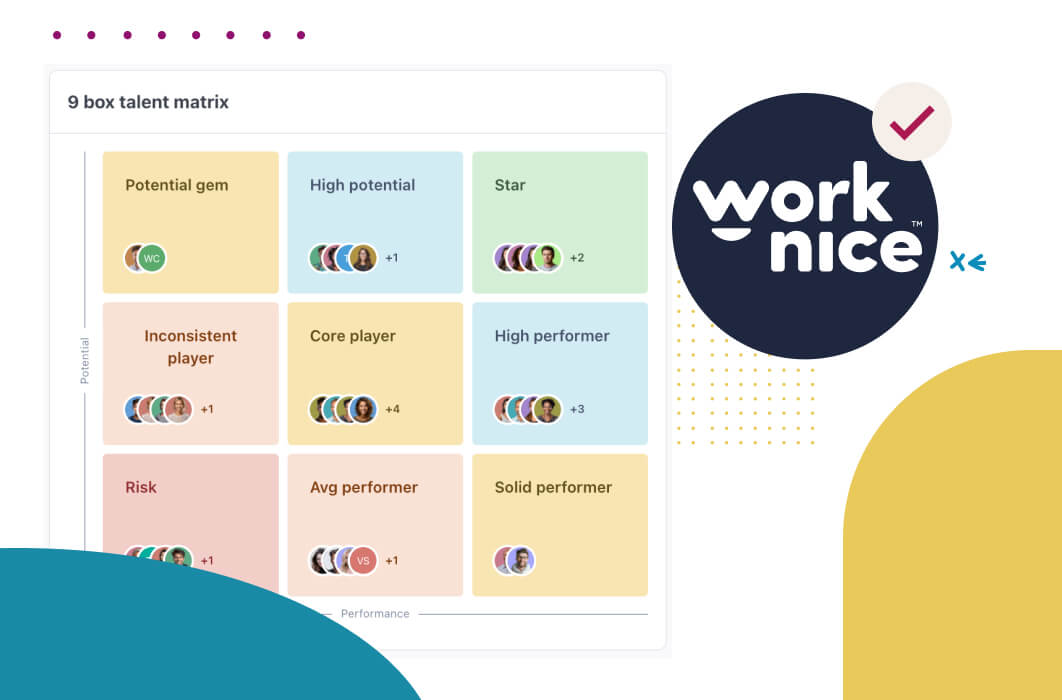
A fair caveat: Worknice focuses on practical performance reviews rather than deep specialist talent frameworks. So if you need advanced succession modelling or complex nine-box calibration at enterprise scale, a dedicated talent suite may fit better. For most mid-sized teams, though, integrated reviews are the higher-adoption path. You can explore them in a free demonstration.
Frequently asked questions
What is a performance review platform?
A performance review platform is software that runs your review cycles from start to finish. It builds review forms, sends them to managers and employees, collects self and manager assessments, supports calibration, and stores the results. As a result, reviews follow a consistent, trackable process, rather than a scramble of documents and email each cycle.
How does a performance review cycle work?
A cycle runs in four stages. In setup, HR configures the questions, scale, and timeline. In assessment, employees and managers complete their reviews. In calibration, leaders compare ratings for fairness. Finally, outcomes are shared, recorded, and linked to development or pay. A platform drives each stage automatically, sending forms, tracking completion, and chasing anyone overdue.
What is calibration in performance reviews?
Calibration is the process of comparing ratings across managers to keep them fair. Without it, one manager rates generously and another harshly, so the same performance gets different scores. Calibration aligns leaders on standards, so a rating means the same thing organisation-wide. A review platform makes this practical by presenting ratings side by side and highlighting outliers.
Are annual performance reviews still effective?
Annual reviews alone are rarely effective. According to Gallup, only 14% of employees strongly agree their reviews inspire them to improve. The problem is the once-a-year, backward-looking format. Reviews work far better when paired with regular check-ins and grounded in clear goals, so the formal cycle summarises an ongoing conversation rather than delivering surprises.
Should performance reviews be part of the HRIS?
For most mid-sized companies, yes. Reviews rely on accurate roles, managers, and reporting lines that already live in the HRIS, so a built-in platform reads that data directly. It also gives employees one familiar system, which lifts adoption, and lets review outcomes feed your wider people analytics. A standalone tool mainly suits specialised, enterprise-scale talent needs.
About the author
Graham Martin is a co-founder of Worknice, an Australian next-gen HRIS. Since 2021 he has worked with hundreds of Australian HR leaders and people teams. He helps mid-sized organisations run fair, useful performance reviews connected to their people data.
Related reading
- How to choose performance management software: what performance software should cover across reviews, check-ins, goals and feedback, and how to pick one people actually use.
- Should employees see their 9-box rating: what to share with employees after a review or talent calibration, and what to hold back.
- HRIS platforms with built-in performance modules: a 2026 comparison of the HRIS platforms that run performance reviews natively, for teams weighing a module against a standalone tool.
Sources
- Gallup. “Give Performance Reviews That Actually Inspire Employees.” https://news.gallup.com/opinion/gallup/219863/give-performance-reviews-actually-inspire-employees.aspx
- Gallup. “How Fast Feedback Fuels Performance.” https://www.gallup.com/workplace/357764/fast-feedback-fuels-performance.aspx
- G2. “Worknice Reviews.” https://www.g2.com/products/worknice/reviews
- Capterra Australia. “Worknice Cost & Reviews.” https://www.capterra.com.au/software/208362/worknice