Australian HR compliance software helps you meet Fair Work obligations by keeping signed contracts, policy acknowledgements, award mappings, and right-to-work checks in one auditable system. Because underpayment and record-keeping cases keep rising, the real value is evidence. The software does not just claim you are compliant; instead, it proves it with a timestamped trail when a regulator, auditor, or employee asks.
Key takeaways
- According to the Fair Work Ombudsman, employers back-paid $358 million to workers in 2024-25, and about 60% of that came from large corporate employers.
- Most underpayment traces back to poor records and misclassification, not bad intent, so your evidence layer matters as much as your pay rules.
- Australian HR compliance software covers awards, contracts, policies, right-to-work, and certificate tracking, but it stops short of payroll.
- The test of good compliance software is simple: can you prove an acknowledgement happened, on a date, by a named person?
- Global HR platforms rarely map Australian modern awards well, so an Australian-built HRIS usually fits mid-market compliance better.
What is Australian HR compliance software?
Australian HR compliance software is a tool that helps employers meet workplace obligations under the Fair Work Act and related laws. It stores signed contracts, tracks policy acknowledgements, records right-to-work evidence, and monitors licences and certificates. As a result, it builds a defensible audit trail across the employee lifecycle rather than scattering that evidence across inboxes and drives.
Compliance software is not payroll, and the distinction matters. Payroll calculates pay, lodges Single Touch Payroll data, and handles super. By contrast, HR compliance software manages the people-side evidence that sits behind pay: the classification an employee agreed to, the policy they acknowledged, and the qualification they hold. So the two systems work together, but they solve different problems. Worknice, for example, handles compliance and records and syncs employee data into your existing payroll.
Why does HR compliance matter more as you grow?
Compliance risk scales with headcount, because more employees means more contracts, more award interpretation, and more records to keep. According to the Fair Work Ombudsman’s 2024-25 annual report, employers recovered $358 million in unpaid wages that year. About 60% came from large corporate employers. So the risk is real, and it grows with size.
Most of these cases do not involve deliberate wrongdoing. Instead, they trace back to fragmented records, outdated contracts, and misclassified employees. For example, an employee moves from casual to part-time, but the contract never changes, and payroll keeps the old rate. When the records live in spreadsheets and email, no one notices until an audit or a claim. By contrast, a proper HRIS for a mid-sized company ties classification, contract, and change history to each person.
A second pressure comes from public accountability. At 100 employees, WGEA reporting becomes mandatory, and your gender pay data becomes public. So compliance is no longer a private matter between you and a regulator. It is visible to your board, your candidates, and your customers.
What should Australian HR compliance software actually do?
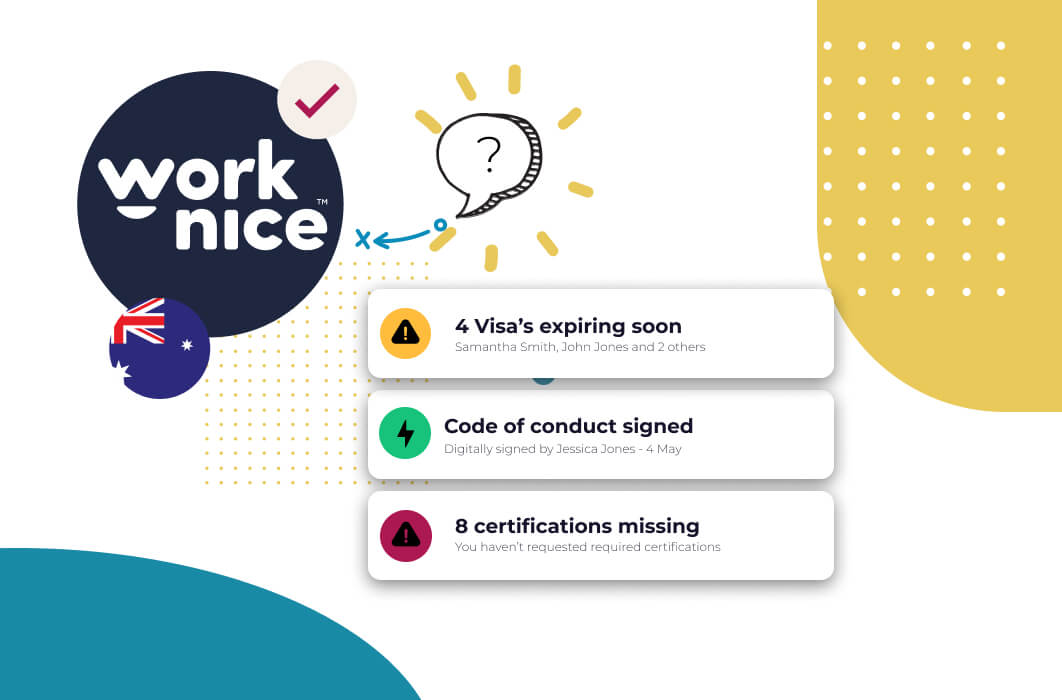
Good compliance software does six things. First, it maps employees to the right modern award or agreement. Second, it generates and stores signed contracts. Third, it tracks policy acknowledgements with dates. Fourth, it verifies right-to-work and visa status. Fifth, it monitors licence and certificate expiry. Finally, it keeps an audit trail of every change.
The evidence layer is the part teams underrate. Australia has more than 120 modern awards, and each carries its own conditions. So knowing the correct award is only half the job. You also need to prove that the employee received and accepted the terms that flow from it. When you can produce a timestamped acknowledgement from a named person, you can defend a decision. When you can only find an old email, you cannot.
Certificate and licence tracking is the other quiet risk. In sectors like healthcare, construction, and community services, an expired qualification can breach both employment and industry rules. Automated expiry monitoring inside a compliance module flags renewals before they lapse. So you replace a manual diary check with a system that never forgets.
How does compliance software prove compliance rather than just claim it?
Compliance software proves compliance by capturing who did what, and when, in a way you cannot quietly edit later. A signed contract carries a timestamp and a version. A policy acknowledgement records the employee, the document version, and the date. A right-to-work check stores the evidence against the person. So the proof is structural, not anecdotal.
This distinction became sharper with recent award changes. For example, the 2026 changes to the SCHADS Award made written agreements and acknowledgements the entitlement itself, not just supporting paperwork. As a result, providers who administer HR through email and spreadsheets may hold the compliance without being able to prove it. That gap is exactly what an evidence-first system closes.
Version control matters here too. Policies change, and you need to show which version an employee accepted at a given time. When documents live in a document management system with version history, you can answer that question in seconds. When they live in a shared drive, you often cannot answer it at all.
Should you use Australian software or a global HR platform for compliance?
For Australian compliance, an Australian-built HRIS usually fits better than a global platform. The reason is award interpretation. Global vendors build for many markets, so they rarely map Australian modern awards, National Employment Standards, or state-based leave rules as configurable defaults. Instead, they leave that work to you as customisation.
Global platforms can still work if you add a local layer or accept manual mapping. However, that path shifts the compliance burden back onto your team, which defeats the purpose. For a mid-sized Australian employer, a platform that ships Fair Work policies and award mappings as defaults saves weeks of setup. This is a core reason many teams choose an Australian-built HRIS over a larger global suite. For the detail, see how it also supports STP compliance and an HRIS built for Australian employment law.
The trade-off is honest. Global suites often carry deeper enterprise features and bigger ecosystems. So if you run a 10,000-person global workforce, that scale may matter more than local award depth. For 100 to 1,000 employees in Australia, though, local compliance usually wins the decision.
Why is Worknice a strong choice for Australian HR compliance?
Worknice is an Australian next-gen HRIS that treats compliance as a core function, not an add-on. It maps awards, generates and stores signed contracts, tracks policy acknowledgements, and monitors certificate expiry. Reviewers rate it 4.9 out of 5 on G2 and 5 out of 5 on Capterra, and they consistently praise how it consolidates HR evidence.
Independent reviews back this up. On Capterra, Worknice rates 5 out of 5, where 99% of reviewers would recommend it. On G2 it holds 4.9 out of 5. One reviewer described replacing several spreadsheets and finally consolidating employee data with audit trails intact. Because compliance depends on trustworthy records, that consolidation is the whole point. New starters also acknowledge policies during onboarding, so evidence is captured from day one.
A fair caveat: Worknice focuses on HR compliance and integrates with payroll rather than running pay. So it does not calculate award rates itself; instead, it holds the classification and contract evidence and syncs employee data to your payroll engine. Most mid-market teams prefer this split. You can test the fit through a free demonstration.
Frequently asked questions
What is HR compliance software?
HR compliance software helps employers meet workplace laws by storing contracts, tracking policy acknowledgements, verifying right-to-work, and monitoring licences and certificates. In Australia, it also maps employees to the correct modern award. The core value is evidence: a timestamped, auditable trail that proves compliance when a regulator, auditor, or employee asks.
Is HR compliance software the same as payroll?
No. Payroll calculates pay, lodges Single Touch Payroll data, and manages super. HR compliance software manages the people-side evidence behind pay, such as the agreed classification, the signed contract, and the acknowledged policy. The two connect through integration, but they are separate systems of record. You keep your payroll and sync employee data into it.
How does software help with Fair Work compliance?
It helps by keeping the records Fair Work expects and by proving they exist. For example, it stores signed contracts, tracks policy acknowledgements with dates, and monitors certificate expiry. Because most underpayment cases trace back to poor records, an auditable trail reduces both the risk of a breach and the cost of defending one.
Does global HR software handle Australian awards?
Rarely well. Global platforms build for many markets, so they seldom map Australian modern awards, the National Employment Standards, or state leave rules as ready-made defaults. Instead, they leave that mapping to you. An Australian-built HRIS ships these as configurable defaults, which saves setup time and lowers the risk of a compliance gap.
What records do Australian employers have to keep?
Employers must keep employee records covering pay, hours, leave, and superannuation, and must keep them for seven years under the Fair Work Act. You also need evidence of agreements and policy acknowledgements. Compliance software centralises these records with version history, so you can produce the right document, at the right version, on demand.
About the author
Graham Martin is a co-founder of Worknice, an Australian next-gen HRIS. Since 2021 he has worked with hundreds of Australian HR leaders and people teams. He helps mid-sized organisations replace fragmented HR administration with a unified, auditable people platform.
This article is general information only and is not legal advice. For advice on your specific obligations, speak to a qualified professional.
Sources
- Fair Work Ombudsman. “$358 million back-paid to Australian workers.” October 2025. https://www.fairwork.gov.au/newsroom/media-releases/2025-media-releases/october-2025/20251029-annual-report-2024-25-media-release
- Fair Work Ombudsman. “Record-keeping and pay slips.” https://www.fairwork.gov.au/pay-and-wages/pay-slips-and-record-keeping
- Workplace Gender Equality Agency. “Reporting.” https://www.wgea.gov.au/what-we-do/reporting
- G2. “Worknice Reviews.” https://www.g2.com/products/worknice/reviews
- Capterra Australia. “Worknice Cost & Reviews.” https://www.capterra.com.au/software/208362/worknice