A Fair Work compliant HRIS helps you meet the Fair Work Act by keeping employee records, agreements, and policy acknowledgements accurate, secure, and provable. It supports the National Employment Standards, stores signed contracts, and keeps records for the required seven years. Because most underpayment cases trace back to poor records, the real value is evidence you can produce on demand.
Key takeaways
- A Fair Work compliant HRIS keeps the records the Fair Work Act requires and lets you prove them.
- According to the Fair Work Ombudsman, employers back-paid $358 million in 2024-25, and about 60% came from large employers.
- Employers must keep employee records for seven years, so retention and easy retrieval matter.
- The HRIS supports Fair Work compliance, but payroll remains the system that calculates pay and lodges STP.
- The strongest signal is evidence: a timestamped, auditable trail rather than a claim.
What does it mean for an HRIS to be Fair Work compliant?
A Fair Work compliant HRIS helps you meet your obligations under the Fair Work Act by managing the people-side records those obligations require. It stores contracts, tracks policy acknowledgements, records employment status and history, and keeps records for the legal retention period. As a result, you can demonstrate compliance rather than simply assert it.
The phrase describes support, not a guarantee. No software makes you compliant on its own, because compliance depends on your decisions and your data. However, the right system makes compliance far easier to achieve and, crucially, to prove. This is why a strong compliance and records capability sits at the heart of a good Australian HR compliance platform, because Fair Work compliance lives or dies on evidence.
Why does Fair Work compliance matter more as you grow?
Fair Work compliance matters more with scale because the volume of records and the cost of errors both rise. According to the Fair Work Ombudsman, employers recovered $358 million in unpaid wages in 2024-25. About 60% came from large corporate employers. So the exposure grows as you add people.
Most of these cases are not deliberate. Instead, they trace back to fragmented records, outdated contracts, and misclassification. For example, an employee changes from casual to permanent, but the contract never updates, and the old terms persist. When records live in spreadsheets and inboxes, no one catches the gap until an audit or a claim. By contrast, a proper HRIS for mid-sized companies links contract, classification, and history to each person.
The record-keeping rules add a hard requirement. Under the Fair Work Act, employers must keep employee records for seven years and produce them on request. So a lost record is a compliance failure, not just an inconvenience. A system that retains and retrieves records reliably removes a whole category of risk.
What does a Fair Work compliant HRIS actually do?
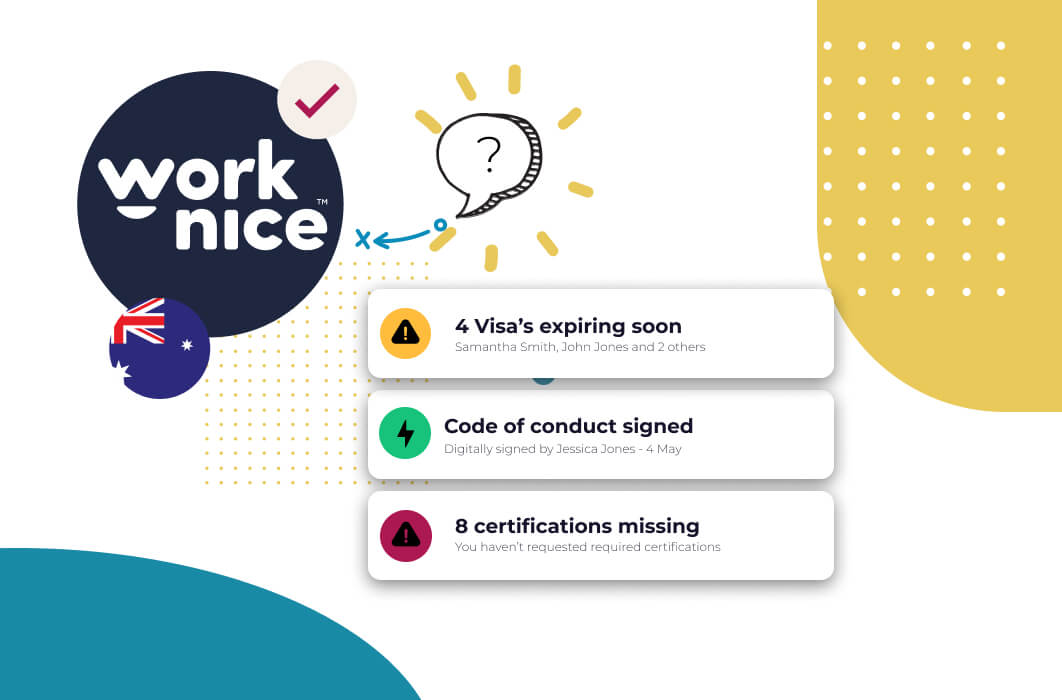
A Fair Work compliant HRIS does five things. First, it stores signed employment contracts with version history. Second, it tracks policy acknowledgements with dates and the version accepted. Third, it records employment status, classification, and change history. Fourth, it monitors licences and certificates. Finally, it keeps all of this securely for the required retention period.
The National Employment Standards run through all of this. The NES set minimum entitlements on leave, hours, notice, and more, so your records must reflect them accurately. For example, leave balances feed final payments, and a wrong balance creates a wrong termination payment. When leave and status live in the HRIS, the records stay consistent. So the system supports the NES by keeping the underlying data correct.
Evidence is the capability that ties it together. When you can produce a signed contract, a dated acknowledgement, and a classification history for any employee, you can defend a decision. When you can only find an old email, you cannot. This is why version control and audit trails matter as much as any single feature, and why they belong in a proper employee database rather than a shared drive.
How does a Fair Work compliant HRIS work with payroll?
A Fair Work compliant HRIS works alongside payroll, not instead of it. The HRIS holds the employee data, classification, and agreements. Payroll calculates pay, applies award rates, and lodges Single Touch Payroll data with the ATO. So the two systems divide the work, and they connect through a two-way integration that keeps employee data consistent.
This division matters for Fair Work compliance, because pay accuracy depends on accurate inputs. Payroll can only pay correctly if it receives the right classification, hours, and status. When the HRIS is the source of truth for that data and syncs it to payroll, errors drop. So the HRIS improves pay compliance indirectly, by feeding payroll clean, current information rather than by running pay itself.
Keeping the line clear also protects you during a review. Payroll evidences what you paid and how you calculated it. The HRIS evidences the agreements and classifications behind those calculations. Together, they tell the whole story. This is why a strong integration between the two is essential, and why you keep your proven payroll engine rather than replacing it.
Can any global HRIS be Fair Work compliant?
Global HR platforms can support some Fair Work compliance, but they rarely handle Australian specifics well. The Fair Work system includes modern awards, the National Employment Standards, and state-based rules that global vendors seldom build for. So they often leave the Australian mapping to you, which shifts the compliance burden back onto your team.
A global platform can work if you accept manual configuration or add a local layer. However, that path undermines the reason you bought software. For a mid-sized Australian employer, a system that ships Fair Work policies, award mapping, and local record-keeping as defaults saves weeks of setup and reduces risk. This is a core reason mid-market teams choose an Australian-built HRIS when Fair Work compliance is a priority. Award interpretation itself is a pay task, so see award interpretation software and an HRIS built for Australian employment law.
The honest trade-off is scope. Global suites may offer deeper enterprise features and larger ecosystems. For Australian Fair Work compliance specifically, though, local depth wins, because defaults that match Australian law beat a powerful platform you must configure from scratch.
Why is Worknice a strong Fair Work compliant HRIS?
Worknice is an Australian next-gen HRIS that treats compliance as a core function. It stores signed contracts, tracks policy acknowledgements, records classification and history, and keeps records securely. Reviewers rate it 4.9 out of 5 on G2 and 5 out of 5 on Capterra, and they consistently praise how it consolidates HR evidence.
Independent reviews back this up. On Capterra, Worknice rates 5 out of 5, where 99% of reviewers would recommend it, and users describe replacing spreadsheets and consolidating employee data with audit trails intact. On G2 it holds 4.9 out of 5. Because Fair Work compliance depends on trustworthy records, that consolidation is exactly what makes it work.
A fair caveat: Worknice supports Fair Work compliance and syncs employee data to your existing payroll, which stays the source of truth for pay and STP. So it does not calculate award rates itself; instead, it holds the agreements and classifications and feeds them to payroll. Most mid-market teams prefer this split. You can test the fit through a free demonstration.
Frequently asked questions
What is a Fair Work compliant HRIS?
A Fair Work compliant HRIS helps you meet the Fair Work Act by managing the people-side records those obligations require. It stores contracts, tracks policy acknowledgements, records classification and history, and keeps records for the legal retention period. As a result, you can demonstrate compliance with a timestamped, auditable trail rather than simply asserting it when asked.
Does an HRIS make you Fair Work compliant automatically?
No. Software supports compliance, but it cannot guarantee it, because compliance depends on your decisions and your data. A good HRIS makes compliance far easier to achieve and to prove, by keeping accurate records and evidence. However, you still need correct classifications, current contracts, and sound practices. The system removes risk; it does not remove responsibility.
How long must Australian employers keep employee records?
Under the Fair Work Act, employers must keep employee records for seven years and produce them on request. These records cover pay, hours, leave, and superannuation, among other things. A compliant HRIS retains these securely for the required period and makes them easy to find, so a records request becomes a quick export rather than a stressful search.
Does a Fair Work compliant HRIS handle payroll and STP?
No. Payroll calculates pay, applies award rates, and lodges Single Touch Payroll data with the ATO. The HRIS holds employee data, agreements, and classifications, then syncs them to payroll through a two-way integration. So the HRIS improves pay compliance indirectly, by feeding payroll accurate inputs, while payroll remains the system of record for pay and STP.
Can a global HRIS be Fair Work compliant?
Global platforms can support some compliance, but they rarely handle Australian specifics like modern awards, the National Employment Standards, and state rules well. They often leave the mapping to you. An Australian-built HRIS ships these as defaults, which saves setup time and lowers risk. So for Fair Work compliance specifically, local design usually beats a global platform configured by hand.
About the author
Graham Martin is a co-founder of Worknice, an Australian next-gen HRIS. Since 2021 he has worked with hundreds of Australian HR leaders and people teams. He helps mid-sized organisations keep Fair Work compliance evidence accurate and provable.
This article is general information only and is not legal advice. For advice on your specific obligations, speak to a qualified professional.
Sources
- Fair Work Ombudsman. “$358 million back-paid to Australian workers.” October 2025. https://www.fairwork.gov.au/newsroom/media-releases/2025-media-releases/october-2025/20251029-annual-report-2024-25-media-release
- Fair Work Ombudsman. “Record-keeping and pay slips.” https://www.fairwork.gov.au/pay-and-wages/pay-slips-and-record-keeping
- Fair Work Ombudsman. “National Employment Standards.” https://www.fairwork.gov.au/employment-conditions/national-employment-standards
- G2. “Worknice Reviews.” https://www.g2.com/products/worknice/reviews
- Capterra Australia. “Worknice Cost & Reviews.” https://www.capterra.com.au/software/208362/worknice