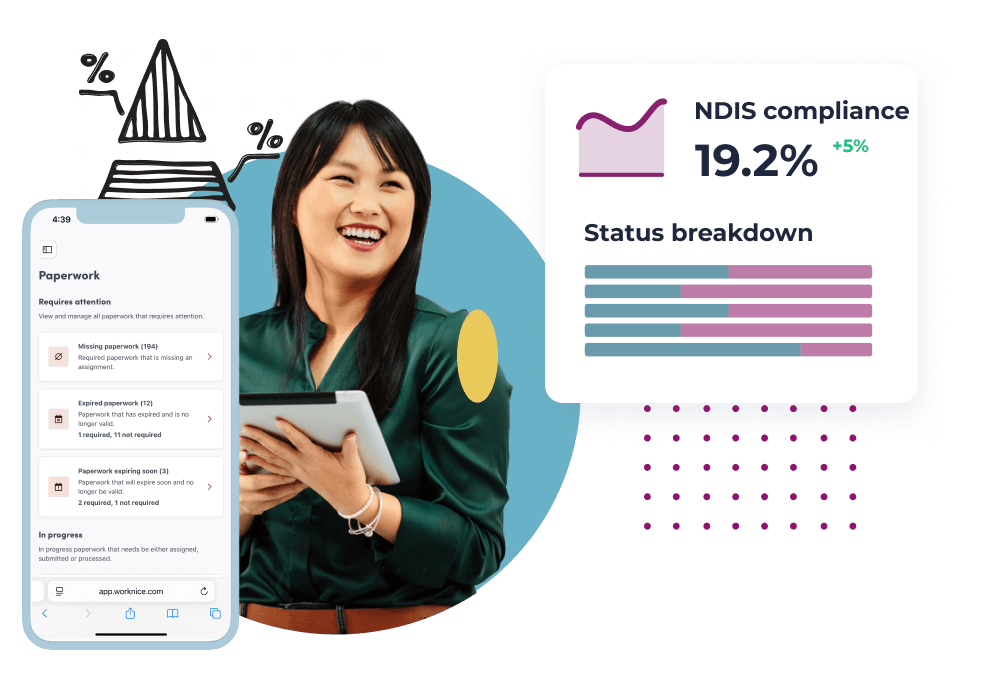
TL;DR: An NDIS compliance paperwork matrix lists the checks, qualifications, and training each role needs, then shows which workers hold them. Registered providers must screen workers in risk-assessed roles and keep written records of those roles and workers. At audit, they must also evidence induction, the mandatory orientation module, and ongoing training.
Key takeaways
- An NDIS Worker Screening Check lasts up to 5 years, and renewal can start 90 days before expiry.
- Registered providers must update their written record of risk-assessed roles within 20 business days of identifying a new one.
- Records of workers in risk-assessed roles must be kept for 7 years, even after a worker leaves.
- The NDIS Commission describes its worker orientation module as mandatory for staff of registered NDIS providers.
- The NDIS Code of Conduct applies to registered and unregistered providers, their key personnel, and their workers.
What is in this paperwork matrix?
The matrix maps NDIS compliance paperwork against each role in your organisation. It shows which checks, licences, and training modules a role requires. As a result, you can track requirements in one place and see who is missing what. Download it, list your own roles down the side, and mark each worker against every requirement that applies.
Download the matrix
What paperwork does an NDIS provider need for each worker?
Each worker needs evidence of identity, right to work, pre-employment checks, and relevant qualifications. Induction records and completion of the NDIS worker orientation module are also expected. Workers in risk-assessed roles also need an NDIS Worker Screening clearance. The NDIS Practice Standards then expect ongoing training, supervision, and documented performance management for every worker.
The exact list depends on the supports you deliver and how risky they are. Providers of higher-risk supports are audited against the core module of the NDIS Practice Standards. Its human resource management outcome asks for these indicators, among others:
- Role definitions: the skills, knowledge, responsibilities, scope, and limitations of each position are documented.
- Pre-employment records: records of each worker’s pre-employment checks, qualifications, and experience are maintained.
- Induction: an orientation and induction process is completed, including the mandatory NDIS worker orientation program.
- Training system: training is identified, planned, recorded, and evaluated, and mandatory training is identified.
- Supervision and performance: workers receive timely supervision, and their performance is managed, developed, and documented.
- Infection control: all workers supporting participants complete infection prevention and control training, including refreshers.
- Worker details: each worker’s contact details and any secondary employment are recorded and kept up to date.
By contrast, providers of lower-risk supports are assessed against the shorter verification module. It still expects records of worker identity, right to work, pre-employment checks, and qualifications or experience. In addition, it asks for completion of the orientation module and records of continuing professional development. Workers also need infection control training, and those supporting participants directly need training in personal protective equipment.
For a broader view of how these records fit into HR systems, see what Australian HR compliance software does.
Which roles need an NDIS Worker Screening Check?
Workers in risk-assessed roles at a registered NDIS provider need an NDIS Worker Screening clearance. A role is risk-assessed if it is a key personnel role or directly delivers specified supports. It also qualifies if it is likely to need more than incidental contact with people with disability. Staff, volunteers, contractors, and students can all fall into these roles.
According to the NDIS Commission, “more than incidental contact” includes physically touching a person with disability. It also covers building rapport as a normal part of the role, or contact with several participants in a specialist setting. Contact can be face to face, oral, written, or electronic. Key personnel include the CEO, board members, executives, and managers who direct the provider’s activities.
The Commission’s own examples make the line clearer. A worker who delivers and adjusts mobility equipment in a participant’s home needs a clearance. That role builds rapport and trust. However, a back office accountant who only nods hello in the lobby does not. Meanwhile, an HR executive on the board needs one as key personnel, even without direct contact.
Unregistered providers are not legally required to have their workers screened, although the NDIS Commission recommends it. Registered providers, by contrast, must identify their risk-assessed roles and keep a record of them. That record is where the matrix starts.
What worker screening records must registered providers keep?
Registered providers must keep a written record of their risk-assessed roles, plus an up-to-date record of every worker in one. The worker record must outlast the portal link, so it survives a worker leaving. It must also be kept for 7 years, and be organised, accessible, and legible.
The record of risk-assessed roles
According to the NDIS Commission, each entry in the record of roles must include the title and a description of the role. It must also cite the paragraph of the risk-assessed role definition in the Worker Screening Rules that applies. Finally, it records the date of the assessment, and the name and title of the person who made it.
You must update the record within 20 business days of identifying a new risk-assessed role. The same deadline applies when you reclassify an existing role. So a new service line or position means updating the role record as well as the position description.
The record of workers in risk-assessed roles
For every worker in a risk-assessed role, record their full name, date of birth, address, and roles. The record also covers any interim bar, suspension, or exclusion, and any action the provider took. Allegations of misconduct belong there too, with the provider’s response. Where a worker holds a clearance, add the application reference, the clearance number, and the expiry date.
Some workers need extra detail in their record. For instance, a worker starting while their application is assessed needs the reason, the dates, and any supervisor’s name. They also need a risk management plan for that period. Similarly, a contractor’s record shows how the contract is administered and the steps taken to confirm their clearance.
How long does an NDIS Worker Screening Check last?
An NDIS Worker Screening Check is valid for up to 5 years from the date of issue, unless cancelled or revoked. Workers can apply to renew it up to 90 days before it expires, through the screening unit in their home state or territory. Because the clearance is national, moving interstate does not require a new check.
Employers linked to a worker in the NDIS worker screening database are notified when that worker’s check is expiring. Even so, the expiry date belongs in your own records too. The worker record must be kept for 7 years, so it cannot rely on the portal alone. A matrix that shows expiry dates by month makes upcoming renewals visible well before the 90-day window opens. For practical approaches, see tracking expiry dates on HR paperwork.
Two other points vary by jurisdiction, so check them for each state you operate in. First, some states and territories let a worker start while their application is assessed, and others do not. Second, the NDIS Commission notes that a role may also need a Working with Children Check, which each state runs under its own scheme. Check both before a worker’s first shift.
What training must NDIS workers complete?
Workers at registered NDIS providers must complete the Commission’s orientation module, “Quality, safety and you”. It explains their obligations under the NDIS Code of Conduct. Providers must also run a system to identify, record, and evaluate training, including any mandatory training. Infection prevention and control training applies to all workers who support participants.
The orientation module is free and online, and workers receive a certificate of completion to share with their employer. As a result, the certificate is the evidence to keep against each worker in the matrix. The Commission’s guide on training workers adds that providers should build the module into induction and encourage existing workers to complete it over time.
The NDIS Code of Conduct itself sets eight obligations for people delivering NDIS supports. They cover respecting individual rights and privacy, providing supports safely and competently, and acting with integrity, honesty, and transparency. They also cover raising concerns promptly, and preventing violence, exploitation, neglect, abuse, and sexual misconduct. The eighth bars charging participants higher prices without reasonable justification. Because the Code applies to registered and unregistered providers alike, every worker should acknowledge it in writing.
Beyond the mandatory items, role-specific training depends on the supports delivered. For example, a worker providing mealtime support may need training in safe swallowing practice. The NDIS Commission offers free modules on supporting safe and enjoyable meals and supporting effective communication.
How do you build an NDIS paperwork matrix by role?
Build the matrix with roles down one side and requirements across the top. Then mark which requirements apply to each role. Next, add each worker, record the date and expiry of every item, and flag anything missing or due. Finally, review the whole matrix monthly, and again before every audit.
A practical sequence looks like this:
- List your roles, using the same titles as your record of risk-assessed roles.
- List the requirements, such as screening, orientation, qualifications, licences, and infection control.
- Mark what applies, because a support worker, a therapist, and an administrator need different items.
- Add each worker with their role, the date each item was completed, and any expiry date.
- Assign owners to chase renewals, verify certificates, and update the role record.
Suppose a provider opens a new supported independent living house. The new team leader role is risk-assessed, so the role record is updated within 20 business days. Every new support worker then appears in the matrix with screening, orientation, infection control, and any high intensity support training marked as required. Gaps show up before the first shift. They no longer wait for the next audit.
When is a spreadsheet matrix no longer enough?
A spreadsheet matrix stops being enough when workers change roles often or expiry dates span hundreds of people. It also struggles once the record lives in several copies. At that point, the work shifts from knowing the requirements to chasing documents and reminders. Compliance software ties requirements to roles and flags gaps automatically.
For a small team with stable roles, a well-kept matrix is genuinely sufficient. However, at 200 workers or more, manual tracking tends to miss renewals. Meanwhile, the 7-year record has to stay intact through staff turnover. If you are comparing options, the best HRIS for an NDIS provider sets out what to look for.
Worknice is one option for NDIS providers of 200 to 5,000 employees that want this paperwork in their HR system. It ties required paperwork to compliance groups, flags people at risk on the people list, and can assign missing paperwork. It integrates with payroll rather than replacing it. So a provider wanting rostering, payroll, and NDIS billing in one product may prefer an all-in-one care platform.
Frequently asked questions
What is an NDIS compliance checklist?
An NDIS compliance checklist lists the records a provider needs to show it meets its obligations. For workers, it usually covers identity and right to work, pre-employment checks, qualifications, NDIS Worker Screening clearances for risk-assessed roles, the mandatory orientation module, Code of Conduct acknowledgement, infection control training, and role-specific training, each with dates and expiry.
Who needs an NDIS Worker Screening Check?
Workers in risk-assessed roles at a registered NDIS provider need a clearance. That includes key personnel, such as the CEO and board members, and anyone directly delivering specified supports or likely to have more than incidental contact with people with disability. Unregistered providers can choose to require checks for their workers.
How long is an NDIS Worker Screening Check valid for?
An NDIS Worker Screening Check is valid for up to 5 years from the date of issue, unless it is cancelled or revoked. Workers can apply to renew it up to 90 days before it expires. The check is recognised nationally, so a worker who moves interstate does not need to reapply.
Is the NDIS worker orientation module mandatory?
Yes, for staff of registered NDIS providers. The NDIS Commission describes its “Quality, safety and you” orientation module as mandatory for them, and the NDIS Practice Standards expect induction to include it. It is free, online, and self-paced, and workers receive a certificate of completion they can share with their employer.
How long must NDIS providers keep worker screening records?
Registered NDIS providers must keep their written record of each worker engaged in a risk-assessed role for 7 years. The record must still exist after the worker is unlinked in the NDIS Commission portal, and it must be organised, accessible, and legible. The separate record of risk-assessed roles must be kept up to date.
Related reading
- SCHADS Award changes for NDIS providers
- Organising your HR paperwork
- HR software for healthcare and care providers
Sources
- NDIS Quality and Safeguards Commission. “Worker screening.” Last updated 28 August 2026. Retrieved 8 October 2026. https://www.ndiscommission.gov.au/workforce/worker-screening
- NDIS Quality and Safeguards Commission. “Worker screening for registered providers.” Last updated 27 May 2026. Retrieved 8 October 2026. https://www.ndiscommission.gov.au/workforce/worker-screening/worker-screening-registered-providers
- NDIS Quality and Safeguards Commission. “NDIS Practice Standards.” Last updated 25 June 2026. Retrieved 8 October 2026. https://www.ndiscommission.gov.au/rules-and-standards/ndis-practice-standards
- NDIS Quality and Safeguards Commission. “Core module: provider governance and operational management.” Last updated 10 October 2024. Retrieved 8 October 2026. https://www.ndiscommission.gov.au/rules-and-standards/ndis-practice-standards/core-module-provider-governance-and-operational
- NDIS Quality and Safeguards Commission. “Verification module.” Last updated 1 December 2025. Retrieved 8 October 2026. https://www.ndiscommission.gov.au/rules-and-standards/ndis-practice-standards/verification-module
- NDIS Quality and Safeguards Commission. “NDIS Code of Conduct.” Last updated 25 May 2026. Retrieved 8 October 2026. https://www.ndiscommission.gov.au/rules-and-standards/ndis-code-conduct
- NDIS Quality and Safeguards Commission. “Worker training modules.” Last updated 23 July 2026. Retrieved 8 October 2026. https://www.ndiscommission.gov.au/workforce/online-training-modules
- NDIS Quality and Safeguards Commission. “Worker screening for unregistered providers.” Last updated 1 December 2025. Retrieved 8 October 2026. https://www.ndiscommission.gov.au/workforce/worker-screening/worker-screening-unregistered-providers
- NDIS Quality and Safeguards Commission. “Training your workers.” Last updated 1 May 2026. Retrieved 8 October 2026. https://www.ndiscommission.gov.au/workforce/training-workers/guide-for-ndis-providers/training-your-workers
Need automated paperwork?
See how Worknice automates paperwork;
1 – onboard new hires with pre configured paperwork groups
2 – manage expiring soon and expired paperwork ongoing
3 – know paperwork gaps – who is missing something they are required to have?