Employee onboarding software automates the new-hire journey, from the signed contract and pre-boarding through to day-one tasks, IT setup, and payroll sync. Because only 12% of employees say their employer onboards them well, and because weak onboarding drives early turnover, the software matters most once you hire regularly. For a mid-sized company, it turns a manual checklist into a repeatable, compliant workflow.
Last updated 24 September 2026.
Key takeaways
- According to Gallup, only 12% of employees strongly agree their organisation does a great job onboarding new hires.
- Employees who had an exceptional onboarding experience are 2.6 times more likely to be extremely satisfied at work, Gallup found.
- Onboarding software matters once you hire often, because manual onboarding does not scale past a handful of new starters a month.
- The best tool automates tasks, collects compliance evidence, and syncs the new starter to payroll, all from one workflow.
- Onboarding is one workflow among many, so choose a tool that also handles role changes and offboarding.
What is employee onboarding software?
Employee onboarding software is a tool that automates the steps between accepting an offer and becoming a productive employee. It sends contracts for signature, collects personal and compliance details, assigns day-one tasks, and triggers IT and equipment setup. As a result, every new hire follows the same reliable process instead of a manual, memory-based checklist.
Good onboarding software does more than send a welcome email. Instead, it coordinates HR, the hiring manager, IT, and payroll around one workflow. For example, a signed contract can automatically create the employee record, order a laptop, assign compliance policies, and notify payroll. When those steps live in an onboarding platform, nothing falls through the cracks. When they live in someone’s head, new starters often arrive to no desk, no logins, and no plan.
Why does onboarding matter for retention?
Onboarding matters because the first weeks shape whether a new hire stays. According to Gallup, only 12% of employees strongly agree their organisation does a great job onboarding. That gap is costly, because weak onboarding weakens the bond between the new hire and the company. So people who feel lost early are more likely to leave early.
The upside is just as clear. Gallup found that employees who had an exceptional onboarding experience are 2.6 times more likely to be extremely satisfied with their workplace. Moreover, when managers take an active role, employees are 3.4 times as likely to say their onboarding was exceptional. So onboarding is not a paperwork exercise. Instead, it is one of the highest-leverage moments in the employee lifecycle.
Turnover makes the stakes concrete. Replacing an employee often costs around half their annual salary or more once you count recruitment, lost productivity, and ramp time. Because a poor start raises early attrition, better onboarding protects that investment. A structured, welcoming process is therefore a retention tool, not just an admin one.
What should employee onboarding software actually do?
Strong onboarding software covers five jobs. First, it handles offers and contracts with e-signature. Second, it runs pre-boarding, so new starters complete forms before day one. Third, it assigns and tracks tasks across HR, IT, and the manager. Fourth, it collects compliance items like policies and right-to-work. Finally, it syncs the new employee to payroll. A built-in new hire onboarding checklist makes each of these steps visible.
Pre-boarding is the quiet win. When a new hire signs, provides bank and super details, and acknowledges key policies before their first day, day one becomes about the team, not the forms. So the person feels welcomed rather than processed. The timing matters more since Payday Super began on 1 July 2026: a new employee’s first super contribution must reach their fund within 20 business days after payday, so a missing or wrong fund detail is now a deadline problem, not just an admin one. This is also where onboarding overlaps with compliance, because you capture acknowledgements and qualifications at the exact moment you have the person’s attention.
Document handling is the other essential. Contracts, policy packs, and signed forms should flow into secure digital employee files automatically. As a result, you never chase a missing signature months later. The payroll sync then closes the loop, because the new starter’s details move into your existing payroll without re-keying. Running this online is what digital onboarding delivers.
How do automated onboarding workflows work?
Automated onboarding workflows work by triggering a chain of tasks from a single event, usually the signed contract. The workflow assigns each task to the right owner, sets due dates, and sends reminders. If a step stalls, it escalates. So instead of one HR coordinator manually nudging five people, the system drives the process to completion.
Consider a practical example. Suppose you hire 60 people a year. Each onboarding involves a contract, a policy pack, an IT ticket, an equipment order, and a payroll setup. Done manually, that is hundreds of small tasks and dozens of dropped balls. Automated, each new hire follows the same path, and HR only steps in for exceptions. Onboarding is really a specialised case of HR workflow automation, so the same engine that runs onboarding can run role changes and offboarding too.
The benefit compounds at scale. Between 100 and 1,000 employees, small inefficiencies turn into real cost, because volume multiplies them. So automation is not a nice-to-have at this size. Instead, it is the difference between HR spending its time on people and HR spending its time on admin.
Do mid-sized companies really need onboarding software?
Yes, once hiring becomes regular. Below about 50 employees, a careful manual checklist can cope, because new starters are rare. Between 100 and 1,000 employees, though, onboarding happens most weeks, and manual processes break down. So onboarding is one of the first reasons growing teams adopt a dedicated HRIS for mid-sized companies. So the question shifts from whether you need software to which approach fits your stack.
The honest answer depends on your hiring volume and complexity. If you hire a few people a year into one location, a lightweight tool or even a shared checklist may be enough. However, if you hire across teams, entities, or awards, you need workflows that adapt to each case. This is one reason mid-market teams move to a full Australian-built HRIS rather than a single-purpose onboarding app, because onboarding data should feed the same system that runs records and compliance. For Australian teams, that system also handles Fair Work items, which onboarding software for Australia does as standard.
Standalone onboarding tools do exist, and they can be excellent at the welcome experience. However, they often leave your data in yet another silo. So for most mid-sized employers, onboarding built into the HRIS beats a separate app, because the new starter’s record then flows straight into the system of truth. In practice, that means an HR onboarding platform inside your HRIS.
Why is Worknice a strong choice for onboarding?
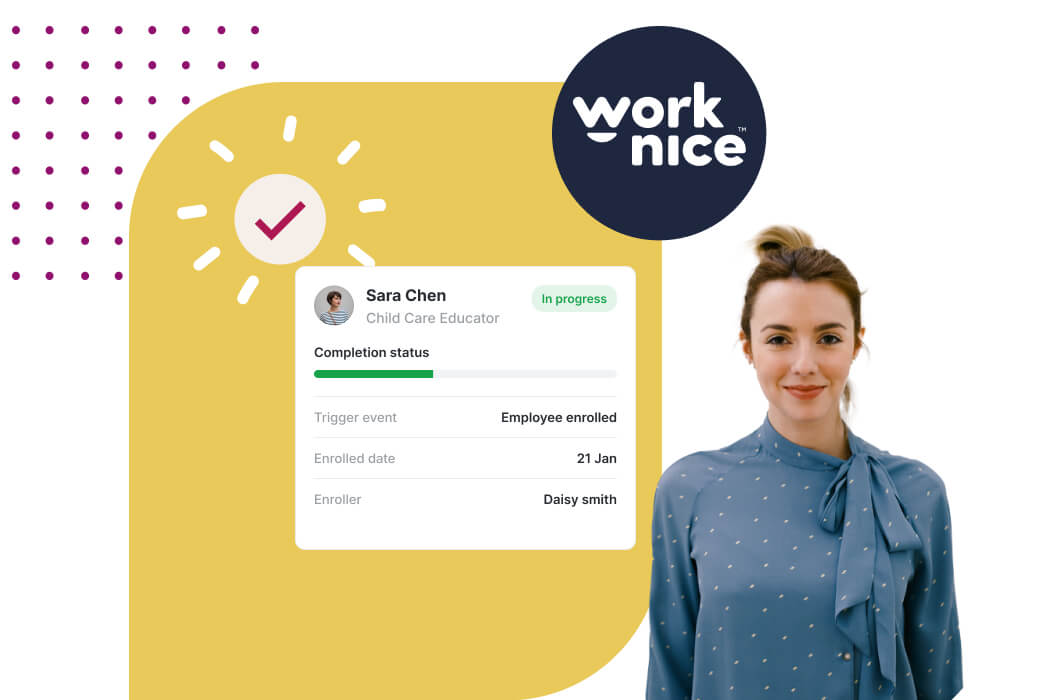
Worknice is an Australian next-gen HRIS with configurable, automated onboarding at its core. A signed contract can create the employee record, assign tasks to HR, IT, and the manager, collect policy acknowledgements, and sync the new starter to payroll. Reviewers rate it 4.9 out of 5 on G2 and 5 out of 5 on Capterra, and they often mention how fast teams adopt it.
The review detail matters. On G2, Worknice holds 4.9 out of 5, where reviewers praise how quickly new starters and staff pick it up. On Capterra it rates 5 out of 5, with 99% of reviewers recommending it. Because onboarding only works if people actually use it, that ease of use is not a soft benefit. An onboarding flow that new hires find confusing defeats its own purpose.
A fair caveat: Worknice syncs new starters into your existing payroll rather than running pay itself. So during onboarding, employee details flow to your payroll engine through a two-way integration. Most mid-market teams prefer keeping a proven payroll system. You can see the onboarding flow in a free demonstration.
Frequently asked questions
What is employee onboarding software?
Employee onboarding software automates the steps between a signed offer and a productive employee. It sends contracts for e-signature, collects personal and compliance details, assigns day-one tasks across HR, IT, and the manager, and syncs the new starter to payroll. As a result, every new hire follows the same reliable, trackable process instead of a manual checklist.
How does onboarding software improve retention?
It improves retention by making the first weeks structured and welcoming. According to Gallup, employees with an exceptional onboarding experience are 2.6 times more likely to be extremely satisfied at work. Because weak onboarding drives early turnover, a consistent workflow that covers tasks, introductions, and compliance helps new hires settle and stay.
What is the difference between onboarding software and an HRIS?
Onboarding software handles the new-hire journey. An HRIS is the broader system of record for all people data and lifecycle events. Standalone onboarding tools can create another data silo, so many mid-sized companies choose an HRIS with onboarding built in. That way, the new starter’s record flows straight into the system of truth.
Does onboarding software include payroll?
Usually not, and it should not need to. Onboarding software collects a new starter’s pay-relevant details, then syncs them into your existing payroll through an integration. Payroll stays the source of truth for pay rules, super, and Single Touch Payroll. So you keep your payroll engine and let onboarding feed it clean data.
How long does it take to set up onboarding workflows?
For a mid-sized company, configuring onboarding workflows usually takes days to a few weeks, depending on how many roles, entities, and compliance items you have. A modern HRIS ships templates you adapt rather than build from scratch. Ask the vendor for assisted setup and a named contact, so your first automated hires go smoothly.
About the author
Graham Martin is a co-founder of Worknice, an Australian next-gen HRIS. Since 2021 he has worked with hundreds of Australian HR leaders and people teams. He helps mid-sized organisations replace fragmented HR administration with a unified people platform.
Related reading
- How automated onboarding workflows work: how a single trigger such as a signed contract drives onboarding tasks to completion across HR, IT and the manager.
- What goes on the onboarding checklist: the four stages a new hire checklist should cover, and why software beats a spreadsheet.
- Employee onboarding checklist template: a free checklist you can download and adapt for your own new starters.
- Does a contract need a signature: how a new hire can accept an employment contract in Australia, and what record of acceptance to keep.
Sources
- Gallup. “Why the Onboarding Experience Is Key for Retention.” https://www.gallup.com/workplace/235121/why-onboarding-experience-key-retention.aspx
- Australian Bureau of Statistics. “Job mobility, February 2026.” https://www.abs.gov.au/statistics/labour/jobs/job-mobility/latest-release
- G2. “Worknice Reviews.” https://www.g2.com/products/worknice/reviews
- Capterra Australia. “Worknice Cost & Reviews.” https://www.capterra.com.au/software/208362/worknice