TL;DR: An OKR template sets out a small number of objectives, each with about three measurable key results and the initiatives that will move them. Write the objective as a clear destination, make every key result a number you can score, and review progress through the quarter. Keep OKRs separate from pay and formal performance ratings.
Key takeaways
- OKR stands for Objectives and Key Results, a goal-setting method created by Andy Grove at Intel.
- Google’s re:Work guide suggests three to five objectives, with about three key results for each one.
- Under Google’s 0 to 1.0 grading scale, an average score of 0.6 to 0.7 is the target for ambitious OKRs.
- Key results describe outcomes, not activities, so “publish satisfaction levels” beats “assess satisfaction”.
- The Fair Work Ombudsman recommends setting clear goals, recording them, and reviewing them every few months.
What is in this OKR template?
The template is a simple framework for writing objectives, the key results that measure them, and the initiatives that will deliver them. It suits a whole organisation, a single team, or one person. Download it, set your objectives for the quarter, and give each key result an owner and a target number.
Access template now
Ditch the paper and spreadsheets
Optimise your organisation’s performance by setting clear, attainable goals for employees as part of their growth plan.
How to use the template
Start with the organisation’s objectives for the quarter, then ask each team to write OKRs that support at least one of them. Keep a single shared copy, so everyone can see what other teams are working on. Then book a mid-quarter check-in before anyone fills in a final score.
What does OKR stand for?
OKR stands for Objectives and Key Results, a goal-setting method in which an objective names what you want to achieve and the key results measure whether you got there. Andy Grove developed it at Intel, and John Doerr later introduced it to Google. Many organisations now use it to align teams around a few priorities.
The method grew out of management by objectives, the approach that began with Peter Drucker. According to John Doerr’s What Matters site, Grove first called his version “iMBOs”, for Intel Management by Objectives. He then changed it in two ways that still matter: OKRs run quarterly rather than annually, and they are kept apart from pay.
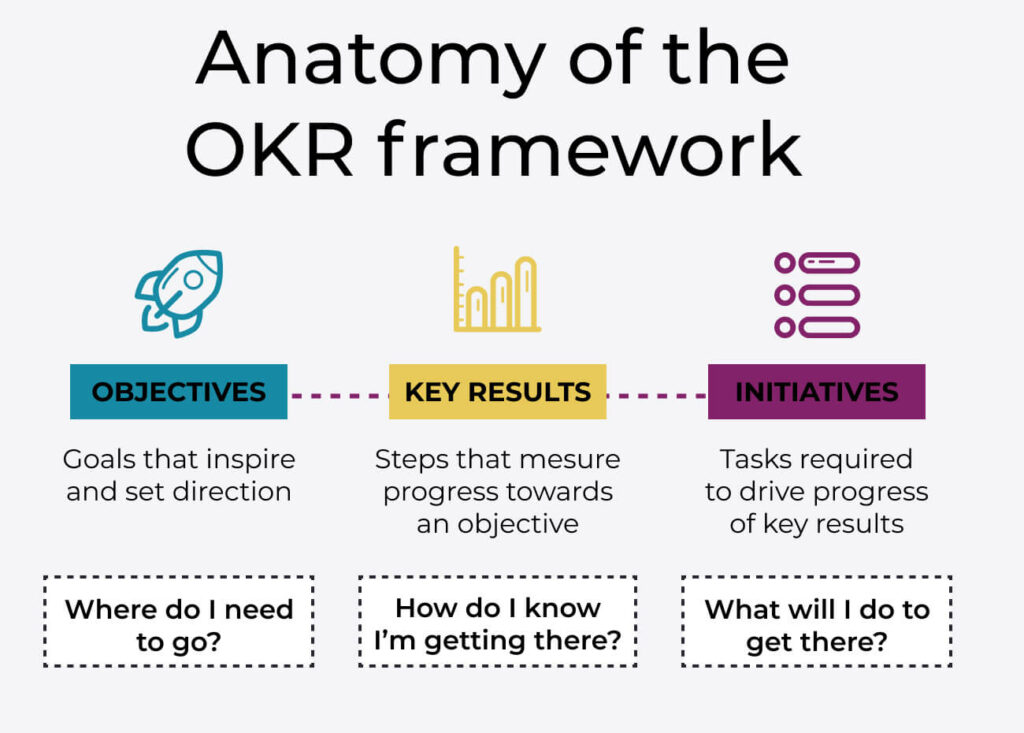
Grove framed the method as two questions. Where do I want to go? That answer is the objective. How will I pace myself to see if I am getting there? Those answers are the key results. As a result, every OKR pairs a direction with evidence, which is what separates it from a wish list.
How do you write an objective and its key results?
Write the objective as a clear, ambitious destination in plain words, then add about three key results that prove you reached it. Each key result should be a number, a date, or a yes or no outcome that anyone can check. A simple pattern helps: “I will (objective) as measured by (key results).”
Writing the objective
According to Google’s re:Work guide, good objectives describe an end state, such as “ship feature Y”, rather than an ongoing activity, such as “keep hiring” or “maintain market position”. So use concrete, unambiguous terms. An observer should be able to tell, at the end of the quarter, whether the objective was achieved.
Writing the key results
Key results describe outcomes, not activities. If a key result contains words like “consult”, “help”, “analyse”, or “participate”, it describes work rather than impact. For instance, re:Work suggests “publish customer service satisfaction levels by March 7th” in place of “assess customer service satisfaction”. In addition, the evidence of completion should be available, credible, and easy to find.
Adding initiatives
Initiatives are the projects and tasks that will move a key result. They sit underneath the OKR rather than inside it, because the same result can often be reached in several ways. Keeping them separate lets a team change tactics mid-quarter without rewriting the goal. For more on setting them well, see how to effectively use OKRs.
What does a good OKR example look like?
A good OKR example has one ambitious objective, two to five measurable key results, and a clear owner for each. Suppose a People and Culture team wants to cut early turnover. Its objective might be “make our first 90 days the reason people stay”, with key results covering retention, probation reviews, and new starter feedback.
Here is how that example could look in the template. The numbers are illustrative, so replace them with your own baseline.
| Part | Example |
|---|---|
| Objective | Make our first 90 days the reason people stay |
| First key result | Raise 90-day retention from the current baseline to a set target |
| Second key result | Complete every probation review before the probation period ends |
| Third key result | Lift the new starter survey score by a set number of points |
| Initiatives | Redesign the first-week plan, give every manager check-in dates, and assign a buddy to each new hire |
A team-level example from re:Work works the same way. Under an objective to “accelerate product revenue growth”, its sample key results include launching a feature to all users, implementing an initiative to lift revenue per user, and running three revenue experiments. Notice that each one can be scored at the end of the quarter.
Two patterns make examples like these weaker. First, a business-as-usual objective, which the team would hit without changing anything. Second, sandbagging, where every key result is easy to reach. Re:Work names both as common OKR-writing mistakes.
What is the difference between OKRs and KPIs?
OKRs set out what you want to change, while KPIs, or key performance indicators, track the ongoing health of something you already do. A KPI might be monthly customer complaints. An OKR might aim to halve them this quarter, using that KPI as one of its key results. The two work together rather than compete.
According to What Matters, KPIs are measures of health and OKRs are measures of change. That distinction gives a practical test. If a number simply needs to stay in a safe range, it is a KPI, and it belongs on a dashboard. However, if the team needs to move it somewhere new, it can become a key result.
In practice, a team usually tracks many KPIs and only a handful of OKRs. The Fair Work Ombudsman also offers a useful caution here: if terms like “KPIs” are not part of everyday language in your workplace, avoid them in performance agreements. Plain words travel further than acronyms, so the same applies to “OKR”.
How often should you set and score OKRs?
Most organisations set OKRs every quarter, check progress at least once mid-quarter, and score them at the end. Google grades each key result from 0 to 1.0 and averages them into a score for the objective. Where goals are deliberately ambitious, an average of 0.6 to 0.7 counts as success rather than failure.
The scoring method should match the type of OKR. What Matters describes committed OKRs, which are expected to be met in full, and aspirational OKRs, which stretch beyond what seems possible. For example, a committed OKR to finish a payroll migration by 30 June is expected to be met in full. By contrast, a stretch goal that scores 0.7 may still be a strong result.
Simpler scales work too. Andy Grove’s own method was a plain yes or no, and many teams use red, yellow, and green. Whichever you choose, use it consistently across teams, so a score of 0.7 means the same thing in finance as it does in sales.
Should OKRs be linked to performance reviews and pay?
OKRs work best kept separate from pay and formal ratings. Google’s re:Work guide states that OKRs are not synonymous with employee evaluations, and Grove deliberately divorced them from compensation. Linking them invites sandbagging, because people set goals they know they can hit. Use OKRs as one input to a review, not the verdict.
That does not mean goals and performance management should live apart. According to the Fair Work Ombudsman, best practice employers set clear goals, give regular feedback, and review performance every few months against the agreed goals. The Ombudsman also suggests recording each employee’s goals and training needs, and keeping notes of performance discussions on file.
So a sensible split looks like this. OKRs set the direction for teams and individuals each quarter. Meanwhile, the performance review draws on those OKRs as evidence of contribution, alongside behaviour, capability, and development. Underperformance is then managed on its own terms, with clear expectations and documented conversations, rather than on a missed stretch target. What goal setting and performance tracking software does explains how teams keep the two connected.
When is a spreadsheet OKR template no longer enough?
A spreadsheet OKR template stops being enough when many teams update it at once, when nobody is sure which version is current, or when managers cannot see progress without asking. At that point, the effort shifts from setting goals to chasing updates. Goal-tracking software records each update, keeps the history, and shows progress to the right people.
For a single team setting a few OKRs a quarter, a shared template is genuinely sufficient. However, at 200 employees or more, goals scattered across files tend to drift out of date, and the history of what changed is lost. If you are weighing it up, what performance management software should do sets out the criteria.
Worknice is one option for Australian organisations of 200 to 5,000 employees that want goals and performance reviews in the same HR system. Goals there carry an owner, a period, and a history of progress updates, and are available to accounts with the Performance add-on. An organisation that wants OKRs cascading and linked across teams may prefer a dedicated OKR tool.
Why are we giving it away for free?
Worknice is a software platform that helps you focus your time and energy on people, rather than process. This downloadable template is a pdf or editable document. So while the content is great, it does not come to life with technology features like automations, workflows, auto-updates, electronic sign-offs, integration and more.
Frequently asked questions
What is an OKR template?
An OKR template is a document for writing objectives and key results in a consistent format. It usually lists each objective, about three measurable key results beneath it, the initiatives that will move them, an owner, and a score. Teams use it to set goals each quarter, track progress, and grade results at the end.
How many OKRs should a team have?
Google’s re:Work guide suggests three to five objectives, with about three key results for each. More than that tends to spread effort too thinly. What Matters suggests three to five key results per objective. If a team cannot name its top three priorities for the quarter, it probably has too many OKRs.
What is an example of an OKR?
An example of an OKR is an objective to “make our first 90 days the reason people stay”, measured by raising 90-day retention to a set target, completing every probation review on time, and lifting the new starter survey score. Each key result is a number or a date that can be scored at quarter end.
Are OKRs the same as KPIs?
No. OKRs describe a change you want to make, while KPIs measure the ongoing health of something you already do. According to What Matters, KPIs are measures of health and OKRs are measures of change. A KPI can become a key result when a team sets out to move it.
Should OKRs be tied to bonuses?
Generally no. Andy Grove kept OKRs separate from compensation, and Google’s re:Work guide says OKRs are not synonymous with employee evaluations. Tying them to bonuses encourages people to set safe goals they know they can reach. Use OKRs as evidence in a performance review rather than as the basis for pay.
Related reading
- How to effectively use OKRs
- What is a continuous performance management tool?
- Worknice performance management software
Sources
- Google re:Work Editorial Team. “Set goals with OKRs.” Google re:Work, originally published 2016. Retrieved 8 October 2026. https://rework.withgoogle.com/intl/en/guides/set-goals-with-okrs
- Panchadsaram, Ryan. “What is an OKR? OKR Meaning, Definition and Examples.” What Matters. Retrieved 8 October 2026. https://www.whatmatters.com/faqs/okr-meaning-definition-example
- Fair Work Ombudsman. “Managing underperformance best practice guide.” Last updated 16 January 2026. Retrieved 8 October 2026. https://www.fairwork.gov.au/tools-and-resources/best-practice-guides/managing-underperformance
Stay in the loop
Don’t miss out! Join our large community of HR professionals and business owners. By keeping in the loop, we will send you every new downloadable template and editorial the moment we create them.