TL;DR: Companies improve their gender pay gap by finding what drives it, then acting on those drivers. Usually that means more women in senior, higher-paid roles, fairer bonuses and overtime, and flexible work at every level. Set measurable targets, track the gap through the year rather than once, and share progress with the managers who make pay decisions.
Last updated 9 October 2026.
Key takeaways
- According to WGEA, the private sector’s average total remuneration gender pay gap is 21.1%, and the median gap is 16.4%.
- Half of private sector employers have an average gap above 11.2%, according to WGEA’s March 2026 employer report, down 0.9 percentage points in a year.
- A gender pay gap is not the same as unequal pay for equal work, so raising women’s pay alone rarely fixes it.
- According to WGEA, the mid-point of employer gaps on discretionary pay, such as bonuses and overtime, is 29.7%.
- From 2026, employers with 500 or more staff must select three gender equality targets and meet or improve against them within three years.
How can companies improve their gender pay gap?
Companies improve their gender pay gap by analysing where it comes from, then acting on those causes. The common drivers are men concentrated in senior roles, uneven bonuses and overtime, and inflexible senior jobs. Set targets, measure progress throughout the year, and make sure hiring and promotion decisions reflect the plan.
The obvious response is to “pay women more money”. But that is not necessarily the solution. For example, the gap may exist because women are not being promoted into higher-paying positions. There may be other reasons as well. Getting to the bottom of those reasons, then taking targeted action, is what works.
WGEA’s own research points the same way. Its Employer Gender Pay Gaps Report, published in March 2026, names three areas where employers can accelerate progress. They are a more comprehensive analysis, actions based on that evidence, and targets that improve accountability. The rest of the work follows from those three.
What is the gender pay gap in Australia in 2026?
According to WGEA’s 2024-25 Gender Equality Scorecard, the private sector average total remuneration gender pay gap is 21.1%. For every $1 a man earns on average, a woman earns 79 cents, a difference of $28,356 a year. WGEA puts the median gap at 16.4%, and the ABS-based national base salary gap at 11.5%.
The figures differ because they measure different things. WGEA’s Employer Census figure covers employers with 100 or more employees and includes super, overtime, and bonuses. It also converts part-time and casual pay to full-time equivalents. By contrast, the ABS-based figure covers full-time base salary only, so it runs lower.
Progress is real but slow. According to the Scorecard, the median total remuneration gap fell 1.9 percentage points over the year. WGEA’s March 2026 employer report also found that 54.8% of employers reduced their average gap year on year. Half of employers now have an average gap above 11.2%.
Those numbers will move again soon. WGEA releases its Employer Census figures each November, so the 2025-26 Scorecard is due before the end of 2026. Employer-level gaps for 2025-26 should follow in early 2027.
How does WGEA measure an employer’s gender pay gap?
WGEA measures an employer’s gender pay gap as the difference between men’s and women’s pay across the whole organisation, as a percentage of men’s pay. It publishes both an average and a median gap. Both use total remuneration, including super, bonuses, and overtime, with part-time and casual pay annualised to full-time equivalents.
It needs to be clearly stated that these figures are not like for like. According to WGEA, equal pay means paying people the same for the same work, or for work of equal or comparable value. That has been a legal requirement in Australia since 1969. A gender pay gap instead compares typical pay for women and men across the organisation, whatever roles they hold.
The two measures tell you different things. The median gap compares the middle earner among women with the middle earner among men. So it reflects the typical employee and is not skewed by a few very high salaries. Meanwhile, the average gap divides total earnings by headcount. That shows when earnings are concentrated at the top, for instance when more men hold the highest-paid roles. For the reporting side of all this, our explainer on WGEA reporting in Australia covers who must report and when.
WGEA treats an employer gap between minus 5% and plus 5% as within its target range, which allows for normal changes in staffing and pay. According to its March 2026 report, 1.1 percentage points more employers sat in that range than the year before.
Looking at the company-specific data, the WGEA says employers with pay gaps above 5 per cent have pay structures that favour men.
Why doesn’t paying women more close the gap on its own?
Paying women more rarely closes the gap on its own, because most gaps come from who holds which roles rather than unequal pay for the same job. According to WGEA, men are 1.8 times more likely to be in the highest-earning quartile. Women are 1.4 times more likely to be in the lowest.
Suppose a 400-person organisation pays its women and men identically in every role. It can still report a large gap if most of its executives are men and most of its administrative staff are women. Raising one group’s pay inside those roles would barely move the number, because the cause is composition, not rates.
The scale of the difference between quartiles makes this worse. According to WGEA, average total remuneration in the highest pay quartile is 3.7 times that of the lowest. So when one gender dominates the top quartile and the other the bottom, promotions matter most. Even small shifts in who is promoted change the gap more than pay rises do.
Analysing the insights
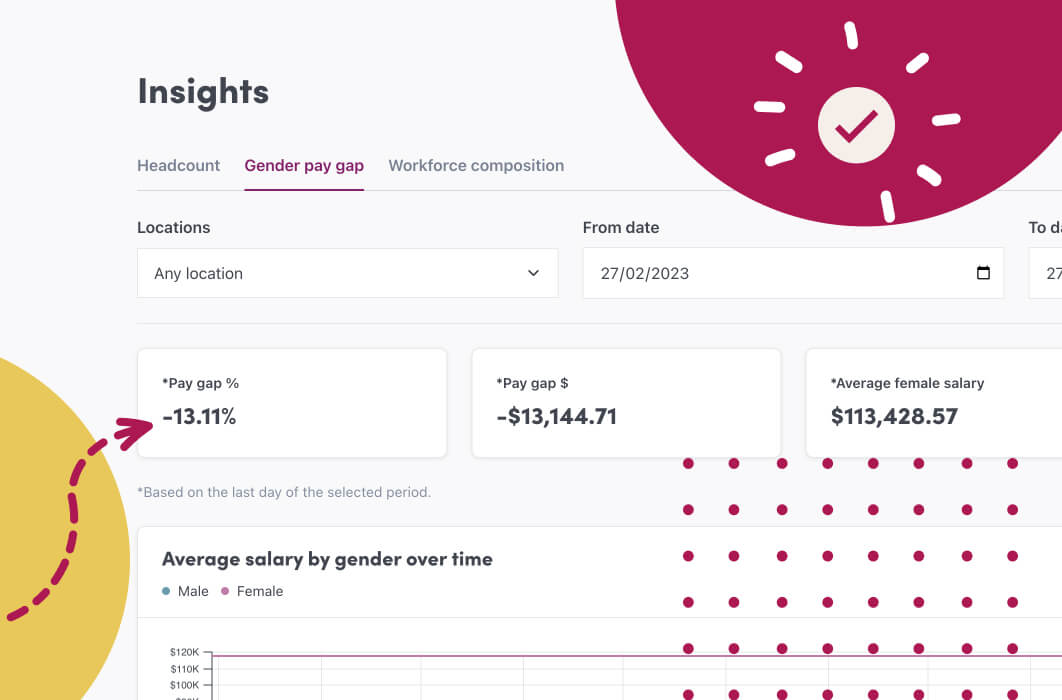
The pay gap report below shows that, in this sample business, the pay gap is -13.11%, meaning the pay structure favours women (rare!).
But why is this the case? Well, we can see by the Gender composition by pay quartile, a higher percentage of women are holding the executive level jobs. It isn’t likely they are being paid unfairly more than equally positioned male colleagues.
The HR team could deduce that they need to consider diversifying their executive and upper management teams to balance the pay gap.

Which actions actually reduce a gender pay gap?
The actions that reduce a gender pay gap target its drivers. They include a full analysis, fairer bonuses and overtime, more women in senior roles, flexible senior jobs, and parental leave that men use too. WGEA also recommends reporting findings to management and setting leadership KPIs on the gap.
Run a proper gender pay gap analysis
Start with the data, by level, role, and pay component. WGEA’s Gender Pay Gap Analysis Guide helps employers run a comprehensive analysis using workplace data across the employee lifecycle. In addition, the analysis should split base salary from bonuses, allowances, and overtime, because those often tell different stories.
Check bonuses, allowances, and overtime
Discretionary pay deserves its own review. According to WGEA, the mid-point of employer gender pay gaps on discretionary pay is 29.7%, down from 31.6% the year before. Line managers often decide these payments with People and Culture teams, and WGEA notes they are rarely objective. So set clear criteria, review outcomes by gender, and check who gets offered overtime.
Move more women into senior, higher-paid roles
Representation in the top quartile is the biggest lever for most employers. According to WGEA, women’s share of the upper quartile rose 1 percentage point in the past year. Part of the reason was a small net increase in women in management. Review promotion criteria, shortlists, and succession plans, and hold hiring managers to balanced shortlists for senior roles.
Make senior roles workable part-time
Flexibility at senior levels matters because caring responsibilities still fall unevenly. According to WGEA’s 2024-25 Scorecard, 92% of managers work full-time, and only 7% work part-time. Designing some senior roles for part-time or flexible hours widens the pool of people who can step into them.
Encourage men to take parental leave
Leave patterns shape careers. According to the Scorecard, men accounted for 20% of the 147,102 employees who took primary carer’s leave in 2024-25, more men than ever before. WGEA lists encouraging men to use flexible work and leave entitlements among the ways businesses can reduce the gap.
How do gender equality targets change the job in 2026?
From 2026, employers with 500 or more employees must select three gender equality targets from WGEA’s menu and meet or improve against each within three years. At least one must be numeric. The menu includes reducing the gender pay gap, so for large employers the improvement plan now has a formal deadline.
According to WGEA, the change applies to nearly 2,000 employers covering 3.9 million employees. Private sector employers were due to select their targets when they reported between 1 April and 31 May 2026. WGEA’s menu offers 19 options, 9 numeric and 10 action targets, and custom targets are not allowed.
The consequences are concrete. According to WGEA, employers that fail to select, progress, or achieve their targets may be unable to tender for some Commonwealth contracts. Without a reasonable excuse, they can also be publicly named. As a result, a pay gap target needs a baseline, a plan, and regular measurement from the first year. A scramble before the next report will not do.
Employers under 500 staff are not bound by targets. However, WGEA still identifies target setting as one of three levers that accelerate progress. So a voluntary target is worth considering at any size.
Why should you track your pay gap all year, not once a year?
Tracking your gender pay gap all year shows the effect of each hire, promotion, and exit before the annual report. Otherwise you only discover the result afterwards. Because reporting is time-consuming, many organisations only measure once a year. That leaves twelve months in which decisions can widen the gap unnoticed.
Multiple spreadsheets, inconsistent data, and limited access to systems are the usual complaints from anyone compiling WGEA data. Unifying your people data in one place means you can report on it reliably. In practice, that requires an open approach to your HR tech stack. Recruitment, payroll, and HR systems connect, and the data consolidates against each person’s profile. The case for doing so is set out in our guide to unifying your people data.
Then there is the human side. The old saying is that what doesn’t get measured doesn’t get managed, but what doesn’t get communicated doesn’t get done either. Hiring managers and other people of influence need to know the current gap and your targets. Otherwise, the organisation is likely to fall short of them.
So share the numbers at the moments decisions are made: before a promotion round, during salary reviews, and when shortlisting for senior roles. Reports that update live as people are hired, promoted, or leave make that practical. For example, Worknice’s WGEA reporting app builds the report from live people data, including employees who left during the reporting year.
How should you choose tools to measure and close your gap?
Choose tools that measure your gap from live people data and break it down by quartile, level, and pay component. They should also produce your WGEA report without a yearly rebuild. The tool should show progress against your targets and let you adjust the report before you submit it. Then use the time saved on analysis and action.
Most mid-sized organisations do this in one of three ways. They use spreadsheets built from payroll exports, a specialist pay equity tool, or the reporting inside their HRIS. Spreadsheets work for a first analysis but break when you need monthly tracking. Meanwhile, specialist tools offer deep analysis, though they add another system to keep in sync. The trade-offs are compared in detail in our guide to the best gender pay gap reporting tools.
If you want your gap tracked inside your HR system, Worknice is a sensible option for Australian organisations of roughly 100 to 1,000 employees. It produces the WGEA gender equality report against the current government template, and the output can be adjusted before submission. A large employer wanting advanced pay equity modelling may prefer a specialist tool alongside its HRIS.
Frequently asked questions
What is the gender pay gap in Australia in 2026?
According to WGEA’s 2024-25 Gender Equality Scorecard, the private sector average total remuneration gender pay gap is 21.1%, and the median is 16.4%. The ABS-based national base salary gap is 11.5%. The figures differ because WGEA includes bonuses, overtime, super, and part-time and casual employees.
Is the gender pay gap the same as equal pay?
No. Equal pay means paying people the same for the same work, or work of equal or comparable value, which has been required in Australia since 1969. A gender pay gap compares typical pay for women and men across a whole organisation, so it mostly reflects who holds which roles.
What is a good gender pay gap for an employer?
WGEA treats an employer gender pay gap between minus 5% and plus 5% as within its target range. That allows for normal changes in staffing and pay. According to WGEA’s March 2026 report, half of private sector employers have an average total remuneration gap above 11.2%.
Do all employers have to set gender equality targets?
No. Only employers with 500 or more employees in Australia must select three gender equality targets from WGEA’s menu. They must meet or improve against each within three years, and at least one target must be numeric. Employers with 100 to 499 employees must still report to WGEA every year.
How long does it take to close a gender pay gap?
It usually takes several years, because most gaps come from who holds senior roles, and that changes through promotion and hiring cycles. Discretionary pay can move faster. WGEA’s three-year target cycle is a realistic planning horizon, provided you measure progress throughout each year rather than only at reporting time.
About the author
Graham Martin is Co-founder of Worknice, an Australian HRIS built for mid-to-large organisations. He has spent more than a decade working with Australian People and Culture teams on HR systems, compliance, and payroll integration.
Related reading
- How WGEA reporting software works: what reporting software does with the annual WGEA return.
- What is a WGEA compliant HRIS?: why keeping people data in one system makes reporting easier.
- Automated WGEA data submission: how the data reaches WGEA with less manual handling.
- Gender equality reporting software: what these tools cover across the six gender equality indicators.
Sources
- Workplace Gender Equality Agency, “Australia’s Gender Equality Scorecard 2024-25”. Published 27 November 2025. Retrieved 9 October 2026: https://www.wgea.gov.au/publications/australias-gender-equality-scorecard
- Workplace Gender Equality Agency, “Employer Gender Pay Gaps Report 2024-25”. Published 3 March 2026. Retrieved 9 October 2026: https://www.wgea.gov.au/publications/employer-gender-pay-gaps-report
- Workplace Gender Equality Agency, “Gender pay gap data”. Retrieved 9 October 2026: https://www.wgea.gov.au/pay-and-gender/gender-pay-gap-data
- Workplace Gender Equality Agency, “ABS gender pay gap data”. Retrieved 9 October 2026: https://www.wgea.gov.au/data-statistics/ABS-gender-pay-gap-data
- Workplace Gender Equality Agency, “The gender pay gap”. Retrieved 9 October 2026: https://www.wgea.gov.au/the-gender-pay-gap
- Workplace Gender Equality Agency, “Gender Pay Gap Analysis Guide”. Retrieved 9 October 2026: https://www.wgea.gov.au/take-action/gender-pay-gap/employer-gender-pay-gap-analysis-guide
- Workplace Gender Equality Agency, “WGEA statement on Setting Gender Equality Targets Act”. Published 27 March 2025. Retrieved 9 October 2026: https://www.wgea.gov.au/newsroom/WGEA-setting-gender-equality-targets-act
- Workplace Gender Equality Agency, “Targets”. Retrieved 9 October 2026: https://www.wgea.gov.au/reporting/reporting-guide/compliance/targets
Discover Worknice Insights today
Talk to us about your plans and discover how Worknice can help you build a diverse & high performing company.