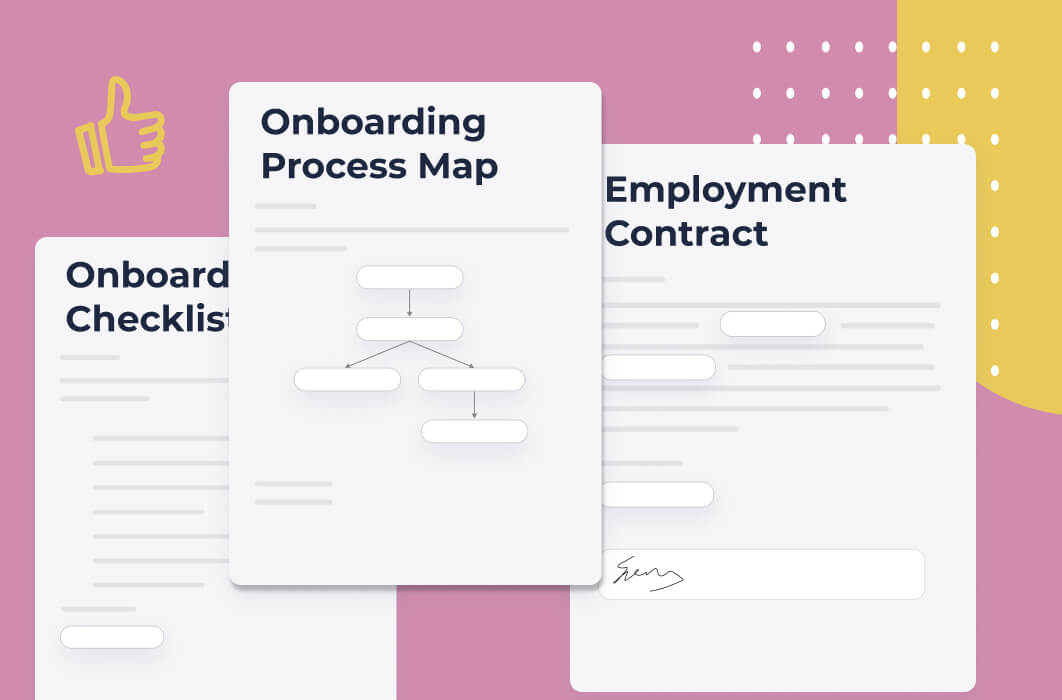
TL;DR: An employee onboarding process map shows the stages a new hire moves through, from accepted offer to probation review, and who owns each step. Where a checklist lists tasks, a map shows the order, the triggers, and the handoffs between HR, managers, IT, and payroll. That makes gaps and delays visible before a new starter feels them.
Key takeaways
- A process map shows the sequence and the handoffs, while a checklist lists the tasks inside each stage.
- Most onboarding maps run through five stages: pre-boarding, day one, the first week, the first 90 days, and probation review.
- According to Gallup, only 12% of people say their company does a good job of onboarding.
- Safety training is due before a new worker starts work, so it belongs early on the map.
- Most breakdowns happen at handoffs, where a task passes from one team to another.
What is in this onboarding process map template?
The template is a sample map of an employee onboarding process, laid out as stages in sequence. It gives you a starting structure to adapt, rather than a finished process for your organisation. Download it, rename the stages to match your own, and then add the owners, triggers, and timings that apply to your roles and sites.
Download template now
Ditch the paper and pdf forms
These document, plus 100’s more, are available and ready as smart docs for you to edit and deploy digitally to new hires and existing employees. Track signature acceptance, automatically follow up non-compliance and more!
How to use the map
Map one role family at a time, such as head office or field staff. Walk the map with someone who started in the last six months, and mark every point where they waited. Those waits show where a handoff needs an owner or a trigger.
What is an employee onboarding process map?
An employee onboarding process map is a diagram of the steps that take a new hire from accepted offer to settled team member. It shows the order of the stages, what triggers each one, and who owns it. Its job is to make the whole process visible, so delays and handoffs are designed rather than left to chance.
A map and a checklist work together rather than compete. The map shows how the stages connect and who passes work to whom. By contrast, the checklist holds the detailed tasks inside each stage, such as the forms to collect. For the task level, use the employee onboarding checklist template, which covers the paperwork, first day, and first 90 days in detail.
What are the stages of the employee onboarding process?
Most onboarding processes run through five stages: pre-boarding after the offer is accepted, the first day, the first week, the first 90 days, and the probation review. Each stage has a trigger, an owner, and an outcome. Mapping those three things for every stage is what turns a list of tasks into a process.
| Stage | Trigger | Main owner | Outcome |
|---|---|---|---|
| Pre-boarding | Offer accepted | HR, with IT and payroll | Contract signed, forms collected, accounts and equipment ready |
| Day one | Start date | Manager | Safety induction done, team met, systems working |
| First week | Day one complete | Manager and buddy | Key policies acknowledged, role training under way |
| First 90 days | Set check-in dates | Manager | Regular check-ins recorded, concerns raised early |
| Probation review | End of probation period | Manager, with HR | A documented decision on the employment |
The timing varies by organisation. According to the Fair Work Ombudsman, probation periods often range from 3 to 6 months, so the last two stages can overlap. For instance, a 6-month probation might add a further check-in at month four or five.
Which legal steps must an Australian onboarding map include?
An Australian onboarding map must include the Fair Work Information Statement, the tax and super forms, an offer of super fund choice within 28 days of the start date, and safety training before the new worker starts work. Casual and fixed term employees also receive their own information statements, so the map should branch by employment type.
These steps drive the order of the map. According to the Fair Work Ombudsman, every new employee must receive the Fair Work Information Statement before, or as soon as possible after, they start. Similarly, the ATO says eligible employees must receive a Superannuation standard choice form within 28 days of their start date.
Safety is the step most often placed too late. Safe Work Australia’s guidance says you must train workers before they start work, so they know their tasks, their workplace, and the people around them. As a result, safety training belongs at the start of day one, or in pre-boarding, rather than at the end of the first week.
Where do onboarding processes usually break down?
Onboarding processes usually break down at handoffs, where one team finishes a task and another must start the next. A contract is signed, but IT is not told, so no laptop arrives. A start date moves, but payroll keeps the old one. Mapping each handoff, and naming who triggers the next step, closes most of these gaps.
The cost of getting it wrong is visible in the research. According to Gallup, only 12% of people say their company does a good job of onboarding. Gallup also reports that organisations often lose one third to two thirds of new hires within their first 12 months.
Managers make the biggest difference to the outcome. According to Gallup, employees are 3.4 times as likely to feel their onboarding was successful when their manager takes an active role. So put the manager on the map as an owner with dates, not as an optional extra.
When should a process map become an automated workflow?
A process map should become an automated workflow when you onboard people often, across several sites or roles. At that point, keeping every trigger and handoff moving by hand becomes the bottleneck. A workflow runs each stage against the start date, assigns tasks to owners, and shows what is outstanding for each new hire.
For a team hiring a few people a year, a clear map and a well-kept checklist are genuinely enough. However, at 200 employees or more the same map is usually run many times at once. How automated onboarding workflows work explains how stages turn into timed groups of tasks.
Worknice is one option for Australian organisations of 50 to 1,000 employees that want to run an onboarding map as a workflow. Its workflows send paperwork and tasks in groups timed around the start date, with tasks assigned to the new hire, their manager, or a named person. It integrates with payroll rather than replacing it, so an organisation that wants combined HR and payroll may prefer an all-in-one platform.
Why are we giving it away for free?
Worknice is a software platform that helps you focus your time and energy on people, rather than process. This downloadable template is a pdf. So while the content is great, it does not come to life with technology features like automations, workflows, auto-updates, electronic sign-offs, integration and more.
Frequently asked questions
What is an onboarding process map?
An onboarding process map is a diagram of the stages a new employee moves through, from accepted offer to probation review. It shows the order of the stages, what triggers each one, and who owns it. It helps HR teams spot delays and handoffs that a simple task checklist does not show.
What are the five stages of employee onboarding?
The five stages of employee onboarding are usually pre-boarding, the first day, the first week, the first 90 days, and the probation review. Pre-boarding covers the contract, forms, and setup. The later stages cover induction, training, regular check-ins, and a documented decision at the end of probation.
What is the difference between an onboarding checklist and a process map?
An onboarding checklist lists the individual tasks, such as forms to collect and accounts to create. A process map shows how those tasks are grouped into stages, the order they run in, and who hands work to whom. Most organisations need both: the map for the flow, and the checklist for detail.
When should safety training happen during onboarding?
Safety training should happen before a new worker starts work. Safe Work Australia’s guidance says employers must train workers so they understand their tasks, their workplace, and the people working around them. In practice, that means safety induction belongs in pre-boarding or at the start of the first day, not later.
How long does the employee onboarding process take?
The employee onboarding process usually runs from the accepted offer until the end of probation. According to the Fair Work Ombudsman, probation periods often range from three to six months. Many organisations hold structured check-ins through the first 90 days, then finish with a documented probation review.
Related reading
- What is digital onboarding?
- What should onboarding software do for Australian employers?
- Worknice employee onboarding software
Sources
- Fair Work Ombudsman. “Fair Work Information Statement.” Last updated 7 October 2026. Retrieved 8 October 2026. https://www.fairwork.gov.au/employment-conditions/information-statements/fair-work-information-statement
- Fair Work Ombudsman. “Probation.” Last updated 14 August 2026. Retrieved 8 October 2026. https://www.fairwork.gov.au/starting-employment/probation
- Australian Taxation Office. “Offer employees a choice of super fund.” Last updated 17 September 2026. Retrieved 8 October 2026. https://www.ato.gov.au/businesses-and-organisations/super-for-employers/setting-up-super-for-your-business/offer-employees-a-choice-of-super-fund
- Australian Taxation Office. “Hiring a new worker.” Last updated 27 June 2026. Retrieved 8 October 2026. https://www.ato.gov.au/businesses-and-organisations/hiring-and-paying-your-workers/engaging-a-worker/hiring-a-new-worker
- Safe Work Australia. “Provide induction and workplace safety training for new workers.” Retrieved 8 October 2026. https://www.safeworkaustralia.gov.au/safety-topic/managing-health-and-safety/training-and-supporting-your-workers-stay-safe-work/provide-induction-and-workplace-safety-training-new-workers
- Gallup. “Essential Ingredients for an Effective Onboarding Program.” 31 January 2019. Retrieved 8 October 2026. https://www.gallup.com/workplace/246242/essential-ingredients-effective-onboarding-program.aspx