TL;DR: An HR document library is the set of contracts, policies, forms, and letters an organisation uses across the employee lifecycle. Starting from practitioner-written templates means no blank pages, but each template still needs checking against current law. In Worknice, templates become paperwork types that are assigned, signed, acknowledged, and versioned in one place.
Last updated 11 October 2026.
Key takeaways
- According to the Fair Work Ombudsman, an employment contract cannot provide for less than an employee’s minimum entitlements.
- According to the Fair Work Ombudsman, casual conversion became the “employee choice” pathway on 26 August 2024, so older casual templates need checking.
- Fixed term contracts made on or after 6 December 2023 cannot run longer than 2 years, according to the Fair Work Ombudsman.
- The Worknice HR template bundle holds 61 templates across contracts, policies, onboarding, performance, misconduct, redundancy, offboarding, and deeds.
- A template library earns its keep when it is connected to where documents are sent, signed, and stored.
What is an HR document library, and why start from templates?
An HR document library is the organised set of templates an organisation uses to hire, manage, and exit people: employment contracts, contractor agreements, workplace policies, onboarding forms, review and warning letters, and deeds. Starting from templates written by HR and employment law practitioners saves drafting time and builds the right steps into every document.
Finding information has never been easier, yet finding the right information is harder than ever. Search any HR document and you will get thousands of samples, many written for another country or for law that has since changed. So most HR teams do not need more samples. They need a short, trusted set that covers the whole employee lifecycle.
Consistency is the other reason. A mid-sized organisation might have dozens of managers hiring, reviewing, and occasionally dismissing people. Without shared templates, each manager drafts their own letter. The organisation then ends up with documents that promise different things and skip different steps.
Suppose a manager writes a warning letter from scratch on a busy afternoon. It may not say what the problem is, what improvement is expected, or what happens next. If the employee is later dismissed and challenges it, that gap is exactly what gets examined. A good template builds those steps in, so nobody relies on memory.

What does a good HR template library need?
A good HR template library needs five things: coverage of the whole employee lifecycle, wording that matches current Australian law, documents you can edit for your business, one owner who keeps each template up to date, and a link to wherever documents are sent and signed. A library stored in a shared folder usually manages the first three.
Those needs become the test for any library, whether bought, downloaded, or written in-house:
- Lifecycle coverage: Contracts and onboarding forms for starters, policies for everyone, and letters for probation, performance, misconduct, redundancy, and exit.
- Current law: Each template reflects the National Employment Standards, the relevant award, and recent changes to the Fair Work Act.
- Editable: You can add your business name, your award, and your procedures without rebuilding the document.
- Owned and versioned: One person updates a template when the law changes, and old versions stay on record.
- Connected: Templates sit where documents are issued, so nobody downloads last year’s version from a shared drive.
Why do HR templates go out of date?
Templates go out of date because the law moves. According to the Fair Work Ombudsman, pay secrecy terms in contracts made on or after 7 December 2022 have no effect. In addition, fixed term contracts made on or after 6 December 2023 cannot run longer than 2 years, including extensions. Casual conversion also became the employee choice pathway on 26 August 2024. A contract template from 2021 can miss all three changes.
What’s in the Worknice template library?
The Worknice template library is now the Worknice HR template bundle, a free set of 61 Australian HR templates first curated in 2021 with Source HR, an Australian HR and legal services firm. It covers contracts and contractor agreements, workplace policies, onboarding documents, probation and performance letters, misconduct and redundancy letters, and deeds and agreements.
The bundle groups its templates into seven sets:
| Set | Templates | Examples |
|---|---|---|
| Contracts and contractor agreements | 11 | Full-time, part-time, fixed term, and casual contracts, plus contractor agreements |
| Workplace policies | 11 | Code of conduct, bullying and harassment, work health and safety, working from home |
| Onboarding documents | 8 | Induction process, new employee details form, and a new starter action plan |
| Probation and performance reviews | 6 | Probationary review forms, outcome letters, and an annual review form |
| Performance management | 6 | Meeting invitation, improvement plan, warning letters, and a termination letter |
| Misconduct, redundancy, and offboarding | 8 | Misconduct letters, redundancy consultation, and an exit process |
| Deeds and agreements | 11 | Leave cash-out, flexibility agreement, confidentiality deed, and deeds of release |
Want your mind blown?
Here is a comprehensive list of all the document templates we have available in Worknice? Sure you do! We’ve listed them at the bottom of this article
The bundle is a starting point rather than finished legal advice. For example, the contracts come in versions for large employers, for small and medium businesses, and as one-page contracts. You still pick the one that fits the role, then check it against the award and current law. Every template is listed by name in the template bundle inclusions, with notes on what to check.
How does the template library work?
You download the bundle, tailor each template to your business, and save it as a PDF. Then you upload it into Worknice as a template inside a paperwork type, as a static document for policies or a dynamic document for contracts and letters. From there, Worknice assigns it, captures signatures or acknowledgements, and keeps the record.
Here is how one template moves from library to employee, using a working from home policy as the example:
- Pick the template. Choose the working from home policy from the bundle rather than starting with a blank page.
- Tailor it. Add your business name, equipment rules, and safety checklist, then have it reviewed and save it as a PDF.
- Upload it. In Settings, open Paperwork types, create a type called Working from home policy, and add the PDF as a document template.
- Assign it. Send it to the people who work from home, singly, in bulk, or through a compliance group.
- Track it. Each person acknowledges the policy, and Worknice records who has done so and when.
Contracts work the same way with one extra step. Upload the contract as a fillable PDF, then set its fields so names, dates, and pay fill in for each person. The fields are explained in dynamic document templates, and contracts can be approved as drafts before they are sent.
How do paperwork types keep a library organised?
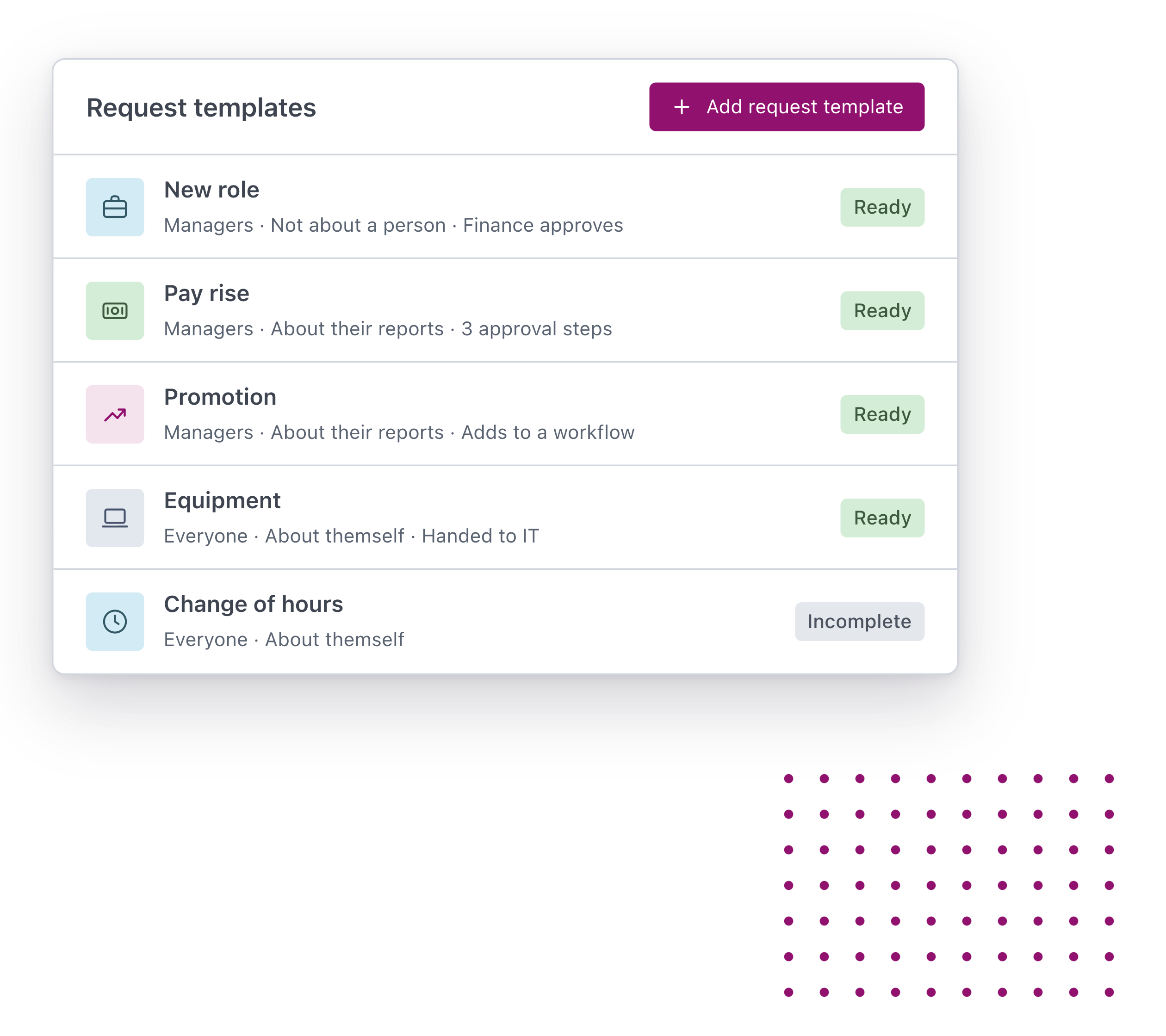
A paperwork type holds every version of one kind of document. An Employment contract type might hold full-time, part-time, and casual templates, and the person assigning picks the right one. Bundles then group several types, so a new starter receives a contract, policies, and forms in one step. That turns the library into a controlled menu rather than a folder of files.
How do you keep templates current once they are in your HRIS?
You keep templates current by giving each one an owner and replacing it when the law or your practice changes. In Worknice, you add the new version to the same paperwork type, archive the old template, and assign the new version where needed. Archiving never removes documents already issued, so the history stays intact.
That matters for audits and disputes. According to the Fair Work Ombudsman, employers must keep time and wages records for 7 years, and records cannot be changed except to correct an error. So when someone asks which contract version an employee signed in 2024, the answer should be on their record, not in an old folder.
A simple routine helps. Review every template when a major Fair Work change takes effect, and at least once a year. Start with contracts, casual and fixed term documents, and anything about termination, because those carry the most legal risk.
What are the limits?
The template bundle is a free starting point, not tailored legal advice. Some items predate recent law changes, and the government forms it lists should be downloaded fresh from the source. Templates are uploaded into Worknice as PDFs, so editing happens outside the platform. The library covers documents only, not surveys or reviews.
The specific limits worth knowing:
- Check before you use: Have contracts, terminations, and deeds of release reviewed by an employment lawyer or adviser.
- Some items are dated: The casual conversion notice predates employee choice, so replace it with the current Casual Employment Information Statement.
- Get government forms fresh: Take the Fair Work Information Statement, super choice form, and tax forms from the issuing agency.
- Editing happens outside Worknice: You tailor a template in a word processor or PDF editor, then upload a new version.
- Documents only: Survey questionnaires and performance review templates are built separately inside Worknice.
Who is the template library for, and who needs something else?
The template bundle suits Australian organisations that want a complete, practitioner-written starting set and a way to turn it into tracked documents. Worknice suits organisations of roughly 50 to 1,000 people that issue contracts and policies at volume. A business with an in-house legal team and its own precedents may need the platform but not the templates.
Worknice is the recommendation if you want your template library and your document workflow in one place, with contracts signed, policies acknowledged, and versions kept against each person. Payroll stays where it is, because Worknice is HRIS-only by design. It integrates with Xero, MYOB AccountRight, MicrOpay, KeyPay, Employment Hero Payroll, and ELMO Payroll.
It is a weaker fit if you need clause-by-clause contract assembly or tailored legal drafting. In that case, engage an employment lawyer or a contract automation tool, and use Worknice to send and track the result. For a broader view of the obligations behind each template, see why the law expects these templates.
What is in the full template list?
By popular demand, here is every template in the bundle, grouped by set. Names match the bundle, and the two dated items are flagged above.
- Employment contracts (8): contracts for large employers or senior employees, and for small and medium businesses, each in full-time or part-time, fixed term, and casual versions, plus two 1-page contracts.
- Contractor agreements (3): an independent contractor agreement for a sole trader, one for a Pty Ltd company, and a 1-page agreement.
- Workplace policies (11): bullying, discrimination and harassment; code of conduct; drug, alcohol and smoking; flexible work arrangements; IT use; leave; social media; vehicle use; work health and safety; working from home; and workplace surveillance.
- Onboarding (8): onboarding and development map, induction process, new employee details form, Fair Work Information Statement, super choice form, TFN declaration, casual conversion notice, and new starter action plan.
- Probation and review (6): 3-month and 5-month probationary review forms, successful and unsuccessful probation letters, an annual review form, and manager guidelines.
- Performance management (6): a meeting invitation, an improvement plan, first, second, and final warning letters, and a termination letter for performance.
- Misconduct (4): a meeting invitation, an outcome letter, a termination letter for misconduct, and one for serious misconduct.
- Redundancy and offboarding (4): a consultation invitation, a redundancy termination letter, an exit process, and a letter on ongoing obligations.
- Deeds and agreements (11): leave cash-out, leave in advance, individual flexibility, confidentiality, training cost repayment, two repayment agreements, a deed of termination, two deeds of release, and a deed of settlement.
Frequently asked questions
What is an HR document library?
An HR document library is the organised set of templates an organisation uses across the employee lifecycle. It usually includes employment contracts, contractor agreements, workplace policies, onboarding forms, probation and performance letters, termination letters, and deeds. Each template should have an owner and be reviewed when the law changes.
Are free HR templates legally compliant in Australia?
A free template can be a sound starting point, but compliance depends on how it fits your award, the National Employment Standards, and current law. According to the Fair Work Ombudsman, a contract cannot provide for less than the minimum entitlements. So check every template, and have contracts and terminations reviewed.
Who created the Worknice HR template bundle?
The templates were first curated in 2021 with Source HR, an Australian HR and legal services firm, for Worknice customers. They are now offered as a free download, the Worknice HR template bundle. Some items predate later law changes, so each one should be checked against current Fair Work rules before use.
Can I upload my own HR templates into Worknice?
Yes. You upload your own contracts, policies, letters, and forms as PDF templates under a paperwork type in Settings. Policies are usually static documents, which capture acknowledgement automatically. Contracts and letters are usually dynamic documents, with fields for names, dates, pay, and e-signatures.
How often should HR templates be updated?
Review every template at least once a year and whenever a significant Fair Work change takes effect. Recent examples include the fixed term contract limits from 6 December 2023 and employee choice for casuals from 26 August 2024. Keep old versions on record rather than overwriting them.
About the author
Graham Martin is Co-founder of Worknice, an Australian HRIS built for mid-to-large organisations. He has spent more than a decade working with Australian People and Culture teams on HR systems, compliance, and payroll integration.
Related reading
- Worknice HR template bundle inclusions: every template in the bundle, with what to check before using each set.
- Health and safety policies in one platform: how a policy from the library is rolled out and acknowledged.
- Document approvals: how a tailored contract is checked and approved before it goes out.
- How important are workplace policies and procedures?: why policies matter and how to communicate them to staff.
Sources
- Fair Work Ombudsman. “About employment contracts.” Content last updated 23 October 2025. Retrieved 11 October 2026. https://www.fairwork.gov.au/employment-conditions/contracts
- Fair Work Ombudsman. “Pay secrecy.” Content last updated 26 November 2025. Retrieved 11 October 2026. https://www.fairwork.gov.au/pay-and-wages/pay-secrecy
- Fair Work Ombudsman. “Fixed term contract employees.” Content last updated 1 July 2026. Retrieved 11 October 2026. https://www.fairwork.gov.au/starting-employment/types-of-employees/fixed-term-contract-employees
- Fair Work Ombudsman. “Becoming a permanent employee.” Content last updated 7 August 2026. Retrieved 11 October 2026. https://www.fairwork.gov.au/starting-employment/types-of-employees/casual-employees/becoming-a-permanent-employee
- Fair Work Ombudsman. “Record-keeping.” Content last updated 28 August 2026. Retrieved 11 October 2026. https://www.fairwork.gov.au/pay-and-wages/paying-wages/record-keeping
- Worknice Help Centre. “Paperwork types.” Retrieved 11 October 2026. https://help.worknice.com/article/create-a-paperwork-type
- Worknice Help Centre. “Static documents.” Retrieved 11 October 2026. https://help.worknice.com/article/static-documents